The U.S. Supreme Court ruled yesterday that the military tribunals set up for prisoners at Guantanamo were unauthorized by federal statute and violated international law. Linda Greenhouse, Justices, 5-3, Broadly Reject Bush Plan to Try Detainees - New York Times, NY Times, June 29, 2006.
The opinion, Hamdan v. Rumsfeld, No. 05-184, is here.
There will be plenty of coverage and commentary. I just wanted to note the local angle: Hamdan's attorneys included one of Seattle's largest firms, Perkins Coie. Nancy Bartley, Local Firm's Role in Case "Very Satisfying," Seattle Times, June 30, 2006. Perkins's press release after the oral argument is here.
Because of my UW boosterism, I'd be sure to tell you if the lawyers were grads or Trial Ad instructors, but they aren't. The five Perkins attorneys listed in the press release went to law school at Chicago, St. Louis University, Vanderbilt, Dickinson, and Washington and Lee. Our "local" firm hires nationally as well as playing a role in a case that is nationally and internationally important.
And now, I'm off for my vacation...
Filed in: cases, SupremeCourt, Hamdan-v-Rumsfeld, Perkins-Coie, international-law, military-tribunals, Guantanamo
Friday, June 30, 2006
Justices, 5-3, Broadly Reject Bush Plan to Try Detainees - New York Times


Thursday, June 29, 2006
Away from the Blog
I'll be away from my office for two weeks -- first for a vacation (yippee!) and then for the annual meeting of the American Association of Law Libraries (yippee!)(I do enjoy the meetings -- in a different way than the out-and-out vacation, but I do). So I won't be posting for a while. I'm sure there will be lots of interesting news, tips, and legal developments for me to sample when I return. Something else to look forward to, after the vacation and the interesting programs and visits with far-flung colleagues!
Filed in: notes-about-the-blog, American-Association-of-Law-Libraries
Wednesday, June 28, 2006
S. Ct. Reverses Recuenco
The Supreme Court reversed a case in which the Washington Supreme Court unanimously held that a sentence could not stand because of a Blakely violation. Washington v. Recuenco, No. 05-83 (June 26, 2006)(reversing State v. Recuenco, 154 Wash. 2d 156, 110 P.3d 188 (2005), legalwa.org). (In another case, the Washington court had held that Blakely errors are never harmless. State v. Hughes, 154 Wn.2d 118 (2005), legalwa.org.)
The defendant, Recuenco, was charged with second degree assault. The "deadly weapon" allegation in the information was: "being armed with a deadly weapon, to-wit: a handgun." The jury found (in a special verdict form) that he did have a deadly weapon. The prosecutor sought a firearms enhancement because the weapon he'd had was a handgun. The trial court imposed a sentence enhancement of 3 years (because of the firearm) rather than 1 year (the enhancement for a deadly weapon). The Washington Supreme Court, finding this violated Apprendi and Blakely, vacated the sentence and remanded for sentencing supported only by the special verdict finding of a deadly weapon.
The U.S. Supreme Court, in an opinion by Justice Thomas, held that "Failure to submit a sentencing factor to the jury, like failure to submit an element to the jury, is not structural error." -- and therefore, it could be harmless error, depending on the circumstances. The case is remanded to the Washington Supreme Court for further proceedings. Justice Kennedy concurred and Justices Stevens and Ginsburg dissented.
Filed in: cases, SupremeCourt, Washington-v-Recuenco, Blakely-v-Washington, sentencing, , firearms-enhancement
U.S. Tactic on KPMG Questioned - New York Times
Yesterday Judge Lewis A. Kaplan (S.D.N.Y.) ruled that KPMG was improperly pressured by the Justice Department not to pay or to cap the legal fees of its employees who were under investigation. U.S. Tactic on KPMG Questioned - New York Times.
Many federal prosecutors tell corporations that they must take certain actions in order to show that they are cooperating with an investigation. These actions -- outlined in a 2003 document referred to as the Thompson memorandum (after then deputy AG Larry D. Thompson) -- include limiting the company's payment of employees' legal fees and sometimes firing employees (before they are convicted). Many groups -- including such rare bedfellows at the U.S. Chamber of Commerce and the ACLU -- have criticized the guidelines.
The judge says that the prosecutor held "the proverbial gun" to KPMG's head, forcing it to cut the attorney's fees. What's the remedy? The judge did not dismiss the indictments (a remedy the defendants probably would have welcomed). And he can't force KPMG to pay the fees. Instead he gave the individuals 14 days to file a civil suit against KPMG for the fees.
Here's a Reuters story that describes a little of the underlying case -- a huge tax fraud case: Judge Faults US for Pressuring KPMG Over Fees, June 27, 2006.
Filed in: cases, news, KPMG, attorney's-fees, white-collar, KPMG, U.S.-Chamber-of-Commerce, ACLU, Thompson-memorandum, Justice-Department,
Friday, June 23, 2006
PI Fraud Gets Disbarment
The Pennsylvania Supreme Court has disbarred a lawyer who fraudulently represented uninjured people in personal injury cases. Representation of Uninjured Clients Brings Disbarment for Pa. Lawyer, Legal Intelligencer, June 23, 2006.
After a federal investigation revealing that the lawyer hired people to recruit clients and helped stage slip-and-falls, among other things, he pleaded guilty in 2003 to one count of health care fraud and one count of filing a false tax return statement. He was sentenced to one year in prison and nearly $261,500 in restitution. At a disciplinary hearing the lawyer said:
I got into personal injury cases and ... when I was a young lawyer, [people told me], "You're going to get accident cases of people that aren't really hurt, you say they're hurt and you send them to the doctor."Id.
That's not right, OK? And I did it for 30 years and there's a thousand more here in this state that do it, and I told [the investigators] that, and they said, "Yeah, but you got caught," [for] which I served my time, I didn't make excuses, so that's true.
The court's order contains no discussion, adopting by reference the report and recommendations of the disciplinary board. But if you're curious, it's here: Office of Disciplinary Counsel v. Radbill, No. 932 Disciplinary Docket No. 3 (Pa. June 19, 2006).
Filed in: cases, ethics, practice-of-law, personal-injury, fraud
Chief Justice Alexander Honored
Chief Justice Gerry L. Alexander will receive the 2006 American Inns of Court Ninth Circuit Professionalism Award at the Ninth Circuit's Judicial Conference next month. Ninth Circuit, Inns of Court to Honor Washington Supreme Court Chief Justice (press release, June 21, 2006).
Chief Justice Alexander, a UW law graduate ('64), is the longest-serving chief justice in our Supreme Court's history. He began his career in private practice in Olympia, then served as a superior court judge in Thurston and Mason counties (1973-84). He was on the Court of Appeals (Div. 2) 1985-94, and has been on the Washington Supreme Court since 1994.
Filed in: event, Alexander, judges, American-Inns-of-Court, Ninth-Circuit, UW
Thursday, June 22, 2006
Toilet Story

CNN features a video about a beautiful new courthouse in Nashville with a problem: Loud Toilets Tanking Courtroom Dignity. The holding area for prisoners has a restroom adjoining courtrooms and, alas, the noise of flushing can be heard all too well in the courtrooms. Building staff are working on soundproofing and promise that the problem will go away.
During the time I was working on this post, I had to try several times to get to the video clip. My guess is that it's getting lots of hits. As news, it's not all that remarkable, but it's hard to resist potty humor. (Obviously, I'm not above it myself.)
Update (July 14): The video clip is no longer available. Apparently CNN only leaves its free video up for a limited time. Take my word for it: there was a tour of an empty courtroom accompanied by very loud flushing sounds from the room next door.
Filed in: news, courthouses, toilets, CNN
Graphic by mw.
House Opens Door to DNA Claims
The Supreme Court in House v. Bell, No. 04-8990 (June 12) held that a man who had been sentenced to death in 1986 had met the requirements of the actual-innocence exception to the rule that habeas isn't available to prisoners who have forfeited claims under state law. At the time of his trial, evidence indicated that semen on the clothing of the rape-murder victim matched his. That was based only on blood type and the characteristic of being a "secreter." Later DNA testing showed that the semen was her husband's. Because of the Supreme Court's ruling, House will get a new hearing.
An article in the ABA Journal eReport explores the significance of the case. Mark Hansen, DNA Evidence Cited in High Court Ruling: Expect More Innocence Claims to Come, Experts Say, June 16, 2006.
Filed in: SupremeCourt, cases, House-v-Bell, DNA
Spam Filter No Excuse for Late Filing
Seeking leave to extend the time for filing a notice of appeal from summary judgment, an Arkansas attorney justified his lateness by saying he had not received notice of the order until about six weeks after the order, when opposing counsel sent him an email message asking if he had decided not to appeal. However, attorneys representing two parties on the other side testified that they had sent him email messages on the date of the order and the day after. Despite the attorney's speculation that he might have missed those messages because of a spam filter, the court denied his motion for permission to file late:
The record indicates that emails were sent to appellant's counsel by both attorneys Waddell and Watts within days of the entry of the orders that gave notice that the orders had been entered. Even if we could say that appellant's counsel received neither email, we could not conclude that counsel acted with due diligence in keeping up with the status of the case. Appellant's counsel was aware that two orders had been submitted to the court as of February 21, yet for over a month, counsel neglected to ascertain whether the court had entered the orders. Under these circumstances, we find no abuse of discretion in the denial of the extension motion.Moody v. Farm Bureau Mutual Insurance Co.ca05-910, No. CA 05-910 (Ark. Ct. App. March 8, 2006) (unpublished). Here is an article from BNA's Electronic Commerce & Law, June 21, 2006. (This source is limited to subscribers.)
Filed in: cases, spam, technology, appeals
Wednesday, June 21, 2006
The Fall of The Father Of the Year
Legal journalist Dahlia Lithwick reflects on the case of Darren Mack, a Reno man who allegedly stabbed to death his estranged wife and shot (but did not kill) the family law judge presiding over their case. In this instance,the author is not just another journalist: she knew the couple and represented the man in his first divorce years ago. She doesn't pretend to have a special insight about the particulars of this incident (why the man might have done what he is accused of), but she comments on the experience of being a litigant in family court:
[T]he judge doesn't have to be an ogre to make someone suffer in family court. I don't know what drives a person to snap, but I do know this about family law: If you strongly self-identify as a parent, and Darren Mack did, then it can be uniquely brutalizing.Dahlia Lithwick, The Fall of The Father Of the Year, Washington Post, June 18, 2006, at B02.
* * *
I suspect that men whose public lives are defined by fatherhood are going to be disappointed by the court system, though they don't always see it that way. They put themselves in the hands of the system to rescue this part of their identity. Their marriage is over but they're still sure they can be Father of the Year. * * * But the system is crafted to make you share that parenting trophy -- sometimes while still carrying the full financial load. And suddenly, without warning, you're Father of the Alternating Weekend.
The lawyers I worked for did everything in their power to help clients maintain perspective and foster sanity. But if you are the sort of person who desperately wants to use the courts to crush your opponent, you don't always hear that.
Divorce courts tend to leave that desire to crush unresolved. Family court judges have no interest in crushing anyone, so there are few epic victories in family court. The judges and the lawyers and the court-appointed special advocates and the forensic accountants and the therapists all work hard to more or less split the baby. And in the best cases, the parents are wildly frustrated but the kids are stable.
Maybe a system that looks adversarial isn't the best way to foster that compromise. Courts create the illusion that at the end of the day there will be a winner. Yet, in my limited experience, no one has ever "won" their divorce.
Hat tip: Carolyn Elefant at MyShingle.
Update (6/22): The Reno Gazette-Journal is hosting a blog about the incident: Judge Weller Shooting. One commenter remarked that some reaction was skewed, focusing attention primarily on the judge (consider the blog title: "Judge Weller Shooting"). It's bad to attempt to kill a judge, but shouldn't the community also be upset about the successful killing of the man's wife? Many news stories can be found here.
Filed in: judges, family-law, domestic-violence, practice-of-law, Lithwick, Elefant, Weller, Mack
CourtLink Strategic Profiles
CourtLink is a subsidiary of LexisNexis with docketing information for various courts. Most academic subscribers do not have access, but now LexisNexis has made CourtLink "Strategic Profiles" available to law school users. (In the Legal tab, look in the right column, under Briefs, Motions, etc.)
With Strategic Profiles, you can get a statistical report of a lawyer's practice. For example, here is part of the report showing Michael Reiss's cases in federal district courts:

It's not surprising that this former EEOC regional counsel has a practice dominated by employment law -- but it's cool to have the figures. You can also get a list of parties represented. Another pie chart will show whether the attorney has representated defendants, plaintiffs, or other parties. (In Reiss's case, it's almost entirely defendants.)
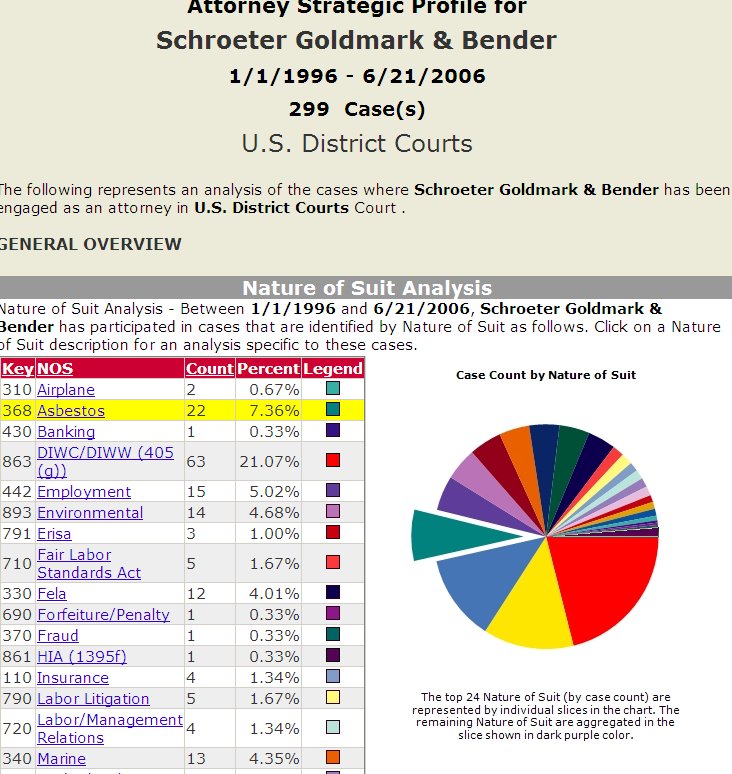
You can get a similar profile for an entire firm. Here is a portion of the profile for Seattle's Schroeter Goldmark and Bender:
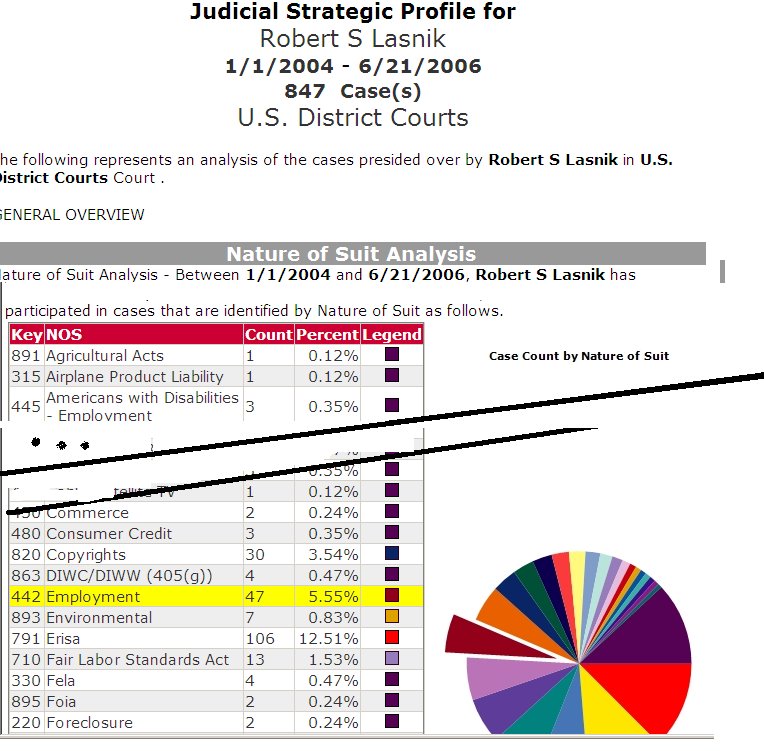
You can also generate profiles of judges. Here's one for Judge Robert Lasnik:
You can also research a litigant. For instance, in the last couple of years, Microsoft has been a party in more trademark cases than copyright cases, over 40% of its federal cases have been in the Western District of Washington, and it's been represented by Preston Gates & Ellis in over 40% of its federal cases.
Note: Be careful when you read the charts. At first glance, I thought the big red pie slice for Microsoft was coded for personal injury but when I double-checked I saw it was trademark (which, of course, makes more sense). Look for name variants -- for instance Microsoft has been represented by both "Preston Gates & Ellis" and "Preston Gates & Ellis (Sea)," and if you only paid attention to one name you'd think the firm handled only a fifth of Microsoft's litigation.
Limitations:
- The federal district court information is for civil litigation only. You won't be able to find the criminal cases prosecuted or defended by a particular attorney.
- State information is limited. You can find data about trial court cases in New York and selected counties in California, Florida, and Illinois, as well as Delaware Chancery cases. But this service does not have information about most states. A company rep told me they plan to add coverage of more states.
Filed in: CourtLink, Strategic-Profiles, LexisNexis, practice-of-law, judges, statistics, Reiss, Schroeter-Goldmark-&-Bender, Lasnik, Microsoft, tips
Terry Stops in Washington
In Terry v. Ohio (1968), the Supreme Court held that a person could be stopped ("seized") and frisked when the police officer has reason to believe (based on "specific and articulable facts") that his safety or the safety of others is in danger. Of course, the rule has been interpreted and shaped over the years in federal cases.
What's the story here in Washington, where our constitution has stronger privacy protections than the U.S. constitution's? Jaime Drozd Allen gives us an overview of the caselaw in Washington Limitations on Investigatory Stops, Bar Bull., June 2006.
[Note: the URL for this article after the next issue comes out will be: http://www.kcba.org/scriptcontent/KCBA/barbulletin/0606/article12.cfm.]
Filed in: 4th-amendment, Terry-v-Ohio, Washington-constitution, Allen
Monday, June 19, 2006
Law School Debt and Career Choice
Carolyn Elefant at Law.com has an interesting post about How Student Loans Influence Legal Career Choices. Citing a New York Times article, she describes an experiment NYU is in the middle of.
From 1998 to 2001, NYU law school gave one group of students loans -- with the promise of debt forgiveness if they go into the public sector. It gave another group grants -- with the caveat that the grants would be converted into loans if the students did not go into the public sector. Preliminary indications are that the perception of big debt makes a difference -- between 36 and 45% more of the students in the grant group went into the public sector than did students in the loan group.
Filed in: LRAP, law-students, NYU, practice-of-law, empirical-studies, Elefant
The Newer Generations in the Jury Box: Who Will Favor Your Cause?
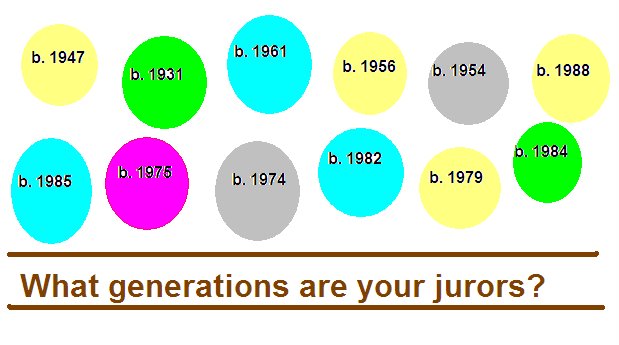
Litigation consultant Karen Lisko offers some tips about younger generations of jurors. First she emphasizes that the strongest predictor of verdicts is the evidence, not who's on the jury. Moreover, individual jurors are complex; their attitudes cannot be reduced to a demographic profile. With those caveats in mind, she characterizes younger generations (Gen X, Gen Y) as wanting to see more data -- and they wanted presented concisely in a technological way. Gen X jurors hold some values often associated with older jurors, such as "personal responsibility" and "self-reliance." Gen Y jurors value teamwork and value "getting along" in the jury room.
Karen Lisko, The Newer Generations in the Jury Box: Who Will Favor Your Cause?, Law Practice Management, June 2006, at 43.
Lisko is with Persuasion Strategies, a service of Holland & Hart, a multistate law firm based in Denver. Persuasion Strategies offers a series of Litigation Tips -- several-page papers discussing topics such as anti-corporate bias in jurors, differences between "red state" and "blue state" jurors, and factors affecting the persuasiveness of opening statements and closing arguments.
Graphic by mw.
Filed in: juries, tips, Lisko, consultants, Persuasion-Strategies
Friday, June 16, 2006
"Knock and Announce" Case

In Hudson v. Michigan the Supreme Court yesterday held that evidence from a search need not be suppressed although the police violated the "knock and announce" rule." The officers had a warrant and they announced their presence, but they did not knock and they waited only a few seconds before walking through the home's unlocked door.
Robert Ambrogi at Law.com summarizes commentary by several bloggers. Some worry that the case signals the decline (or death) of the exclusionary rule.
Filed in: SupremeCourt, cases, Hudson-v-Michigan, Ambrogi, 4th-amendment, exclusionary-rule, knock-and-announce
Graphic by mw. (By the way, I know these pictures are not great art. I just hope that some splashes of color will break up the screen a little. And the fastest way to get art without having to ask permission to use it is to create it myself.)
Federal Civil Practice Bulletin
Interested in federal civil practice? Check out this blog by Prof. A. Benjamin Spencer of the University of Richmond School of Law: Federal Civil Practice Bulletin.
Prof. Spencer also has a blog that watches splits among the federal courts of appeals: Split Circuits. If you're casting about for a paper topic or trying to put together a moot court problem, circuit splits are great.
Filed in: blogs, Federal-Civil-Practice-Bulletin, Split-Circuits, Spencer
ACS Moot Court Champs
Yesterday a UW team won the American Constitution Society's national Constance Baker Motley Moot Court Competition on the topic of felony disfranchisement. Congratulations to Suzanne LiaBraaten and Andrea Schmitt!
Filed in: American-Constitution-Society, LiaBraaten, Schmitt, UW, moot-court
Thursday, June 15, 2006
ATLA: Convention in Seattle

This year's annual meeting of the American Association of Trial Attorneys is in Seattle, Sat. July 15 through Wed. July 19. Take a look at the program and registration information.
Students: law student registration is just $80. (That might seem like a lot, but it's way less than the basic attorney rate of $560. (There are various packages and discounts for different groups of attorneys.) The biggest bargain is the law professor rate: no registration fee at all if the professor is a member of ATLA (and law professor membership is just $35/year)!
Filed in: ATLA, event
Wednesday, June 14, 2006
Pattern Interrogatories Report

KCBA's Jury & Courts Committee has drafted pattern interrogatories for use in automobile tort cases. Comments are invited by July 15. Pattern Interrogatories Report.
The King County Superior Court adopted local rules (LR26(d)(1) and 33) that limit interrogatories to 40 -- OR approved pattern interrogatories plus 15 more.
Filed in: interrogatories, King-County, KCBA, rules, automobiles
Graphic by mw.
Pioneering Woman Attorney Dies
Kathleen M. Taft, UW class of 1936, died in December.
Kathleen M. Taft, 98, died December 23, 2005, in Spokane. One of the state's longest-lived lawyers, she joined the Bar in 1936 after graduating from the UW Law School. In 1950, she became Spokane County's first family court commissioner, a post she held for 27 years. Taft was mentor to countless judges and lawyers, and her distinguished work in family law was widely and frequently honored. Taft's husband, one-time Spokane mayor and state legislator Willard Taft, died in 1971. Survivors include a number of nieces, nephews, grandnieces and grandnephews, and eight great-grandnieces and nephews. Always looking ahead, Taft worked until a week before suffering a stroke, and only a fortnight before a planned trip to Antarctica -- the only continent she hadn't yet visited.In Memoriam, Wash. St. B. News, June 2006.
Her name stood out from this months list of attorneys and judges we have lost because I heard about her attending a reunion here recently and saw a profile that made her seem like quite an impressive figure: Heather Lalley, Raising the Bar: Approaching 98, Spokane's Kathleen Taft, Spokesman Review, May 15, 2005. This stood out:
For a time in the '80s, Taft became the go-to attorney in Spokane for lesbians seeking to adopt.As you might have noticed in the newspapers (or in the United States Senate), lesbians forming families can still be controversial today. I wonder what Spokane thought of "Mrs. Taft," then in her 70s, serving these clients so matter of factly.
"We showed sympathy for them," she says. "Any of the reports that came in on them were always good. The children did well in school."
Here is the Spokesman-Review's obituary (Dec. 23, 2005).
Filed in: obituaries, Taft, Spokane, UW