Showing posts sorted by relevance for query american soil. Sort by date Show all posts

Friday, April 14, 2006

On American Soil


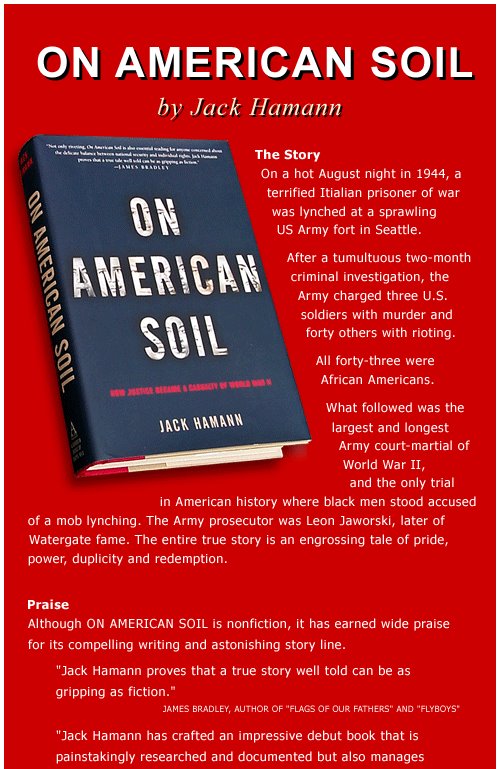
On American Soil: How Justice Became a Casualty of World War II tells the story -- or stories -- of a violent incident at Fort Lawton and the ensuing investigation and court martial. Jack Hamann, a journalist and documentary filmmaker, has written a gripping, thought-provoking tale, exploring issues of race, war, justice, and military bureaucracy. His description of the book from his website:

On a hot August night in 1944, a terrified Italian prisoner of war was lynched at a sprawling US Army fort in Seattle.

After a tumultuous two-month criminal investigation, the Army charged three U.S. soldiers with murder and forty others with rioting.

All forty-three were African Americans.

What followed was the largest and longest Army court-martial of World War II, and the only trial in American history where black men stood accused of a mob lynching. The Army prosecutor was Leon Jaworski, later of Watergate fame. The entire true story is an engrossing tale of pride, power, duplicity and redemption.
I heard Mr. Hamann speak at the Innocence Project conference last month and immediately went out and got the book. It really is this good.


Some Seattleites may not even know about Fort Lawton, which was a big, active military base during World War II. It was where Discovery Park is today. See maps and pictures.


A UW connection is that the lead defense attorney, Major William Beeks, was a UW law grad. When he was twenty-four, he wanted to go to sea in the merchant marines, but his wife persuaded him to stay in Seattle, where he attended law school and became a maritime lawyer. He joined the Army after the U.S. entered World War II. After the War, he joined Jaworski in Germany prosecuting war crimes. He was a district court judge (Western District of Washington) from 1961 until his death in 1988.


More information about the book is here. It's available in the library: D805.5.F66 H36 2005 at Classified Stacks.

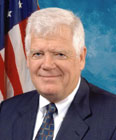
Moved by the story, Rep. Jim McDermott introduced H.R. 3174, to direct the Secretary of the Army to review the cases of the 28 men who were convicted. The bill now has a few dozen cosponsors.


This has nothing to do with trial advocacy, but I note that Mr. Hamann is currently working on "Generation IX", a documentary about the national champion UW women's volleyball team and its upcoming trip to China. Something to watch for!

Filed in: , , , , , , , , , , , , , , , ,

Friday, June 9, 2006

Ft. Lawton Convictions to Be Reviewed


Rep. Jim McDermott announced yesterday that the convictions of African American soldiers stemming from a riot at Fort Lawton in 1944 will be reviewed. Congressman Jim McDermott - Speeches - Fort Lawton Breakthrough: "Justice Delayed Is No Longer Justice Denied" McDermott reached an agreement with Rep. Duncan Hunter, the Republican Chairman of the House Armed Services Committee. Under the agreement, the Army Board of Correction of Military Records (ABCMR) has set up a point of contact to review the cases. The four living soldiers and the families of the others can request review -- now, for the first time, including investigatory records that were not available to the defense when they were convicted.

See earlier post about On American Soil, the book that recounts the story of the incident, the investigation, and the trial.

Photo of Rep. McDermott from his House website.

Filed in: , , , ,

Saturday, December 1, 2007

Army Pays $725 in Set-Aside World War II Case - New York Times

Army Pays $725 in Set-Aside World War II Case, N.Y. Times, Dec. 1, 2007.

A month after the Army said it made a mistake when it court-martialed Samuel Snow and 27 other black soldiers in World War II, the Pentagon has cut Mr. Snow a check for back pay, money withheld while he served a year in prison on a rioting conviction.

The check was for $725. No interest. No adjustment for inflation.
The court-martial stemmed from a riot -- black soldiers (in a Jim Crow Army) against Italian prisoners of war -- at Fort Lawton in Seattle. (Fort Lawton was one of the Army's main feeders to the Pacific Theater during World War II. Discovery Park is now on the site.)

I missed posting about the Army's ruling in October: 1944 Conviction of Black G.I.’s Is Ruled Flawed, N.Y. Times, Oct. 27, 2007.
The [Board for Correction of Military Records] found that the court-martial was flawed, that the defense was unjustly rushed and that the prosecutor, Leon Jaworski, a young lieutenant colonel who went on to fame three decades later as a Watergate special prosecutor, had important evidence that he did not share with defense lawyers.


The Army reviewed the case, after a resolution from the House of Representatives, inspired by Jack Hamann's book, On American Soil: How Justice Became a Casualty of World War II (D805.5.F66 H36 2005 at Good Reads). See Hamann's website for more. See earlier posts too.

Tuesday, July 22, 2008

Race, Justice & the Military - Thursday


A tribute to the veterans of the 1944 court martial at Ft. Lewis recounted in On American Soil will kick off with a panel at Seattle University: Race, Justice & the Military. The panel is at 5:00, Thur. July 24, in Pigott Auditorium. Speakers include Jack Hamann, Gen. Timothy Lowenberg, Robert Chang, James Bible, and Margaret Chon (moderator).

Monday, October 18, 2010

Justice for Washington's Wrongly Convicted?

The University of Washington School of Law is presenting a half-day program on wrongful convictions and the prospect of compensation for the exonerated. Justice for Washington's Wrongly Accused? will take place Fri., Oct. 29, 2010, 1:30-5:00 p.m.

Jack Hamann, author of On American Soil: How Justice Became a Casualty of World War II, is the keynote speaker, followed by Lara Zarowsky, policy staff attorney, Innocence Project Northwest, and a panel of three Washington who were exonerated after being imprisoned for crimes they did not commit.

The program has been approved for 2.75 CLE credits. It is free, but registration is required.