[BOOK] The How-to-Win Trial Manual (2d ed.) offers advice, with lots of specific examples, from Ralph Adam Fine, an experienced judge and trial advocacy trainer. Could you use some help with evidence rules? Appendix A gives you a copy, Appendix B analyses the rules and shows how they relate to one another, and Appendix C summarizes how to use the rules strategically. Check it out: KF8915 .F54 2001 at Classified Stacks.
Categories: books, evidence, tips
Friday, April 29, 2005
The How-to-Win Trial Manual


Thursday, April 28, 2005
Hospitals Must Give Info About Injuries
[LEGISLATION] A new law requires hospitals to give patients information about "unanticipated outcomes" (the title of the bill is "Relating to injuries resulting from health care")ch. 118, Laws of 2005 (SSB 5065) (effective July 24). The notification -- and any statements or conduct expressing apology -- may not be introduced as evidence in civil actions.
The law is so short, I'll quote it in full:
NEW SECTION. Sec. 1. A new section is added to chapter 70.41 RCWCategories: med-mal, apologies, unanticipated-outcomes, legislation
to read as follows:
Hospitals shall have in place policies to assure that, when appropriate, information about unanticipated outcomes is provided to patients or their families or any surrogate decision makers identified pursuant to RCW 7.70.065. Notifications of unanticipated outcomes under this section do not constitute an acknowledgement or admission of liability, nor can the fact of notification, the content disclosed, or any and all statements, affirmations, gestures, or conduct expressing apology be introduced as evidence in a civil action.
NEW SECTION. Sec. 2. Beginning January 1, 2006, the department shall, during the survey of a hospital, ensure that the policy required in section 1 of this act is in place.
Free Sex Offender Records for Law Enforcment
[LEGISLATION] A new law provides that public agencies may not charge fees to law enforcement agencies for providing various records relating to sex offenders. ch. 202, Laws of 2005.
Categories: sex-offenders, record, legislation
New Law on Legal Aid Funding
[LEGISLATION] A new law establishes a state office of civil legal aid as an independent agency of the judicial branch. Laws of 2005, ch. 105 (SHB 1747). The office of civil legal aid will contract with legal aid programs
for legal representation of indigent persons in matters relating to: (a) Domestic relations and family law matters, (b) public assistance and health care, (c) housing and utilities, (d) social security, (e) mortgage foreclosures, (f) home protection bankruptcies, (g) consumer fraud and unfair sales practices, (h) rights of residents of long-termThe law becomes effective July 1.
25 care facilities, (i) wills, estates, and living wills, (j) elder abuse, and (k) guardianship.
Categories: access-to-justice, legislation
New Law Revamps Indigent Defense in State
[LEGISLATION] A new law sets up a new system for funding city and county indigent defense and adds standards for those services. Laws of 2005, ch. 157 (SSHB 1542). Section 3 provides:
In order to receive funds, each applying county or city must require that attorneys providing public defense services attend training approved by the office of public defense at least once per calendar year. Each applying county or city shall report the expenditure for all public defense services in the previous calendar year, as well as case statistics for that year, including per attorney caseloads, and shall provide a copy of each current public defense contract to the office of public defense with its application. Each individual or organization that contracts to perform public defense services for a county or city shall report to the county or city hours billed for nonpublic defense legal services in the previous calendar year, including number and types of private cases.
Section 4 requires cities and counties to document that they are
meeting the standards for provision of indigent defense services as endorsed by the Washington state bar association or that the funds received under this chapter have been used to make appreciable demonstrable improvements in the delivery of public defense services, including the following:The Governor signed the law on April 22; its effective date is July 24.
(i) Adoption by ordinance of a legal representation plan that addresses the factors in RCW 10.101.030. [Those factors are: Compensation of counsel, duties and responsibilities of counsel, case load limits and types of cases, responsibility for expert witness fees and other costs associated with representation, administrative expenses, support services, reports of attorney activity and vouchers, training, supervision, monitoring and evaluation of attorneys, substitution of attorneys or assignment of contracts, limitations on private practice of contract attorneys,
qualifications of attorneys, disposition of client complaints, cause for termination of contract or removal of attorney, and nondiscrimination.]
(ii) Requiring attorneys who provide public defense services to attend training under section 3 of this act;
(iii) Requiring attorneys who handle the most serious cases to meet specified qualifications as set forth in the Washington state bar association endorsed standards for public defense services or participate in at least one case consultation per case with office of public defense resource attorneys who are so qualified. The most serious cases include all cases of murder in the first or second degree, persistent offender cases, and class A felonies. * * *;
(iv) Requiring contracts to address the subject of compensation for extraordinary cases;
(v) Identifying funding specifically for the purpose of paying experts * * * ;
(vi) Identifying funding specifically for the purpose of paying investigators * * * .
(b) The cost of providing counsel in cases where there is a conflict of interest shall not be borne by the attorney or agency who has the conflict.
Categories: access-to-justice, legislation, criminal-law
Judge gives Ressam new chance to cooperate
[NEWS] Ahmed Ressam's sentencing for his April 2001 conviction in a bombing plot had been delayed for years while he cooperated with investigators, providing information about al-Qaida. Sentencing was scheduled for yesterday, with a wide gap between the requests from defense (12.5 years) and prosecution (35 years). District Judge John Coughenour stressed that he would determine the sentence and that he would be influenced by cooperation -- would Ressam take another chance to cooperate? After consultation with his legal team, Ressam agreed to delay sentencing three more months. The Seattle Times: Local News: Judge gives Ressam new chance to cooperate.
Ressam's lead counsel is Thomas Hillier, of the Federal Public Defender and one of the instructors in the UW Trial Ad Program. Judge Coughenour teaches Advanced Trial Advocacy.
Categories: sentencing, judges,cooperation, Ressam, Coughenour, Hillier, UW
Wednesday, April 27, 2005
Dwyer Jury Project Award
[EVENT] The first annual William L. Dwyer Jury Project Award was awarded on Thursday to UW 3L Rebecca Povarchuk for her paper, "The American Bar Association's Approach to Jury Reform: Necessary and Practical Steps to Modernize the Jury System for the Twenty-First Century."
The award, sponsored by the University of Washington School of Law and the Federal Bar Association of the Western District of Washington, honors the late Judge Dwyer.
In addition to being a trial lawyer and a trial judge, Dwyer wrote a book on the jury system: In the Hands of the People: The Trial Jury's Origins, Triumphs, Troubles, and Future in American Democracy (KF9680 .D89 2002 at Classified Stacks).
Categories: juries, Dwyer-Jury-Project-Award, UW, Federal-Bar-Association, Dwyer, books
Making the Blog Easier to Skim
This blog includes a mix of items related to trial practice -- news stories, summaries of cases, information about pending bills, tips, etc. The posts appear in simple reverse chronological order -- and that depends mostly on when I came across an item that I thought was interesting and topical.
From a post's headline, you sometimes can't tell whether the post is, say, a case summary or a link to an article. I thought it might make it easier for readers to skim if you could, and so I'm going to start labeling posts like this:
[BOOK]
[CASE]
[EVENT]
[LEGISLATION]
[NEWS]
[OPINION]
[RESEARCH]
[TIP]
As always, I welcome feedback.
By the way, you can search the blog:
(1) Use your browser's Find command (control-f or Edit, Find (on This Page)).
(2) Use Google's Search Site feature (if you have the Google toolbar).
Categories: notes-about-the-blog
District Judges Surveyed re Rule 11 Sanctions
[RESEARCH] What do federal district judges think of Rule 11? The Federal Judicial Center surveyed them -- see Report of a Survey of United States District Judges' Experiences and Views Concerning Rule 11, Federal Rules of Civil Procedure (2005).
Why the survey now?
In the 108th Congress, the House of Representatives passed H.R. 4571, the Lawsuit Abuse Reduction Act of 2004, which would have amended Rule 11. That bill would have provided for mandatory sanctions for violations, repealed the safe harbor, and required judges to order the offending lawyer or party to compensate the opposing party for attorney fees incurred as a direct result of a Rule 11 violation. The proposed legislation would have reversed three amendments to Rule 11 adopted through the rulemaking process in 1993: to convert mandatory sanctions to discretionary sanctions, to create a safe harbor, and to deemphasize attorney fee awards. The proposed legislation also would have introduced a requirement that a district court suspend an attorney’s license to practice in that district for one year if the attorney was found to have violated Rule 11 three or more times in that district.Id. at 1.
Among other things, the survey tried to elicit judges' views based on their experience with the 1993 amendments.
More than 80% of the 278 district judges indicated that “Rule 11 is needed and it is just right as it now stands.” In evaluating the alternatives, 87% of the respondents preferred the current Rule 11, 5% preferred the version in effect between 1983 and 1993, and 4% preferred the version proposed in H.R. 4571.
Id. at 2.
Do the judges think that groundless litigation is a big problem?
Approximately 85% of the district judges view groundless litigation [in cases where the plaintiff is represented by counsel] as no more than a small problem and another 12% see such litigation as a moderate problem. About 3% view groundless litigation brought by plaintiffs who are represented by counsel as a large or very large problem. For 54% of the judges who responded, the amount of groundless litigation has remained relatively constant during their tenure on the federal bench. Only 7% indicated that the problem is now larger. For 19%, the amount of groundless civil litigation has decreased during their tenure on the federal bench, and for 12% there has never been a problem.Id. at 3.
Categories: Rule-11, judges, empirical-studies, surveys, legislation, Federal-Judicial-Center
Monday, April 25, 2005
"Objection, form!"
[TIP] Here are tips on how to handle form objections in depositions: The Illinois Trial Practice Weblog: Depositions: Don't Ignore Form Objections
Categories: tips, depositions, objections, Illinois-Trial-Practice-Weblog
Innocence Project Speaker: Peter Neufeld
[EVENT] The Innocence Project Northwest presents Peter Neufeld, Co-Director and Founder of the Innocence Project at Benjamin N. Cardozo School of Law.
Neufeld is the co-author of Actual Innocence: Five Days to Execution and Other Dispatches from the Wrongly Convicted.
When: Monday, May 2nd, 6:30 pm - 8:00 pm
Where: UW School of Law, Room 138
Categories: event, Innocence-Project, Neufeld, books, UW
Sunday, April 24, 2005
Effect of juvenile conviction on sentencing
[CASE] Can a juvenile adjudication be counted in the determination of a defendant's offender score under the sentencing reform act? King County Superior Court Judge John P. Erlick's memorandum opinion in State v. Tagaloa (King Co. Super. Ct. April 15, 2005) answers no: it would violate the due process protections of the Sixth Amendment and does not constitute a prior conviction under Apprendi v. New Jersey, 530 U.S. 466, 120 S.Ct. 2348 (2000) and Blakely v. Washington, --- U.S. ----, 124 S.Ct. 2531, 2536, 159 L.Ed.2d 403 (2004).
Categories: sentencing, Blakely-v-Washington, Apprendi-v-NJ, juvenile-adjudications, cases
Materials on Electronic Discovery: Civil Litigation
The Federal Judicial Center offers Materials on Electronic Discovery: Civil Litigation. Included are a presentation outline and PowerPoint presentation from a workshop for magistrate judges; a bibliography; a research paper; and sample forms and orders.
Categories: discovery, electronic-discovery, Federal-Judicial-Center, tips
Good reason for judicial canons of ethics
[OPINION] Judge M. Margaret McKeown responds to her 9th Circuit colleague Judge Alex Kozinski's critique of the Canons of Judicial Ethics in a letter to Legal Affairs (May-June 2005 issue, at 6).
The full text of Judge McKeown's letter is not on the magazine's website -- but you could read the library's copy in print. In the meantime, here are excerpts:
The guiding principles of the canons --integrity, impartiality, and avoidance of the appearance of impropriety -- serve as daily reminders of the public trust placed in judges.
* * *
Although the appearance-of-impropriety rule may seem objectionable to Kozinski, it is not trivial to public confidence in the judiciary . . . . Kozinski's solution to this dilemma is "to trust the judges" and operate with fewer rules. Our system does function in large part on public trust and credibility. But that trust should not be blind, and accepting accountability through rules of judicial ethics is a small price to pay for the honor and responsibility of servicng as a judge.
Categories: judges, ethics, McKeown, Kozinski
Friday, April 22, 2005
HeraldNet: Hospital's defense flawed, jury says
[NEWS] A jury awarded $17.1 in a malpractice case against Stevens Hospital and two doctors. The Herald's coverage includes a comment from a juror about why the defense was ineffective as well as a discussion of the shadow jurors hired by plaintiff's counsel. The defendants plan to appeal. HeraldNet: Hospital's defense flawed, jury says, Herald, April 19, 2005.
Categories: juries, verdicts, med-mal, news
"What Was the Judge Thinking? The Duty to Decide"
[EVENT] How do judges decide controversial issues?
WSBA's Public Information and Media Relations Committee is hosting a free public forum: "What Was the Judge Thinking? The Duty to Decide."
Panel on gay marriage:
- King County Superior Court Judge William Downing, who decided Andersen v. King County, one of the marriage equity cases currently before the Supreme Court. (See the oral argument from March 8.)
- Prof. Julie Shapiro, from Seattle University.
Panel on judicial review of citizen initiatives:
- Justice Barbara Madsen, Washington Supreme Court
- former King County Superior Court Judge Robert Alsdorf.
Wed., May 4, 6:30-8:30 pm
Seattle Public Library
1000 Fourth Avenue
(have you seen the new building yet?)
Categories: judges, event, WSBA, Downing, Shapiro, Madsen, Alsdorf, initiatives, marriage-equality
Wednesday, April 20, 2005
Theft by deception - other dealings admissible despite ER 404(b)
[CASE] Defendant was prosecuted for theft by deception in his getting a victim to give him title to a Dodge viper without paying the victim $55,000 as he had promised. Could the state introduce evidence of a transaction whereby defendant had gained title to a cruise ship (the Crown Princess Martha) without paying promised money? Division One says yes -- possession of the cruise ship, along with many other assertions about defendant's education, family, investments, and so on, contributed to the trust that led the victim to give him the title pending payment. State v. Mermis, 2005 Wash. App. LEXIS 486 (Wash. App. March 21, 2005) (unpublished) Get a Document - by Citation - 2005 Wash. App. LEXIS 486.
Categories: 404(b), evidence, cases
Discovery maneuvering - can dr testify when no report?
[CASE] In an unpublished opinion, Div. 2 rules that it was error for the trial court to exclude testimony of defendant's expert.
Plaintiff was injured in a car accident and sued the other driver (and the company the driver worked for). Defendant proposed to call Dr. C as a witness. Plaintiff requested Dr. C's report -- and said that if there wasn't a report, she would schedule a deposition. Defendant said there was no report and plaintiff should depose Dr. C. A month before trial, plaintiff again requested a report, asserting that failure to supply one violated CR 35(b). At trial, plaintiff moved to exclude Dr. C's testimony, and the court granted the motion. The jury awarded the plaintiff some $290,000. Division 2 reversed and remanded, finding that it was error to exclude the testimony. "CR 35(b) requires a report, but only when an examination has been performed under CR 35(a). CR 26(b)(5)(A) requires a summary but not a report." Dr. C had not examined the plaintiff and would have testified based only on medical records. Hudson v. Hapner, 2005 Wash. App. LEXIS 610 (Wash. App. Apr. 12, 2005), Get a Document - by Citation - 2005 wash app lexis 610.
Categories: depositions, discovery, experts, cases
Tuesday, April 19, 2005
Distorting the Law
[BOOK] 
Distorting the Law: Politics, Media, and the Litigation Crisis takes a look at litigation in the United States -- and how it is portrayed by the media. The publisher's description summarizes:
Scholars have argued for years that this common view of the depraved ruin of our civil legal system is a myth, but their research and statistics rarely make the news. William Haltom and Michael McCann here persuasively show how popularized distorted understandings of tort litigation (or tort tales) have been perpetuated by the mass media and reform proponents. Distorting the Law lays bare how media coverage has sensationalized lawsuits and sympathetically portrayed corporate interests, supporting big business and reinforcing negative stereotypes of law practices.Note that one of the authors, Michael McCann, is the Gordon Hirabayashi Professor for the Advancement of Citizenship here at the University of Washington and has an adjunct appointment in the School of Law.

Categories: books, tort-reform, press, UW, McCann
And the Walls Came Tumbling Down
[BOOK] 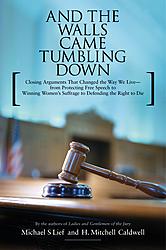
And the Walls Came Tumbling Down tells the stories -- with extensive quotations from the trial transcripts -- of a selection of famous cases (the subtitle promises "closing arguments that changed the way we live, from protecting free speech to winning women's suffrage to defending the right to die").
Did the Schiavo controversy get you interested in right-to-die issues? See the account of Karen Ann Quinlan's case. There's much more -- from the Amistad to Flynt v. Falwell. The catalog record and the publisher's description list the contents.
Categories: books, famous-trials, closing-arguments
Subscribe to:
Posts (Atom)