Thursday, August 31, 2006

Juvenile Crime Up; PERF; Police and Mental Health

The Minneapolis Star Tribune reports: Rise in violent juvenile crime sparks nationwide meeting. Responding to a nationwide increase in juvenile crime, the Police Executives Research Forum hosted a meeting of officials from cities around the country in Washington, DC, this week.

This story led me to look up the Police Executives Research Forum, since I'd never heard of it. This 30-year-old group

is a national membership organization of progressive police executives from the largest city, county and state law enforcement agencies. PERF is dedicated to improving policing and advancing professionalism through research and involvement in public policy debate.
It's funded largely by grants from government and foundations. It has lots of interesting research projects, including such varied topics as law enforcement DNA practices and a study comparing classroom programs for 6th- and 7th-graders to reduce gender violence and harassment.

Currently PERF is working (with the Justice Department) on procedures "to help improve outcomes of police encounters with people with mental illnesses," and is inviting input. The announcement links to the Consensus Project's list of The Essential Elements of a Specialized Police-Based Program, a web forum seeking community comments.

Filed in: , , , , ,

Wednesday, August 30, 2006

Sources for Sample Motions in Limine

See the Illinois Trial Practice Weblog for links to a couple of sample motions in limine recommended by Evan Schaeffer (Aug. 1, 2006).

Filed in: , , ,

The Effect of the Internet on Class-Action Settlements

Recently proposed class-action settlements in a couple of cases (Netflix and Netgear) were opposed by consumers communicating on the Internet. See Evan Schaeffer's comment -- and advice to lawyers handling class actions: The Effect of the Internet on Class-Action Settlements, Illinois Trial Practice Weblog, Aug. 10, 2006.

Interestingly, a consumer who created SonySuit.com about a class action posted a comment. Remember the news that Sony and BMG had put some code in music CDs to prevent their being copied, and the code turned out to expose computers to viruses? Mark Lyon, a law student, found his laptop, that he used for school, was crashing and acting up because of this. Naturally, he followed the lawsuits and proposed settlements. He also filed his own action, in January 2006, in Mississippi, where he bought the CD that infected his computer. His site provides information about his suit (including his demand letter, Sony's response, and his complaint), as well as the national class action and various other litigation.

Filed in: , , , , , , , , , , , , , ,

Remember When You Weren't Legally Trained?

Evan Schaeffer has some advice for lawyers trying to communicate with jurors: don't condescend, just remember what you were like before you went to law school -- intelligent and thoughtful, just ignorant of legal jargon. Communicating with Juries by Acting Like a Regular Person: Is It Even Possible?, Illinois Trial Practice Weblog, Aug. 15, 2006.

Filed in: , , ,

Demonstrative Evidence in Civil Cases

Nowadays it's common to use demonstrative evidence -- photos, models, computer simulations, and more -- in civil cases, but it wasn't always so. Evan Schaeffer begins a series of posts about the topic with an excerpt from Melvin Belli's autobiography. The Use of Demonstrative Evidence in Civil Cases: A Brief History, Illinois Trial Practice Weblog, Aug. 29, 2006.

Filed in: , , , ,

Friday, August 25, 2006

King County District Court Wins Award for Interpreter Web System


The National Association of Court Management (NACM) gave the King County District Court the 2006 Justice Achievement Award in recognition of the King County District Court Interpreter Web (KCIW). Washington Courts press release, Aug. 24, 2006.

This web-based system empowers District Court clerks, court administration staff, and court interpreters to efficiently and conveniently manage scheduling and assignment of interpreter services at all ten District Court locations. This includes civil, criminal, and probation matters, as well as other District Court business requiring an interpreter. A public access feature allows the public to view the system to check whether or not an interpreter is assigned to a case.
The system also handles payments and provide information for budgeting and planning.

Filed in: , , ,

Graphic by mw. (I'm sure the actual trophy or plaque for the Justice Achievement Award looks much better than this!)

Successful Insanity Defense for Senior on Antidepressant

Thurston County Superior Court Judge Chris Pomeroy signed an order finding Eric Attwood, 83, not guilty by reason of insanity in the attempted murder of his wife. Attwood had been taking Wellbutrin, a prescription antidepressant, for 12 days when he stabbed his wife, later saying he'd planned to kill her and then himself.

He was sent to Western State Hospital (Steilacoom) for psychological evaluation. He is taking a different antidepressant and antipsychotics, and has been living in an adult family home since June. One of his lawyers is Jeffery Robinson.

"It's night and day," Robinson said, adding that Attwood is the "same sort of normal, intelligent, reasonable man" that he was up until a couple of days before the attack.
Prosecutors did not oppose the order finding him not guilty by reason of insanity and granting him conditional release. Man, 83, not guilty of stabbing wife - The Olympian - Olympia, Washington, Aug. 15, 2006.

UW note: Robinson is a Trial Ad instructor.

Update: Couple allowed to reunite after yearlong nightmare, Olympian, Sept. 13, 2006.

Filed in: , , , , , , ,

Damages for Dog's Wrongful Death


Adam Karp reports:

Arbitrator Tim McGarry (WSBA 8486) served as arbitrator in the case Hane v. James (King Cy. Sup. Ct. 05-2-31242-2KNT/Darvas) on August 16. The matter involved admitted negligence by the owner of two pitbulls, felicitously named "Mafia" and "Menace," who trespassed on my clients' property, broke into a secure kennel, and killed my clients' 4-year-old border collie mix (adopted for free at a few weeks of age) in the kennel. Based on pretrial orders eliminating general damages (emotional distress), we asked for the dog's intrinsic value, loss of his use/companionship, and special damages (kennel and fence repair). Defense attorney Steve Russell with Keolker & Swerk suggested a fair award would be $5000 to $10,000 for the value of the dog plus a few hundred dollars for the kennel/fence repair. We asked for the MAR limits of $50,000.

On August 21, Mr. McGarry awarded $10,000 for "general/utility damages" (ostensibly the value of the dog) and $2750 for "special damages' (ostensibly the fence/kennel repair costs).

I believe this is one of only three arbitrated wrongful animal death cases in the State of Washington (McLeod, Van de Ven, Hane).

What this shows is that the intrinsic value of a "mutt" is worth at least $10,000. NOTE: You may recall the arb award of $6700 for the wrongful death of an 11-y.o. cat.
(Adam sent this to the email list for WSBA's Animal Law Section and agreed that I could post it here.)

Photo: Candy Sue, a law dog at SIU, courtesy of Diane Murley, one of the bloggers at Law Dawg Blawg.

Filed in: , , , , , , , ,

Thursday, August 24, 2006

School closures based on color, suit alleges

A new community group filed a suit against the Seattle Public Schools in King County Superior Court, alleging that the school district unfairly targeted for closure schools with high representations of minority and poor children. Christine Frey, School closures based on color, suit alleges, Seattle PI, Aug. 22, 2006.

Save Our Children/Kids Education Defense (SOCKED) is supported by community-based organizations and churches. The oversight committee includes Rev. Patrinell Wright, Rev. Carl Livingston, and Chris B. Bennett. The lead attorney is Brenda J. Little; legal advisers include Lem Howell, Ron Ward (WSBA past president), and Carl Linvingston, Jr. Chris H. Bennett, Save Our Children/Kids Education Defense (S.O.C.K.E.D.) Set Up, Seattle Medium, Aug. 17, 2006.

Ms. Little went into private practice after 14 years representing Seattle Public Schools. Suing the district for the first time required an adjustment, she says.

"I mean I was just sick. Just sick. But, you know I had to readjust, and when I was able to prevail on the behalf of the parent and the child, I went 'oh, this is the same thing I was doing when I was there.'"
Former School Lawyer Files Suit Against Closures, KUOW, Aug. 22, 2006.

Filed in: , , , , , , , ,

Notorious Batterer Wants to Reunite with Wife

Victor David, who was convicted of assault and given an exceptional sentence because of his years of abuse of his wife, is now out of prison and wants to reunite with his wife, who suffered permanent brain damage from the abuse. Immigration officials have begun deportation proceedings (he is Canadian) and there are three protective orders to prevent him from contacting her. Jennifer Sullivan, Victor David wants to reunite with the wife he abused, Seattle Times, Aug. 24, 2006.

During the years of abuse, Victor David had been receiving money from the state department of Social and Health Services to care for his wife, who he said had MS. The state settled a civil lawsuit for $8.8 million. The Times article, above, has links to older stories and a timeline.

Ms. David's attorney was David P. Moody (also a Trial Ad instructor). See his page about the case.

Filed in: , , , , ,

Summer Associate Life

This morning's Seattle Times has a story about summer associates in the city's large law firms: Natalie Singer, For law interns, work comes with big perks, Aug. 24, 2006.

Juxtapose this with two of yesterday's posts. In one, critics said that the Legal Services Corporation was wasting money by having its board members meet in hotels and have catered meals. In another, prosecutor's offices reported having trouble recruiting and retaining staff attorneys.

Filed in: , , , , ,

Wednesday, August 23, 2006

Legal Services Corp Leadership Extravagant?

The AP reported that the Legal Services Corporation's leadership has indulged in luxuries, citing things like having board meetings at hotels around the country instead of in LSC offices. The story listed catering bills (e.g., $14 "Death by Chocolate" for each board member at one meeting) and other apparent luxury items (e.g., a limo ride). Larry Margasak, Legal Aid Program Has Expensive Taste Aug. 15, 2006. See also Legal Defender of Poor Under Scrutiny, CBS News, Aug. 13, 2006.

Of course, there's another side to the story. See Legal Services Corporation (LSC) Response to Issues in CBS and AP News Stories, press release, Aug. 17, 2006.

Thanks to Carolyn Elefant for the links and her own commentary. See her post, Follow-up on LSC Story: The LSC Response (Aug. 23).

Filed in: ,

Choice of Law in Insurance Conflicts

Carolyn Elefant at Law.com - Inside Opinions: Legal Blogs recommends a detailed post walking readers through the choice of law issues in insurance litigation: Marc Mayerson, Conflict of Laws and Insurance Disputes: Choice of Law or Choice of Outcomes?, Insurance Scrawl, Aug. 22, 2006.

Filed in: , , , ,

Bureau of Justice Statistics: Prosecutors in State Courts, 2005

The Bureau of Justice Statistics has a new, 12-page report on Prosecutors in State Courts, 2005.

Presents findings from the 2005 National Survey of Prosecutors, the latest in a series of data collections about the Nation's 2,300 State court prosecutors' offices that tried felony cases in State courts of general jurisdiction. This study provides information on the number of staff, annual budget, and felony cases closed for each office. Information is also available on the use of DNA evidence, computer-related crimes, and terrorism cases prosecuted. Other survey data include special categories of felony offenses prosecuted, types of non-felony cases handled, number of felony convictions, number of juvenile cases proceeded against in criminal court, and work-related threats or assaults against office staff.
Highlights include the following:
  • At least two-thirds of the State court prosecutors had litigated a computer-related crime such as credit card fraud (80%), identity theft (69%), or transmission of child pornography 967%).

  • A quarter (24%) of the offices participated in a State or local task force for homeland security; one-third reported an office member attended training on homeland security.

  • Most prosecutors (95%) relied on State operated forensic laboratories to perform DNA analysis, with about a third (34%) also using privately operated DNA labs.
Thinking about a job in a prosecutor's office? A quarter or more of offices report having trouble recruiting staff attorneys, and most medium and large office have trouble retaining staff attorneys. Here are the numbers:


What the statistics don't tell us is why the offices have the problems.
  • Do they have a hard time recruiting because bright and capable students don't apply? I wouldn't guess that, based on the students I meet who say they'd like to work in a prosecutor's office.

  • Is it about location? Are the offices with trouble recruiting in cities and towns that law students and young attorneys don't consider when they're looking for jobs? Law students and lawyers come here to Seattle from all over -- but is that as true of Duluth, Tulsa, and Norfolk? If the problem is location, can the offices improve recruiting with a little PR? Certainly law students who are having trouble finding their dream jobs in their favorite cities might do well to stretch widen their sights geographically. (I have friends in each of those cities, by the way.)

  • Do prosecutor's offices have trouble offering salaries that are competitive with the private sector? If so, would recruiting be improved by better budgets? By more loan repayment assistance programs?

  • What about retention? Is the problem burnout? If so, then what could be done to make the job something for the long haul?

  • If the problem is salaries, then we're back to budgets, LRAP, etc.

  • Do some attorneys only plan to work as prosecutors long enough to get enough experience to market themselves elsewhere? Is that really a problem, as long as some core of experienced people sticks around?
If you have ideas you'd like to share about these (or other questions), just click the Comment link at the end of this post. Do you have any advice for students who want to work as prosecutors?

So far, there have been few comments posted on this blog, but they are very welcome! I moderate comments to avoid spam, but if a comment is on topic and reasonable for public consumption, I'll gladly post it.

Thanks: beSpacific.

Filed in: , , , , , , , ,

Follow the Judge's Ruling on Motion in Limine

Here's a comment on attorneys who allude to evidence that was excluded pursuant to a motion in limine. John Day (of Day on Torts) says: "Lawyers who cheat need to be popped - hard." He expresses frustration about an opposing attorney who rpeatedly violated an order because he knew that Day's side did not want a mistrial.

it is the responsibility of the lawyer to know what the judge has ruled in limine, and if he or she does not understand the ruling to ask for a clarification. It is not appropriate to gamble on what the order means and ask for forgiveness later.
Day on Torts: Sanctions for Misconduct of Counsel, March 30, 2006.

Filed in: , ,

Sex Offender Charged with Murder

Curtis S. Thompson, who spent 17 years in prison on rape convictions, has been charged with first-degree murder for the 2004 stabbing of a local woman (Deborah S. Byars). Convicted sex offender charged in 2004 slaying, Seattle Times, Aug. 22, 2006.

Thompson was convicted of four rapes in 1985. Before he was due to be released from prison (about 2002), prosecutors tried to have him committed as a sexually violent predator (see RCW 71.09).

They argued that Thompson had a history of sexual sadism, had refused sex-offender treatment in prison and was likely to offend again.

But a King County jury was swayed by his attorney's arguments that he had been a model prisoner and developed good relationships with women who worked for the Department of Corrections during his incarceration.
I imagine that some people are saying that it was wrong to release him from prison or that the jury was wrong not to find that he was a sexually violent predator. But that's hindsight. If the current allegations are true, then he did offend again. But, on the evidence they heard, should jurors have found beyond a reasonable doubt that Thompson had “a mental abnormality or personality disorder” that made him “likely to engage in predatory acts of sexual violence if not confined in a secure facility”? (see RCW 71.09.020(16), 71.09.060(1)) We can’t expect juries to be omniscient. And if we lowered the standard of proof, then we’d risk depriving of their liberty more people who were not risks to the community. I'm not at all saying that Ms. Byars's death was OK -- just that predicting it and preventing it might have been harder than one would think.

UW note: The prosecutor quoted in the article is Trial Ad instructor Scott O’Toole.

Filed in: , , , , , ,

Tuesday, August 22, 2006

Is Fear of Being Sued Why Doctors Don't Admit Mistakes?


Some doctors say that fear of litigation is what prevents them from admitting mistakes an apologizing. But a new study, comparing U.S. and Canadian doctors, questions that.

As debates over medical malpractice raged in Washington and across the country, many doctors have blamed a litigious system in the United States for discouraging doctors from openly admitting mistakes to patients. Those same doctors have held up the Canadian system, which drastically limits liability and discourages lawsuits, as a model.

But it turns out that it's not the risk of lawsuits that zips doctors' lips but rather the 'culture of medicine' itself, say leading researchers on the subject.

Canadian doctors are just as reluctant to fess up to mistakes, said Dr. Thomas Gallagher, a University of Washington internal- medicine physician and co-author of two studies published Monday in the Archives of Internal Medicine. They are the first to compare attitudes about error disclosure among doctors in the two countries.
Carol M. Ostrom, Lawsuit fears aren't reason for docs' silence on errors, Seattle Times, Aug. 17, 2006.

Another researcher mentioned in the article are Dr. Eric Larson (formerly at UW Medical Center and now the head of Group Health's Center for Health Studies).

The published studies are:
  • Thomas H. Gallagher, Amy D. Waterman, Jane M. Garbutt, Julie M. Kapp, David K. Chan, W. Claiborne Dunagan, Victoria J. Fraser, and Wendy Levinson, US and Canadian Physicians' Attitudes and Experiences Regarding Disclosing Errors to Patients, Archives of Internal Medicine. 2006;166:1605-1611. Link to abstract (will work for people at UW and other institutions with subscription).
  • Thomas H. Gallagher; Amy D. Waterman; Jane M. Garbutt; Julie M. Kapp; David K. Chan; W. Claiborne Dunagan; Victoria J. Fraser; Wendy Levinson, US and Canadian Physicians' Attitudes and Experiences Regarding Disclosing Errors to Patients, Archives of Internal Medicine, Aug 14/28, 2006; 166: 1605 - 1611. Link to abstract (will work for people at UW and other institutions with subscription).
The researchers found that the doctors studied were more likely to admit mistakes that would be discovered by the patient. Many doctors would discuss the problem indirectly (as "an adverse event" rather than "an error"). Only a third would apologize.

Is this really about "the culture of medicine"? Or is it equally hard for ordinary people to admit mistakes?

I did a little searching in PsychInfo, hoping to find studies about mistake-admitting generally. I didn't find much,* but I think it's an interesting question. Some percentage of doctors won't admit mistakes. Is it a greater or smaller percentage than bus drivers, police officers, air traffic controllers, firefighters, child care workers, bank tellers? What about whatever occupational group the Fonz was in?

Thanks: Greedy Trial Lawyer.

_________
* Some possible leads for further research:
  • Nazareth, Avertano M; Kanekar, Suresh. Effects of admitting or denying a mistake. Journal of Social Psychology. Vol 126(4) Aug 1986, 531-537.
  • Gollwitzer, Peter M; Wicklund, Robert A; Hilton, James L. Admission of failure and symbolic self-completion: Extending Lewinian theory. [References]. Journal of Personality and Social Psychology. Vol 43(2) Aug 1982, 358-371.
  • Aaron Lazare, On Apology (Oxford University Press - hardback 2004, paperback 2005). Publisher's description.
Photo: Surgeons at work, NIH, from National Library of Medicine. By using this photo here I am not suggesting that these surgeons were making mistakes that they would not admit.

Filed in: , , , , , , ,

Access for People with Disabilities

Ensuring Equal Access for People with Disabilities: A Guide for Washington Courts (Aug. 2006) is a new guide from the Impediments to Access to Justice Committee of Washington State's Access to Justice Board.

The whole guide is 79 pages. You can get a good introduction by reading People First: Ensuring Equal Access for People with Disabilities, which excerpts the report. The Bar News also offers a resources page, a Guide to Etiquette, and People-First Language Guidelines.

UW note: the committee that prepared the guide is co-chaired by Judge Catherine Shaffer (King County Superior Court), who is also a Trial Ad instructor.

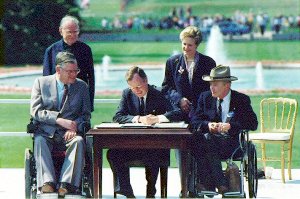
Photo: Signing of the Americans with Disabilities Act. President George H.W. Bush (center) is flanked by Evan Kemp, Chairman, Equal Employment Opportunity Commission (left) and Justin Dart, Chairman, President's Committee on Employment of People with Disabilities (right). Standing are the Rev. Harold Wilke (left) and Sandra Swift Parrino, Chairperson, National Council on Disability (right). Photo is from EEOC website. (If you follow that link, note that this page is not current. The current page on the Americans with Disabilities Act is here.)

Filed in: , , , , ,

Friday, August 18, 2006

Big Case Against Payday Lender

Washington's Department of Financial Institutions has filed a Statement of Charges against a payday lender, Check 'N Go of Washington, Inc. The company allegedly made borrowers write multiple checks for individual loans (often resulting in multiple NSF charges -- in violation of state law) and unlawfully collected borrowers' PINs.

This is an administrative proceeding "to revoke Check 'N Go's license, impose fines, order restitution, and charge for the cost of the investigation." With fines that could add up to $333,000, this is the biggest case in the agency's history. DFI press release: State Files Largest Case Against Payday Lender, Aug. 15, 2006.

For more on payday loans, see:

Thanks to Michele Storms for the lead.

Filed in: , ,

Clearinghouse Review Looks at Civil Gideon


The July-August 2006 issue of Clearinghouse Review: Journal of Poverty Law and Policy looks at "the growing momentum toward establishing a civil right to counsel," often known as "Civil Gideon."

Paul Marvy, a 2003 UW Law School grad now at Northwest Justice Project, wrote two of the articles:Other articles about individual states cover at Wisconsin, Maryland, Ohio, California, and Canada.

One article is actually excerpts from an amicus brief:
Eleven state court judges in Wisconsin filed an amicus brief in Kelly v. Warpinski, a case in which the petitioners asked the Wisconsin Supreme Court to take original jurisdiction and rule on their argument that the state constitution conferred a right to appointed counsel in civil cases. In their brief, the amici explained how pro se litigants burdened the courts; the amici argued that original jurisdiction in the supreme court was warranted under state law.
Judges' Views of Pro Se Litigants' Effect on Courts, 40 Clearinghouse Rev. 228 (2006). The argument addresses not just the problems faced by the pro se litigants themselves, but also the burden they create for the court system and other litigants. Providing counsel would benefit not just the unrepresented but all the players.

Thanks to Michele Storms for the lead.

Filed in: , , , , , , , , , , , , , ,