Friday, August 18, 2006

Clearinghouse Review Looks at Civil Gideon


The July-August 2006 issue of Clearinghouse Review: Journal of Poverty Law and Policy looks at "the growing momentum toward establishing a civil right to counsel," often known as "Civil Gideon."

Paul Marvy, a 2003 UW Law School grad now at Northwest Justice Project, wrote two of the articles:Other articles about individual states cover at Wisconsin, Maryland, Ohio, California, and Canada.

One article is actually excerpts from an amicus brief:
Eleven state court judges in Wisconsin filed an amicus brief in Kelly v. Warpinski, a case in which the petitioners asked the Wisconsin Supreme Court to take original jurisdiction and rule on their argument that the state constitution conferred a right to appointed counsel in civil cases. In their brief, the amici explained how pro se litigants burdened the courts; the amici argued that original jurisdiction in the supreme court was warranted under state law.
Judges' Views of Pro Se Litigants' Effect on Courts, 40 Clearinghouse Rev. 228 (2006). The argument addresses not just the problems faced by the pro se litigants themselves, but also the burden they create for the court system and other litigants. Providing counsel would benefit not just the unrepresented but all the players.

Thanks to Michele Storms for the lead.

Filed in: , , , , , , , , , , , , , ,

Thursday, August 17, 2006

Website Rates Federal Judges


The Robing Room gives lawyers, litigants, and others an opportunity to rate federal district judges and magistrates -- and to view others' ratings. The website is run by North Law Publisher, Inc. (New York).

So far, the sample sizes are far too small to mean much. For instance, in the Western District of Washington, only one judge has been rated at all, and that one has only been rated by one person.

That judge, Ronald B. Leighton did very well: straight 10s for Temperament, Scholarship, Industriousness, Ability to Handle Complex Litigation, Punctuality, Evenhandedness in Civil Litigation, and Flexibility In Scheduling. The one rater, who identified himself or herself as "civil litigation - private," did not rate the judge on the other criteria: Evenhandedness in Criminal Litigation; General Inclination Regarding Bail; General Inclination in Criminal Cases, Pre-Trial; Involvement in Civil Settlement Discussions; General Inclination in Criminal Cases, Trial; General Inclination in Criminal Cases, Sentencing; Typical Discount Off Guidelines for Cooperators.

Some other jurisdictions have had a little more ratings action. But even in the Southern District of New York, some judges have yet to be rated and no one has been rated by more than a handful of people. One judge whose ratings are posted (Judge Constance Baker Motley) died almost a year ago.

So, right now, the site is not a rich source of information. But I think it's worth watching to see if it fills out.

Filed in: , , , ,

Wednesday, August 16, 2006

Judicial Voter Pamphlet

A judicial voter pamphlet from the Administrative Office of the Courts will be published in newspapers around the state on Mon. Aug. 28. Washington Courts press release, Aug. 15, 2006. This voter pamphlet was begun in 1996 after a commission reviewed all aspects of our judicial selection system. (See The People Shall Judge: Restoring Citizen Control to Judicial Selection: A Report of the Walsh Commission, 1996 -- KFW525.5 .N6P46 1996 at Reference Area and Classified Stacks.)

The pamphlet will also be on the Washington Courts website. TVW will have a video voters guide with Supreme Court candidates.

Filed in: , ,

Tuesday, August 15, 2006

Food Additives


BusinessWeek Online has an article about food additives that are often not well explained to consumers -- for instance, an "artificial color" that is made from crushed beetles. (Some people might object because they are vegan or allergic to the substance.) An Insider's Guide to Food Labels, BusinessWeek Online, Aug. 13, 2006.

When I started reading this article, it was only for curiosity, but it turns out to have a trial practice angle: Seattle law firm Smith and Lowney sued three grocery chains for failing to label the artificial coloring in farm-raised salmon. Although the article says the lawsuits were "thrown out of court," the firm's website indicates the litigation is ongoing:

Thomas v. Albertson's Inc.; Dolin, et al., v. Safeway Inc.; Krupp, et al., v. Kroger Co.

Brought nationwide class actions against the nation's largest three grocery store chains for failing to label the artificial coloring in their farmed salmon. These chains operate over 6,000 grocery stores. Suit resulted in a firestorm of media attention across the nation. Within several weeks, Safeway, Kroger, Albertsons and others began labeling the color additives in their farmed salmon. Damages suit on behalf of consumers is still pending.
Filed in: , , ,

Graphic by mw.

Odds of Dying from Injury


The National Safety Council provides a table with the odds of dying from various injuries. One column lists the number of U.S. deaths in 2003; the next lists the odds of dying from that activity in a year; the third lists the lifetime odds.  

[Update (Sept. 16, 2012): That link is broken. A graphic from 2012 is here. The National Safety Council invites you to purchase its book, Injury Facts, in order to get the detailed table. Or you can use the Internet Archive to view the 2004 stats here. And a page from Learn Stuff based on the NSC stats is here. Thanks to Hannah Edwards for pointing out the broken link and offering the Learn Stuff link. Even old blog posts can be interesting and useful, so it doesn't hurt to fix the broken links.]

This is all based on the raw numbers. For example, to compute the odds of dying for "Animal rider or occupant of animal-drawn vehicle," take 101 deaths in 2003 and divide by the 2003 population 290,850,005 -- 1 in 2,879,703 . Of course, most of us don't spend much time riding animals or riding in animal-drawn vehicles. If you were a jockey or rodeo rider, your odds of dying from an injury related to riding an animal would be much greater than the average American's.

There's a cool graphic from National Geographic (Aug. 2006) that presents the lifetime odds in a series of circles, dwindling as the odds get smaller. The graphic includes non-injury causes of death: heart disease (1/5), cancer (1/7), stroke (1/24), motor vehicle accident (1/84) ... fireworks discharge (1/340,733). The largest circle: "Total odds of dying, any cause: 1 in 1." (I'm not copying the graphic here because I'm cautious about copyright, but do take a look. It's a good example of the visual display of information.)

Here are selected lifetime odds of injuries that are often litigated in one way or another:

  • Motor vehicle accidents: 1 in 84
  • "Fall on same level from slipping, tripping, and stumbling": 1 in 6,278
  • Bitten or struck by dog: 1 in 117,127
  • Assault by firearm: 1 in 314
  • Assault by sharp object: 1 in 1,829
  • Complications of medical and surgical care: 1 in 1,313
Graphic from NSC.org. Thanks for the lead to beSpacific.

Filed in: , , , ,

ACLU Report Details Horrors Suffered by Orleans Parish Prisoners in Wake of Hurricane Katrina


ACLU Report Details Horrors Suffered by Orleans Parish Prisoners in Wake of Hurricane Katrina (press release Aug. 10, 2006):

As the anniversary of Hurricane Katrina approaches, the American Civil Liberties Union's National Prison Project today released Abandoned & Abused: Orleans Parish Prisoners in the Wake of Hurricane Katrina. The report documents the experiences of thousands of men, women and children who were abandoned at Orleans Parish Prison (OPP) in the days after the storm.

* * *

In conjunction with the report's release, the National Prison Project urged the president to direct the Department of Justice to evaluate OPP's current evacuation plans in an effort to determine whether any meaningful improvements have been made over the past year. The ACLU also asked Congress to audit the jail's emergency preparedness plans. The ACLU is calling for a full and immediate investigation into abuses at Louisiana correctional facilities during and after the storm and is also urging the DOJ to make the findings from such an investigation public and accessible to state and federal prosecutors.
The 145-page report is here (cover at right).

Thanks: beSpacific.

Filed in: , , , , ,

Monday, August 14, 2006

Recordings of DUI Stops Admissible?


The Washington Supreme Court addresses the admissibility of sound and video recordings made during traffic stops. The case involves four consolidated cases, with drivers who were prosecuted for DUI offenses. Lewis v. State, --- P.3d ---, --- Wash. 2d ---, 2006 WL 2237888 (Aug. 3, 2006).

(There were two court of appeals cases on the way up, each dealing with two drivers: Lewis v. State, 125 Wash. App. 666, 105 P.3d 1029 (2005); City of Auburn v. Kelly, 127 Wash. App. 54, 111 P.3d 1213 (2005).)

First the Court considers whether the conversations were "private" and hence covered by the privacy act, RCW 9.73.030, which requires consent for recording private conversations. Justice Fairhurst, writing for a unanimous court, says no.

Next the Court looks at RCW 9.73.090, which includes:

A law enforcement officer shall inform any person being recorded by sound under this subsection (1)(c) that a sound recording is being made and the statement so informing the person shall be included in the sound recording, except that the law enforcement officer is not required to inform the person being recorded if the person is being recorded under exigent circumstances.
After reviewing the legislative history, the Court finds that the drivers must be notified of the recording.

Next, there's the question of remedy, and the Court holds that the appropriate remedy when a subject is not notified of the recording is to exclude it as evidence. So the cases are remanded. In one the recording will be admissible, because the driver was told the conversation was being "recorded" (even though the officer did not specify it was a "sound recording"). In the other three, the recordings will be excluded.

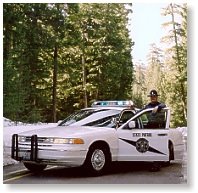
Photo: Washington State Patrol trooper at Mt. Rainier, from WSP.

Filed in: , , , , , ,

Vehicular Homicide and Separation of Powers

Does the vehicular homicide statute violate the separation of powers doctrine? In a Division II case decided last week, the appellant argued that the legislature improperly delegated definition of a term in RCW 46.61.520, because it made proximate cause an element of the offense without defining it. The court didn't buy the argument, but noted that it was an argument of first impression, and so published the discussion. State v. David, --- P.3d ---, 2006 WL 228587 (Wash. App. Aug. 8, 2006)(published in part), Westlaw, courts.

The unpublished portion of the opinion discusses various evidentiary and trial issues: (1) OK for the jury to see a picture of the victim when she was alive; (2) OK to exclude the victim's toxicology report; (3) jury instructions on proximate cause and DUI were fine; (4) prosecutorial misconduct in remarks during closing argument wasn't shown; (5) exceptional sentence upheld.

Filed in: , , , ,

Saturday, August 12, 2006

Start with Jury Instructions

Since jury instructions are the last thing jurors hear before they begin deliberations, David Swanner likes to plan his case around them -- even drafting them before he drafts the complaint. See South Carolina Trial Law Blog: Start Your Case with Jury Instructions (July 23, 2006).

Filed in: , , ,

Paperless Law Office

Here's a comment from an attorney whose firm is very happy with handling everything electronically, scanning and using a case management system called TrialWorks: South Carolina Trial Law Blog: Going to a Paperless Law Office (July 27, 2006).

Filed in: , , ,

More on ATLA's Name Change

ATLA Trades "Lawyers" for "Justice," ABA Journal eReport, July 28, 2006. Thanks to David Swanner (of South Carolina Trial Law Blog), who is quoted in the article saying he supports the name change "But I’m very proud of being a trial lawyer and being called a trial lawyer. I wouldn’t change that at all."

Filed in: , ,

Acquittals in Bench vs. Jury Trials

When should a defendant waive a jury trial in favor of a bench trial? Does it make any difference? Andrew Leipold studied the conviction rates in federal cases:

Andrew D. Leipold, Why Are Federal Judges So Acquittal Prone?, 83 Wash. U. Law Quart.151 (2005).

According to the abstract:

Federal criminal defendants almost always prefer a jury trial to a bench trial, but it is unclear why. Statistically, federal judges are significantly more likely to acquit than a jury is—over a recent 14 year period, for example, the jury trial conviction rate was 84%, while the bench conviction rate was a mere 55%. Moreover, while the conviction rate for juries has remained nearly constant for many years, the judicial rate has fallen steadily since the late 1980s. This Article presents the first systematic attempt to explain this “conviction gap.” Using original compilations of government records on over 75,000 federal criminal trials, this Article explores a variety of possible stories that would explain why judges and juries behave so differently. It concludes that some, but not all, of the gap can be explained by identifiable features of those cases that defendants direct toward judges rather than juries. It also concludes, however, that the recent changes in judicial behavior cannot be fully explained on these grounds; instead, the Article hypothesizes that the federal sentencing scheme, which changed dramatically during the 80s and 90s, may well have affected the way judges evaluate the government’s case in bench trials. The latter conclusions may have significant implications for the changes in federal sentencing that are likely to occur over the next several years.
For discussion by bloggers, see this post from The Volokh Conspiracy (July 24) and follow the links. Thanks to Oregon Legal Research.

Filed in: , , , , , ,

"Civil Gideon"

This week the ABA House of Delegates unanimously apporved a resolution urging governments to make counsel available as a right to low-income parties whose basic human needs are at stake. The full resolution, as adopted:

RESOLVED, That the American Bar Association urges federal, state, and territorial governments to provide legal counsel as a matter of right at public expense to low income persons in those categories of adversarial proceedings where basic human needs are at stake, such as those involving shelter, sustenance, safety, health or child custody as determined by each jurisdiction.
Michael S. Greco, outgoing president of the ABA, strongly supported the proposal.
“This is historic,” Greco said, “in the realm of an extraordinarily meaningful action by the ABA,” expressing the principle “that every poor American, like every wealthy American, should have access to a lawyer to protect the fundamental needs of human existence.”
A Civil Law Gideon, ABA Journal Annual Meeting Daily Report, Aug. 8, 2006.

As ABA president, Greco encouraged the profession to recommit to its noblest principles, serving the disadvantaged and performing public service. He created the Commission on the Renaissance of Idealism in the Legal Profession, whose final report (Aug. 2006) is here. Recommendations included a set of resolutions:
  • that the ABA encourage lawyers to participate in pro bono work and that employers give lawyers the time to do so (Resolution adopted, Feb. 13, 2006).
  • that the ABA urge lawyers and law firms to adopt a set of Pro Bono Policies and Procedures (Resolution not yet submitted).
  • that the ABA urge law schools to require employers that interview to make their pro bono policies available and disclose their pro bono records AND that law schools have policies of their own encouraging pro bono service by all members of the law school community (Resolution not yet submitted).
  • the the ABA urge courts to develop programs to encourage pro bono representation of indigent parties (Resolution not yet submitted).
Several local attorneys served on the Commission or its Advisory Committee: Coast Guard Commander Benes Z. Andana (SU '91), former WSBA president Ronald R. Ward, Rudy A. Englund (UW '75), Kathleen J. Hopkins (UW '91).

Thanks to Michele Storms for pointing out this week's ABA resolution to me. Storms is the new executive director of the William H. Gates Public Service Law Scholarship Program. Thanks to Mary Hotchkiss for the information about the Commission on the Renaissance of Idealism in the Legal Profession.

Filed in: , , , , , , , , , , , , , ,

Neukom to be ABA President

Seattle Lawyer William H. Neukom was named president-elect of the ABA. Press release, Aug. 8, 2006. Neukom is currently chair of Preston Gates & Ellis; he worked for 17 years as executive vice president of Law and Corporate Affairs at Microsoft.

Filed in: , , ,

Friday, August 11, 2006

Longtime defender making a case for a new generation of lawyers

After 33 years at The Defender Association, Bob Boruchowitz is leaving to join Seattle University School of Law's faculty. Longtime defender making a case for a new generation of lawyers, Seattle PI, July 28, 2006.

Norm Maleng, who became King County prosecutor the same year Boruchowitz assumed leadership of The Defender Association, said Boruchowitz's efforts have made Seattle's public defenders "the finest in the country."
Boruchowitz is proud to have helped change the public perception of public defense:
Before, he said, people were advised to hire lawyers if they possibly could.

Now they're told, "Don't mortgage your mother's house, because if you have the public defender's office, you'll be fine," he said.
Thanks: Public Defender Stuff.

Update (Nov. 2, 2006): See also Boruchowitz Moving To Seattle U., Bar Bull, Sept. 2006.

Filed in: , , ,

New Orleans judge will start releasing prisoners if trials put off much longer


JURIST - Paper Chase: New Orleans judge will start releasing prisoners if trials put off much longer. There is a backlog of about 6000 cases and a shortage of public defenders.

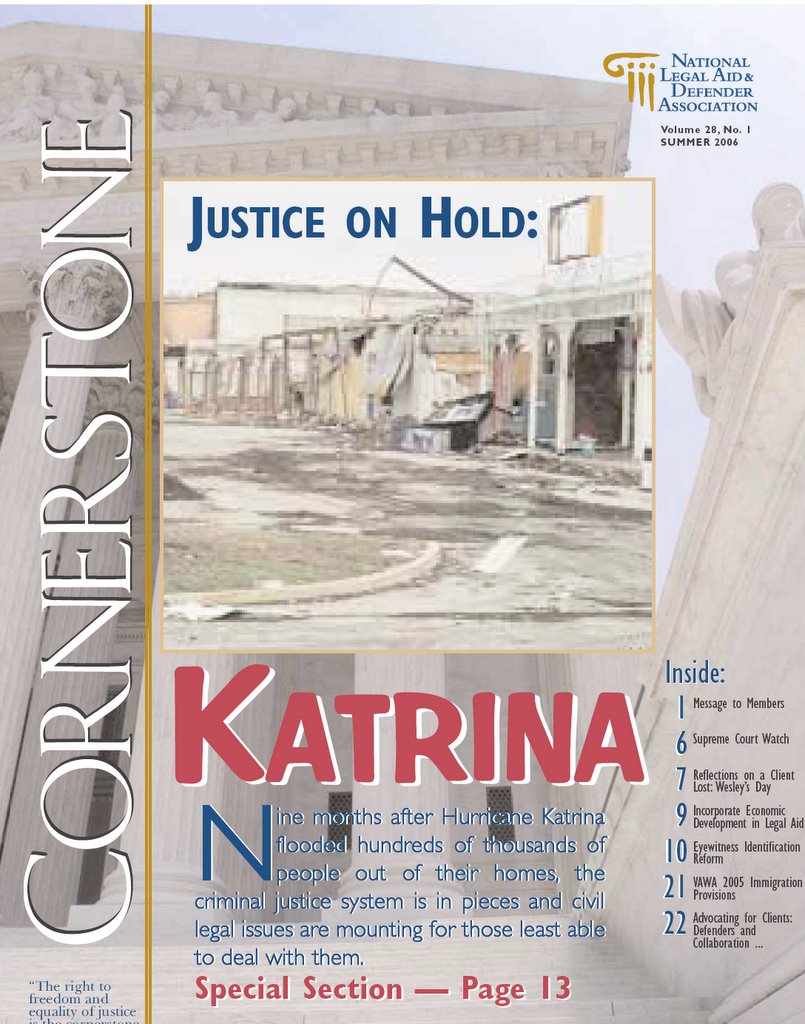
For more on problems in the justice system post-Katrina, see the National Legal Aid and Defender Association's magazine, Cornerstone, whose Summer 2006 issue (cover at right) is devoted to the topic.

Filed in: , , , , , , ,

Prison sexual violence often unreported for fear of reprisal: DOJ

Prison sexual violence often unreported for fear of reprisal: DOJ, Jurist - Paper Chase, July 31, 2006.

The Jurist story links to a report from the Bureau of Justice Statistics and the Prison Rape Elimination Act of 2003.

Filed in: , , ,

Libby lawyers seek to use memory expert in CIA leak trial

Libby lawyers seek to use memory expert in CIA leak trial, Jurist - Paper Chase, Aug. 1, 2006. "In a court filing, Libby's attorneys said that testimony about how human memory works and why it fails will help a jury consider whether Libby lied to federal investigators about his knowledge of the CIA leak scandal. . . ." They hope to call as an expert Dr. Robert A. Bjork, chair of the UCLA's Psychology Department.

The Jurist article links to Libby's indictment and other resources.

Filed in: , , , ,

Immigrants file lawsuit against US government over delay in citizenship bids

The Council on American-Islamic Relations and the ACLU have sued the federal government, saying that their naturalization applications have been delayed for years because of the FBI's slowness in "name checks" referred to it by US Citizenship and Immigration Services. Immigrants file lawsuit against US government over delay in citizenship bids, Jurist - Paper Chase, Aug. 2, 2006. The complaint in Aziz v. Gonzales (C.D. Cal.) is here.

Filed in: , , ,

Violent Felons in Large Urban Counties

Bureau of Justice Statistics Press Release: Violent Felons in Large Urban Counties, Aug. 6, 2006.

Fifty-six percent of the violent felons convicted in the nation's 75 most populous counties from 1990 through 2002 had a prior conviction record, 38 percent had a prior felony conviction and 15 percent had been previously convicted for a violent felony.
Links to the 12-page report and downloadable spreadsheets are here.

Thanks again to beSpacific.

Filed in: , , ,

TRACking Federal Enforcement with Statistics: Tax, Immigration, More

Interested in statistics about federal enforcement efforts? Want to know whether tax fraud prosecutions are up, what corporations are most often audited, what the patterns are for prosecutions of federal wildlife laws? TRAC (Transactional Records Access Clearinghouse) is a great source.

TRAC is associated with Syracuse University. Researchers use FOIA to get data sets from the federal government, check them against other sources, analyze the data, and make the results available in different ways. Sometimes the FOIA requests must be backed by litigation -- for instance, Long v. Internal Revenue Service, No. C74-724P (W.D. Wash. April 3, 2006)(Judge Marsha Pechman's order graning TRAC's motion to require the IRS to provide certain statistics). See TRAC's press release (April 4, 2006) and update (May 21, 2006).

Subscribers to the TRACFED service can produce their own detailed reports from TRAC's databases. Various parties -- agencies, public interest groups, journalists, lawyers -- also hire TRAC statisticians to compile reports on different issues.

Some of the information available even without a subscription:

If you explore the site, you'll find much more. You can also sign up for email alerts -- general or immigration -- to learn about new reports as they come out.

I saw a demonstration of this site a few years ago and thought it was great, but I'd forgotten about it until I saw a post in beSpacific about the study of immigration judges today.

Graphic: Federal Tax Prosecutions, from TRAC.

Filed in: , , , , , , , , , ,

Computer Forensics

GCN (Government Computer News) offers a special report on computer forensics (July 31, 2006). Components include:

  • Computer forensics: The New DNA, featuring the Department of Defense's Cyber Crime Center ("DC3").
  • Who is accredited to analyze forensic evidence? Three states -- NY, OK, TX -- "have passed legislation requiring forensic evidence presented in court to have been processed by an accredited facility." There are only 12 labs accredited for computer forensics.
  • Darlene Druyun's downfall: e-mail, discussing the investigation of the Air Force employee who steered business to Boeing while negotiating for a job at Boeing -- the employee and Boeing's former chief financial officer both pleaded guilty to conflict-of-interest charges.
Thanks: beSpacific.

Filed in: , , , , , ,

The Legality of Web "Blacklists"

Findlaw columnist Julie Hilden discusses practical and legal implications of web-based lists of med mal claimants, doctors, lawyers, etc. The Legality of Web "Blacklists" (Aug. 1, 2006).

Her example is LitiPages.com, which lists medical malpractice plaintiffs who have lost jury trials or settled their cases. The site (it wasn't available when I checked) apparently encourages doctors to avoid treating the plaintiffs -- at least for elective procedures -- and encourages the unsuccessful plaintiffs to sue their attorneys.

Hilden observes that sex offender lists may invite viewers to equate all offenders listed -- e.g., an 18-year-old convicted of statutory rape after having consensual sex with a teen partner with a 54-year-old child molester. She says that the solution is more information, not less. Likewise, she acknowledges the potential for improper use of a list of med mal plaintiffs, but says that, again, more information could address the problem -- e.g., if defendants had a right to post replies.

Thanks: beSpacific.

Filed in: , , , , ,

Moussaoui Exhibits


The federal court that heard the Zacarias Moussaoui case has posted the trial exhibits from both prosecution and defense. Included are "all 1,202 exhibits admitted into evidence during the trial of U.S. v. Moussaoui, with the exception of seven that are classified or otherwise remain under seal. This is the first criminal case for which a federal court has provided access to all exhibits online."

Photo: Prosecution Exhibit Number MM00756.4: Interior close-up photo of the pilot and co-pilot area of a flight simulator for a Boeing 727 at the Pan Am International Flight Academy.

Thanks: beSpacific.


Filed in: , , ,

Interpreting in Federal Courts

In the last fiscal year, federal court proceedings required interpreters in a total of 111 languages, according to a press release (July 31, 2006) from the Administrative Office for the U.S. Courts.

Spanish is by far the most prevalent language, accounting for 94% of the quarter-million proceedings. (I rounded a little: it was 227,461 events.)

Since 1994, some interpretation for short proceedings (such as pretrial hearings) is handled over the phone, through the Telephone Interpreting Program (TIP). Seven courts provide the service to 80 locations.

Thanks to beSpacific.

Filed in: ,

A Blog's Life

I write a column for Law Library Journal. It's generally outside the scope of this blog, since practicing reference is not trial practice, but those interested in blogging might like the latest column, which describes my experience with Trial Ad notes: A Blog's Life, 98 Law Libr. J. 559 (2006).

Filed in: , ,

Wednesday, August 9, 2006

Voting for Judges.org


A partnership of about a dozen organizations (including WSBA, KCBA, WSTLA, Washington Defense Trial Lawyers, and the League of Women Voters of Washington) has launched Voting for Judges.org, a website with information for state voters about judicial candidates. (See Dec. 9 post about the Judicial Selection Coalition.)

The site includes a campaign financy summary and links to media stories.

Eventually the site will include links to endorsements and ratings by various newspapers and organizations.

I've been thinking about the endorsement process since I read a piece in the Stranger about Justice Madsen (Josh Feit, Dishonor Role, Stranger, Aug. 3, 2006), who was endorsed by SEAMEC (a gay and lesbian rights group) two years ago and yet wrote the majority opinion upholding the Defense of Marriage Act last month (Andersen v. King County, links to majority, two concurrences, and three dissents).

During the endorsement process Justice Madsen said that she did not believe that the purpose of marriage is for the nurturing of children or that same-sex marriage is a threat to the institution of marriage and the social fabric of the nation. The questionnaire and interviewers did not ask: "Applying a rational-basis standard to a statute such as DOMA, do you believe that the legislature could rationally believe those things?" And of course her assessment that the legislature's belief was rational was the hook for her decision, not her own belief. Yet can one blame the interviewers for being surprised by her decision? How could interviewers -- including laypeople untrained in the subtleties of constitutional analysis* -- be able to differentiate between what the candidate believes and what the candidate would later say it would be rational for the legislature to believe?

Canon 7(B)(1) of the Code of Judicial Conduct provides:

(1) Candidates, including an incumbent judge, for a judicial office:
* * *
(c) should not
(i) make pledges or promises of conduct in office other than the faithful and impartial performance of the duties of the office; [or]
(ii) make statements that commit or appear to commit the candidate with respect to cases, controversies or issues that are likely to come before the court; * * *
How can an advocacy group assess a candidate's likely approach to cases without expecting the candidate to violate that rule?
---------
* This is not to slight laypeople or any other interviewers. I've studied constitutional law a bit and my crystal ball would have missed this one too.

Filed in: , , , , , , , , , , , , , , ,

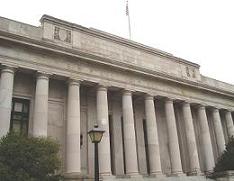
Photo: Temple of Justice, Olympia, from Washington Courts website.

The 'Jewish' Con (Seattle Weekly)

Here's one I missed when it appeared: George Howland Jr., The 'Jewish' Con, Seattle Weekly, March 1, 2006. It discusses issues about religion in prison. Some prisoners who are not Jewish say that they are so that they can get kosher meals. That seems harmless enough if they just like the food -- but what about the gangs who arrange to have the special meals so they can meet in the dining hall? Or the White Supremacists who go to Jewish services to intimidate the Jews? What about the prisoners who sincerely believe in a faith, even without formal training in it?

According to the Weekly Sen. Ken Jacobsen (D. - 43rd Dist.) hopes to find a way to address the problem of gangs using religion as a pretext in prisons.

Filed in: , ,

Judges Disciplined

Washington's Commission on Judicial Conduct has given admonishments to two Pierce County judges. Judge Beverly Grant (superior court) was sanctioned for leading the courtroom in a cheer for the Seahawks during a sentencing proceeding; Judge David Ladenburg (Tacoma municipal court) for ordering a Muslim woman to leave his courtroom when she would not remove her head covering. Each judge agreed not to repeat the conduct and to study the Code of Judicial Conduct. Judge Ladenburg will also complete a course on cultural competence at his own expense. The Seattle Times: Local News: State penalizes judges; 1 ordered courtroom Seahawks cheer.

The Commission's orders are here: In re Beverly G. Grant (Aug. 4, 2006); In re David B. Ladenburg (Aug. 4, 2006). Both incidents had received media attention, and in both cases the judges had apologized for their missteps. In fact, Judge Grant filed the formal complaint with the Judicial Conduct Commission herself. The orders are interesting to read for the factual context. For instance, one reason Judge Grant's cheering for the Seahawks was seen as insensitive was that the case before her was a homicide that had taken place on the previous Super Bowl Sunday.

Well now, since the Times article led me to look at the Judicial Conduct Commission's orders, I'll also share a couple of others not mentioned by the paper:

  • Judge Robert D. Austin (Spokane County Superior Court) was admonished (Aug. 4, 2006) for disagreeing with a jury's verdict. After a jury rendered a guilty verdict, the judge met with the jurors in the jury room and told them that he was surprised. He explained that he had earlier denied a motion to dismiss for lack of evidence because he felt confident the jury would not convict, and now he expected further motions as a result of the verdict. He later said that he did not intend for his comments to be interpreted as a criticism of the verdict, but in agreed that his comments could have created the impression among the jurors that they had reached the wrong verdict or disappointed him.
  • A judge who is no longer sitting (because he lost the Nov. 2005 election) was censured. He contested many of the allegations -- from ethnic slurs to failure to maintain courtroom decorum -- but conceded some (e.g., that referring to a victim as a "heifer" was insensitive, even outside the presence of the parties) and agreed that it is likely that the Commission would be able to prove some or all of the facts and misconduct alleged if the matter proceeded to a public hearing. He accepted the censure and promised not to repeat the conduct should he hold judicial office again. In re Jonathan Martin (June 2, 2006)(Yakima Municipal Court).
  • Judge Mary Ann Ottinger (King County District Court) was censured and suspended for thirty days for failing to protect the rights of unrepresented defendants (especially during the entry of guilty pleas). Washington Supreme Court order (July 20, 2006); Commission decision (May 5, 2006). The Commission decision recounted that the judge's violations continued despite an order in 2004, but stopped in 2005. Because of Judge Ottinger's efforts to learn of standard practices, the Presiding District Judge for King County is reforming practices generally. One member of the Commission dissented because he would have imposed a harsher sanction: removal from office.
  • A municipal court judge was admonished for "impatient, undignified and/or discourteous demeanor," including "inappropriate humor." In re Stephen E. Moore, April 7, 2006 (Lynnwood Municipal Court).
  • Remember the two attorneys who pleaded guilty to federal charges related to accepting drug money? They were also censured by the Judicial Conduct Commission: In re James L. White, Oct. 28, 2005 (former Edmonds Municipal Court Judge); In re A. Mark Vanderveen (Dec. 9, 2005)(former Edmonds Municipal Court Judge Pro Tem). White was also disbarred (Feb. 3, 2006). (The WSBA directory shows that Vanderveen's license has been suspended but it does not link to the disciplinary notice.)
Filed in: , , , , , , , , , , , , , , , , , ,

Pretrial Rulings in Haq Prosecution

Yesterday Judge Michael Trickey (King County Superior Court) ruled that Naveed Afzal Haq, the man accused of killing one woman and wounding five in the Jewish Federation office on July 28, could have his own investigator at the scene. Natalie Singer, Judge: Haq defense can send own crime-scene investigator, Seattle Times, Aug. 9, 2006. Prosecutors and representatives of thew Jewish Federation objected. The Federation would like to have its staff have access to the offices again.

In an effort to reduce prejudicial pretrial publicity, Judge Trickey also granted a defense motion to prohibit the media from filming or photographing Haq while he has his hands or legs in shackles or is surrounded by sheriff's deputies. Id.

Columnist Susan Paynter discusses the range of opinion within the Jewish community about whether King County Prosecutor should seek the death penalty. Susan Paynter, Jewish community ponders whether Haq should face death, Seattle PI, Aug. 9, 2006.

It is unclear whether the incident can be prosecuted as a hate crime. Mike Carter, Charges: It may take more than hate to qualify as hate crime, Seattle Times, Aug. 1, 2006.

Filed in: , , , , , , , , ,

Tuesday, August 8, 2006

DSHS Risk Manager

Today's Seattle Times has an obituary of Bernie Friedman, who was the risk manager for the Department of Social and Health Services (DSHS), "the state's most-sued agency." Lawyer helped state stem losses from DSHS suits, Seattle Times, Aug. 8, 2006.

Mr. Friedman had a varied career, serving in the Air Force as a meteorologist, working for a large firm, losing his job, starting a small firm with Phil Talmadge, working as a law clerk for Talmadge when he was on the Washington Supreme Court, and, finally, working at DSHS.

In 2003, Mr. Friedman insisted on defending at trial the case filed by Said Aba Sheikh, a teenaged Somali refugee who was beaten into a coma by four youths, including two living in a home where they were placed by DSHS. (One was in foster care; the other was in a dependency guardianship). The state lost, and the plaintiff was awarded a judgment of over $10 million. But this year the Washington Supreme Court reversed, finding that the state owes no duty to persons harmed by torious acts of dependent children. Aba Sheikh v. Choe, 156 Wash. 2d 441, 128 P.3d 574 (Feb. 16, 2006) (Owens, J.) Findlaw links: majority, concurrence, dissent.

Justice Chambers, in his concurrence, emphasized that the state could still be liable for its own negligence -- just not the torts of the children. Justice Sanders, dissenting, said that the state has a duty to place foster children with foster parents capable of controlling them. He emphasized facts in this case -- that the state knew of the boys' criminal records and gang activity, that it did not tell the foster mother, and that she had asked DSHS to place the boys elsewhere before the attack.

See also:

UW note: The obituary quotes Trial Ad instructor Bill Bailey, who praised Friedman's "unerring moral compass."

Update (Jan. 15, 2007): The Washington State Bar Association posthumously awarded Mr. Friedman its Local Hero award. Press release, Jan. 11, 2007.

Filed in: , , , , , ,

Cops in Dorms?

This spring, Judge David Frazier (Whitman County superior court) threw out two cases against WSU students arrested by WSU campus police in their dorms. He said that students have a resonable expectation of privacy in the hallways of their dorms. In one case, an officer in in the hallway smelled marijuana smoke coming from a room and got a warrant before entering the room, where he discovered marijuana in the defendant's purse. WSU police now say that they will no longer patrol the dorms. Here at the UW, campus police will continue to patrol at night. Police won't patrol dorm halls at WSU, Seattle Times, Aug. 8, 2006.

Filed in: , , , , , ,

Glass Art Litigation

In a series on famed glass artist Dale Chihuly, today's installment discusses his copyright-infringement case against another glass artist. The Seattle Times: Chihuly Inc.: Chihuly turns up the heat on competing glass artists.

The copyright suit, filed in October in U.S. District Court, accuses glassblower Rubino, a longtime collaborator of Chihuly's, and businessman/artist Kaindl of collaborating in a scheme to make and sell knockoffs of Chihuly's work. Both have denied the allegations, and have filed counterclaims alleging that Chihuly is seeking to claim ownership of basic forms, shapes and colors that are fundamental to glassblowing.
Filed in: , , , ,

Schierman Motions

Judge Gregory Canova (King County Superior Court) has granted the defense motion to extend the time for the prosecutor to file notice of seeking the death penalty by 60 days in the trial of Conner Schierman for murder and arson. Judge Canova said that he needs more time to decide whether the release of investigative documents to KING-TV would prevent Schierman from receiving a fair trial. Defense attorney James Conroy is seeking an order preventing the further release of document. He is also moving for a change of venue. Natalie Singer, Judge to give papers' release further review, Seattle Times, Aug. 8, 2006.

Filed in: , , , , , ,

Monday, August 7, 2006

Ethics for Judges

Ethics Essentials: A Primer for New Judges on Conflicts, Outside Activities, and Other Potential Pitfalls (Committee on Codes of Conduct, Judicial Conference of the United States, April 2006) is just what its title says (26 pp.).

Thanks again to BeSpacific.

Filed in: , ,

RPC update

Last month, the Supreme Court adopted a set of changes to the Rules of Professional Conduct. Now WSBA's Special Committee for the Evaluation of the Rules of Professional Conduct (Ethics 2003 Committee) offers an overview for Washington attorneys. One notable change: now the rules have official comments. (Interestingly, at the same time the Evidence Rules dropped official comments.)

See also Peter Callaghan, State ethics code compels lawyers to keep secrets, News Tribune, Aug. 3, 2006. This article focuses on the rules relating to maintaining clients' confidences and candor toward the tribunal. UW note: The article quotes Prof. Tom Andrews.

The complete Rules of Professional Conduct and comments are available for download. The changes take effect Sept. 1.

Thanks to Lisa Kremer for the News Tribune link.

Filed in: , , , , ,

Friday, August 4, 2006

Schierman Plea, Motions

Conner Schierman pleaded not guilty to aggravated first-degree murder (four counts) and arson for the incident in which four family members were stabbed to death and their house burned. Natalie Singer, Man pleads not guilty in deaths of four members of Kirkland family, Seattle Times, Aug. 1, 2006.

Schierman's defense attorney, James Conroy, moved to dismiss the charges, alleging prosecutorial misconduct when the Kirkland Police Department released about 300 pages of the case file to KING-TV. Conroy wrote that releasing the documents was

concerted and protracted effort by the news media, with the obvious and purposeful assistance of the state of Washington and the Kirkland Police Department, to try the case and convict Conner Schierman in the press before he was ever able to enter his initial plea.
The Times reported:
In his response, Senior Deputy Prosecuting Attorney Scott O'Toole said that KING-TV, which obtained the documents through a public-information request, removed from its Web site the story and related photographs that referred to the documents and agreed not to run any more stories based on the material in the discovery.

He also said much of the information mentioned in the media was properly released in public documents days before KING-TV obtained the discovery evidence.
I went to KING's website, looking for some statement about removing the documents. Instead I found what appears to be the original story, Documents uncover more evidence in Kirkland murders, KING5.com, July 25, 2006:
KIRKLAND, Wash. – New court documents exclusively obtained by KING 5 News uncovers more evidence in the Kirkland arson and murders case. . .
(All I did was type "schierman" in the search box on KING's main page.) I did not see any photographs related to the file. (The PI's article covering the arraignment says that Conroy acknowledged that this motion was unlikely to be granted. Tracy Johnson, Kirkland man says he's not guilty of killings, arson, Seattle PI, Aug. 1, 2006.

Defense attorney Conroy also moved to extend the time limit the prosecutor's office (King County Prosecutor Norm Maleng) to decide whether to seek the death penalty. By statute (RCW 10.95.040), the prosecutor must file notice of seeking the death penalty within 30 days of the arraignment. The defense has moved for a 5-month extension -- i.e., making it 6 months.

As in many capital cases in Washington now, the defense will likely raise proportionality, since the death penalty was not imposed on Gary Ridgway, despite his pleading guilty to 48 counts of aggravated first-degree murder, because he cooperated with the prosecution in some unsolved murders.

Filed in: , , , , , , , , , ,

Including Pets in DV Orders


Maine has passed a new law giving judges the power to include pets in protective orders in domestic violence cases. Saving Fido, ABA Journal eReport, Aug. 4, 2006.

A supporter estimates that 70% of the victims of domestic violence also have their pets threatened. Lawyer Anne H. Jordan, a former prosecutor and now a member of Maine's Animal Welfare Advisory Council, says that threatening to harm pets is a classic intimidation technique -- and often keeps victims of domestic violence from leaving their abusers for fear that a beloved dog or cat would be killed. Vermont, New York, and Illinois are considering similar legislation.

Since 2001 Maine has had a program -- a collaboration between an animal shelter and a domestic violence shelter -- to provide foster homes to pets of domestic violence victims.

See also

Now, I thought I'd throw in a link to the new law. That should be easy enough, right? But this turned out to challenge my research skills.

The answer is: It was Legislative Bill 1881, signed by the governor March 27, 2006, Public Law, Chapter 510. What made finding it so hard was that the bill does not use the terms "protective order" or "domestic violence." The new provision was included in a bill with various other animal welfare provisions. And the only language that links it to domestic violence protective orders is the citation of the code section it amends -- 19-A M.R.S. section 4007 -- which now includes the phrase "N. Directing the care, custody or control of any animal owned, possessed, leased, kept or held by either party or a minor child residing in the household." You have to go to 19-A M.R.S. sec. 407 to find that A-M are subsections listing what can be in a DV protective order. Geez, it shouldn't be that hard to find a recent bill that's been in the news.

Thanks to Mary Hotchkiss for sending me today's story from the ABA Journal eReport.

Update: See also Law Shields Pets from Domestic Violence, USA Today, Aug. 23, 2006.

Update (March 14, 2007): Legislator Wants to Open More (Doggie) Doors to Courthouse, Recorder (Law.com), March 2, 2007.

Filed in: , , , , , , ,

Graphic by mw.

Justice Talking


NPR's Justice Talking explores a current legal topic each week. You can listen on the radio (see the list of stations) or online. You can also sign up for podcasts.

This week's program is Collecting DNA from the Accused: Will it Help or Hurt Law Enforcement? .

The list of past shows (there are 250!) has lots of other great topics and speakers -- for instance
  • "Are Lawyers Necessary in All Cases?" (3/28/06)
  • "Murder: Beyond the Blood and Gore" (2/20/06)
  • "When Kids Commit Crimes: What's a Fair Sentence?" (3/15/06)
  • "Should Sex Offenders Have Civil Rights?" (11/14/05)
  • "Limiting Lawsuits" (11/16/04)
Many of the programs have been accredited for CLE credits in many states (including Washington).

Thanks for the lead to WisBlawg.

Filed in: , , , , , , , , , , , , , , ,

Graphic by mw.

Wednesday, August 2, 2006

15% of Civil Trials Appealed

A 15-page report, Appeals from General Civil Trials in 46 Large Counties, 2001-2005, from the Department of Justice Bureau of Justice Statistics says that about 15% of civil trials are appealed. Plaintiffs and defendants are about equally likely to appeal. Bureau of Justice Statistics Press Release, July 6, 2006.

Some statistics by type of case -- appeals are filed in:

  • 11% of all tort trials
  • 21% of trials involving contracts
  • 24% of property trials
  • 18% of medical malpractice cases
  • about 33% of products liability cases
  • 5% of automobile accident cases.
The press release states:
According to the report, the appeals process provides another opportunity for litigants in a sizeable percentage of cases to reach a settlement outside the court. Many appeals are withdrawn or dismissed because the parties reach settlement after the initial appeal is filed.
Thanks: beSpacific.

Filed in: , , ,

Asset Forfeiture Resources

Forfeiture Endangers American Rights (F.E.A.R.) is a nonprofit group "dedicated to the reform of federal and state asset forfeiture laws to restore due process and protect property rights in the forfeiture process."

It makes some handbooks and documents available free on its website; others are available for sale in print or online to subscribers.

In response to FEAR's FOIA requests, the Department of Justice released

the 2006 versions of: Selected Asset Forfeiture Statutes, Money Laundering Statutes and Related Materials, and the DOJ Asset Forfeiture Policy Manual. These manuals are hot off the presses -- the two compilations of statutes (both of which include what appears to be a complete collection of every relevant federal statute on the subject -- and some very useful tables and "related material") were published in May 2006.
FEAR plans to scan them and sell them in PDF -- with FEAR commentary -- on CD-ROM.

Thanks to beSpacific for the lead.

Filed in: , , ,

Nicknames for Bank Robbers

This morning's Seattle Times has a piece about how Catchy nicknames help FBI snare bank robbers.

Because robbers move so quickly, typically spending less than 20 seconds inside a bank, it's not uncommon for the FBI to receive shoddy surveillance video, vague descriptions and little physical evidence, [FBI Special Agent Larry] Carr said. By having nicknames, he hopes descriptive details will stick with people so that, if they see an alleged bank robber, they can identify them.
Examples in the article included "Attila the Bun," "the Button-Up Bandit," and "the Uncle Fester Bandit."

Naturally I wondered about the legal angle. Is there ever an allegation that a suspect was prejudiced by the name? Does a nickname taint the defendant with uncharged crimes? Does the media attention a nickname brings prejudice the jury? What if the nickname ("the Redbeard Bandit") draws attention to one physical characteristic that results in a mistaken identification?


I did just a little research and didn't find much -- no ALR annotations, no law review articles. (There was an ALR annotation about whether it's prejudicial for a prosecutor to call a defendant names at trial "this monster," "a nightmare," etc. That's not the same.) Most of the cases with robber! within 3 words of nickname involve nicknames used by the robbers, not assigned by the FBI. For instance, a teller hears one robber call the other "Snake," and one piece of evidence against the defendant is that many of his buddies call him "Snake." United State v. Henderson, 241 F.3d 638 (9th Cir. 2000) upheld the conviction of "the Wig Bandit," but didn't discuss the name. (By the way, the defendant was identified by someone who saw "the Wig Bandit" featured on "America's Most Wanted.")

Since I didn't find anything in my quick search, maybe this isn't an issue. Any thoughts?

Filed in: , , ,

Graphic by mw.

Coughenour Profile

Judge John C. Coughenour (W.D. Wash.) is a well-respected judge, noted for his high standards for attorneys and compassion for criminal defendants, according to a profile in yesterday's Seattle Times. David Bowermaster, "Senior status" isn't likely to dilute judge's demanding, compassionate style, Seattle Times, Aug. 1, 2006.

When Judge Coughenour toured the new federal prison in Sheridan, Oregon, in 1989, a prisoner greeted him and Coughenour talked to him about prison conditions and his plans after his release. Since then, the judge has regularly visited the prison and offers to spend 15-20 minutes with anyone he has sentenced.

Judge Coughenour has spoken out against mandatory minimum sentences for drug offenses because they are often harsh and remove discretion from the judge.

Judge Coughenour has handled some high-profile cases, including the fraud trial of the Montana Freemen in 1998 and the trial of terrorist Ahmed Ressam.

The Times article doesn't mention it, but Judge Coughenour also chaired the Ninth Circuit Gender Task Force whose report, The Effects of Gender in the Federal Courts, was issued in 1993. I remember hearing him speak around then, and he indicated that his service on the task force had made a big impression on him. Having a white, Midwestern Reagan-appointee become an advocate for gender equity may have made an impression on others, as well: if he thinks there might be a problem here, well, then maybe there is!

UW notes: Coughenour was a full-time faculty member at the UW in the early 1970s, teaching Trial Practice (the predecessor to today's Trial Advocacy class). He has taught Advanced Trial Advocacy here as a part-time faculty member for years. (Sign up for it in winter 2007!) The Times profile quotes two Trial Ad instructors, private attorney Jeffery Robinson and federal public defender Thomas Hillier.

Filed in: , , , , , , , ,

Tuesday, August 1, 2006

National Sex Offender Public Registry

The Department of Justice hosts a National Sex Offender Public Registry. This site allows users to search sex offender registries from several states or all states at once. A statement cautions that information might be out of date or inaccurate.

Users must agree to conditions of use and are warned: "Any person who uses information contained in or accessed through this Website to threaten, intimidate, or harass any individual, including registrants or family members, or who otherwise misuses this information, may be subject to criminal prosecution or civil liability under federal and/or state law."

A year ago, this site was introduced with data from 22 states. (Press release July 20, 2005.) Now, with the addition of Florida and Oregon, all fifty states are included. (Press release July 3, 2006.)

I'm reminded of an essay I read in Legal Affairs by a person (a former flasher) who has to register as a sex offender. I was struck by this:

Why don't we register murderers? Drunk drivers? Batterers? People who have committed fraud?

I can't understand why people think I need to know about the guy next door who might expose his penis to my daughters but I don't need to know about the guy who went into his last neighbor's driveway and beat her with a baseball bat. Or the guy who has a drunk-driving conviction and just might come driving home drunk one day and drive through my front yard, killing someone. It defies reason. I've read recent studies that say that sexual abuse constitutes around 10 percent of all child abuse. Where is the rampant emotional hysteria about the real abuse? Let's register the emotional and physical abusers.
Robert J., Ex-Offender, Legal Affairs, Sept./Oct. 2003. I don't buy Robert J.'s apparent suggestion that sexual abuse is not "real abuse" -- but I do see his point. If we want to worry about people who could endanger us, the field is much larger than just sex offenders.

Robert J. concludes by recommending that we register no one -- and that citizens understand that anyone can commit a sex offense. "Not understanding that and relying on a registry to target a few individuals is what puts you at risk." Id.

Food for thought.

Filed in: , ,