Wednesday, May 25, 2005

Outstanding Trial Ad Instructors, Outstanding UW Alumni!

[EVENT] At its annual dinner on June 23, the King County Bar Association is honoring:

  • Outstanding Lawyer: Thomas W. Hillier, II, Federal Public Defender -- UW Trial Ad instructor
  • Outstanding Judge: Hon. Robert S. Lasnik, U.S. District Court -- UW School of Law alumnus (class of '78)
  • William L. Dwyer Outstanding Jurist: Hon. Robert F. Utter, Retired -- UW School of Law alumnus (class of '54)
  • Outstanding Young Lawyer: Felix Gavi Luna, Heller Ehrman White & McAuliffe, LLP -- UW Trial Ad Instructor and UW School of Law alumnus (class of '97)

    Congratulations!!!
Filed in: , , , , , , ,

Tuesday, May 24, 2005

Empirical study of federal civil litigation

[RESEARCH] In Exploring Economic and Democratic Theories of Civil Litigation: Differences Between Individual and Organizational Litigants in the Disposition of Federal Civil Cases, Gillilan K. Hadfield analyzes a large sample of cases from federal courts.

In the abstract, Prof. Hadfield writes:

I endeavor to show the differences between individual and organizational litigants in the rate at which cases are abandoned, defaulted, adjudicated without a trial, adjudicated with a trial, or settled.

The results show substantial differences in cases based, primarily, on plaintiff rather than defendant type. I find individual plaintiff cases are substantially more likely to be determined by an adjudication—especially a non-trial adjudication—than are organizational plaintiff cases. I also find evidence that organizational plaintiffs—against either individual or organizational defendants—are substantially more likely to settle their cases rather than to have them decided either by trial or non-trial adjudication.
The paper is forthcoming in the Stanford Law Review. It may be downloaded now from the link above.

Filed in: ,

Monday, May 23, 2005

King County Superior Court clerk honored

[NEWS] King County Superior Court Clerk Barbara Miller has been named Court Manager of the Year. Washington Courts press release. Congratulations!

Filed in: , ,

Trial over gov's election begins today

[NEWS] The trial over Washington's 2004 governor's election opens today. Here are some links:

Filed in: , , ,

Discovery: Cut Out the Middleman

[TIP] Evan Schaeffer offers a tip to avoid delays in opposing counsel's responses to interrogatories: give notice that you want to depose the corporate representative. The Illinois Trial Practice Weblog: Discovery: Cut Out the Middleman

Filed in: , , , ,

Saturday, May 21, 2005

Input needed!! Time to evaluate Trial Ad Notes!

In a couple of weeks, we'll be deciding whether to continue this blog. Your input is important. Is anyone out there reading it? Is it helpful? What do you like and dislike?

Please take this short survey.

Filed in:

Family Law Pattern Interrogatories

[RULES] Proposed discovery rules (to take effect Sept. 1) in King County Superior Court would limit interrogatories unless there are court-approved pattern interrogatories in a particular area. Currently there are none. The King County Bar Association has a committee working on pattern interrogatories for family law.

For more information, with a link to the proposed interrogatories, see KCBA's statement on Family Law Pattern Interrogatories.

Comments to KCBA are due by May 31.

Filed in: , , , ,

Friday, May 20, 2005

Comments to Evidence Rules: who cares?

[RULES] WSBA's Court Rules and Procedures Committee decided at its March 28 meeting to recommend elimination of the Comments to the Rules of Evidence. The Committee's web page states:

A majority of the Committee concluded that the Comments have outlived their usefulness, and in many cases they are inadequate or obsolete. * * * A minority of the Committee's membership felt that the Comments retain some value, particularly as they indicate where Washington's rules differ from the Federal Rules of Evidence. * * *

The Board of Governors is interested in hearing from practitioners on this issue. Do attorneys in litigation actually use the Comments or do they rely on evidence manuals?

Interested people may comment to the committee (WSBACourtRules@wsba.org) or to a WSBA Governor. The Board of Governors has deferred a vote until its July meeting.

[April 2006 update. I checked the Board of Governors' minutes. The BOG voted unanimously to remove the comments at its meeting July 29-30, 2005.

Filed in: , ,

Does admission of 911 call violate defendant's confrontation right?

[CASE] The Washington Supreme Court addresses the admissibility of a 911 call when the caller was not present for cross-examination. State v. Davis, --- P.3d ---, 2005 WL 1115865 (Wash. May 12, 2005).

Facts: A woman called 911 and hung up without speaking. The 911 operator called her back. The woman "was hysterical and crying as she responded, 'He's here jumpin' on me again." She told the operator that the defendant had hit her with his fists, that he had just left, and that she had a protective order against him. Police officers responded within four minutes, interviewed the woman, saw her injuries, and observed her conduct.

The prosecutor was unable to locate the woman at the time of trial. The 911 tape was admitted. Defendant was convicted of felony violation of the provisions of a domestic no-conduct order.

The Supreme Court holds admission of the tape was proper (although 911 tapes are not always admissible -- they must be evaluated case by case). Justice Sanders dissents, finding that the conversation in this case was testimonial.

The case also involves a jury instruction issue.

Filed in: , , , ,

Wash. Supreme Court clarifies rules for hearsay in sentencing modification hearings

[CASE] The Washington Supreme Court clarifies the standards for admission of hearsay testimony in sentencing modification hearings. State v. Abd-Rahmaan, --- P.3d ---, 2005 WL 1115858 (Wash. May 12, 2005).

Mr. Abd-Rahmaan was serving the community placement portion of his sentence for delivery of cocaine. The state sought to modify his sentence, alleging violations of certain conditions of his community placement. At the hearing, his Community Corrections Officer testified about what he had been told by staff at the day labor organization where Mr. Abd-Rahmaan had worked. The trial court admitted the hearsay and increased the sentence. The Court of Appeals affirmed

After an extensive discussion of Supreme Court and Washington precedents, the Washington Supreme Court summarized:

We reverse the Court of Appeals' decision. While we note that relief for Abd-Rahmaan here is moot because he has already served his time, we issue this opinion to clarify the rule for future sentence modification hearings. We hold that Crawford does not apply in sentence modification hearings. Under Morrissey and Dahl, the right to confront witnesses at sentence modification hearings exists unless good cause is established by the trial court to admit the hearsay evidence. When admitting hearsay on a finding of good cause, trial courts are required to articulate the basis on which they are admitting the hearsay testimony by either oral or written findings in order to facilitate appellate review. While we agree with the Court of Appeals that trial courts should articulate the reasons for admitting hearsay evidence in these hearings, we disagree that the record here is sufficient to review the trial court's reasoning.
Filed in: , ,

Wednesday, May 18, 2005

Senate Looks at Safety of Judges

[NEWS] The Senate Judiciary Committee today heard testimony from Judge Joan Lefkow (N.D. Ill.), whose mother and husband were killed by a former litigant. NPR has excerpts: NPR : Senate Looks at Safety of Judges. You can read her prepared statement -- as well as the statements of 4 other witnesses -- on the Committee's website.

Filed in: , , ,

Wednesday, May 11, 2005

Take my survey ... please!

Please take a few minutes to take a short survey about this blog.

Original post (May 3): Feedback! Feedback! Feedback!. Survey responses so far: three (1 UW Trial Ad student, 1 student from another law school, 1 legal professional).

Filed in:

Woman awarded $45,000 in cat death

[NEWS] A woman was awarded over $45,000 in a bench trial in Seattle District Court against a dog owner whose dog mauled her cat to death. The award includes $15,000 for the woman's emotional distress. Woman awarded $45,000 in cat death, Seattle Post-Intelligencer, May 9, 2005. See also Seattle Times story (includes pictures).

The story has received national and international press attention. See, e.g., BBC News World Edition, CNN, Court TV, Frontera.info (Tijuana, Mexico), Stuff (New Zealand)

The plaintiff's attorney was Adam Karp, a UW alumnus who has also taught Animal Law here. Adam was also the first president of WSBA's Animal Law Section.

Filed in: , , , ,

Friday, May 6, 2005

Report on Wrongful Convictions in Virginia

[RESEARCH] The Innocence Commission for Virginia has released a new report analyzing seven wrongful capital convictions and proposing reforms. A Vision for Justice: Report and Recommendations Regarding Wrongful Convictions in the Commonwealth of Virginia (March 2005).

According to the press release (March 30):

The ICVA is only the second innocence commission in the United States and the one of the first groups to study a state’s exoneration cases.

The eleven exonerated individuals spent a collective 118 years in prison before being pardoned by Virginia’s governor or released from prison after courts determined their innocence. It required many years, thousands of hours of legal assistance, and huge costs to taxpayers, to secure their release. Meanwhile, the actual perpetrators remained at large and, in some cases, committed additional crimes.

* * *

Said former FBI Director and federal judge William S. Sessions, a member of ICVA’s Advisory Board, “The conviction of an innocent person has broad implications for the criminal justice system. Victims, who have a right to see their victimizers punished, suffer when the wrong person is convicted, then suffer again if the true perpetrator is apprehended and the victims must relive the crime through another trial. And the public’s faith in law enforcement officials and the legitimacy of the criminal justice system is diminished.”
Virginians spent over two million dollars to imprison these innocent men, whose wrongful convictions might have been prevented by the policy recommendations set forth in the ICVA’s report.

The report identifies common problems that led to these eleven wrongful convictions. It calls for reform and highlights measures in seven areas – eyewitness identification, interrogation, discovery, law enforcement investigation, scientific evidence, and defense practices – that would improve Virginia’s criminal justice system and offer the latest and best practices to law enforcement officers, courts, prosecutors, and defense counsel alike.

* * *

The ICVA is sponsored by the Mid-Atlantic Innocence Project, the Administration Justice Program at George Mason University, and the Constitution Project, part of Georgetown University’s Public Policy Institute.
Filed in: , , , , ,

Thursday, May 5, 2005

Six-year-old competent to testify about abuse when he was three and four

[CASE] Division 2 discusses in some detail the grounds for finding a six-year-old competent to testify in a sexual abuse case against the boy's babysitter. State v. Yackley, 2005 WL 1023146 (Wash. App. May 3, 2005) (unpublished), Find Result - 2005 WL 1023146.

A word on unpublished decisions...
Unpublished opinions can't be cited as authority (see RAP 10.4(h)). When deciding whether to publish, the panel of judges considers

(1) Whether the decision determines an unsettled or new question of law or constitutional principle; (2) Whether the decision modifies, clarifies or reverses an established principle of law; (3) Whether a decision is of general public interest or importance; or (4) Whether a case is in conflict with a prior opinion of the Court of Appeals.
RAP 12.3(d).

So why bother looking at them?

I think this case is a good illustration. The judge (C.C. Bridgewater) gives a lot of factual detail from the record -- for instance, where the boy was living, what he told his mother, his father, and investigators, and what he said at the hearing to determine whether he was competent to testify. Reading those factual details can help you develop a sense of "real life" investigations. The opinion also analyzes the law, of course, and applies it to the specific facts -- so you can develop your judgment about when, for example, a child will be deemed competent to testify, when child hearsay is admissible, and so on.

... So I sometimes note unpublished decisions here. When I have a long list of cases to skim and time is short, I also skip past some unpublished decisions. After all, they aren't as important as published decisions.

Filed in: , , ,

TrialPrep: Boxers or Briefs? - No - Binders or Files?

[TIP] A lawyer who says she "must have missed the 'Trial Notebook' class in law school" talks about her experience with using file folders -- and why she's now a convert to notebooks.TrialPrep: Boxers or Briefs? - No - Binders or Files? The author (Rachel Brill) is one of two contributors to TrialPrep, a new blog sponsored by the Puerto Rico Association of Criminal Defense Lawyers.

Filed in: , ,

Wednesday, May 4, 2005

Judge sentences AWOL juror to 10 days

[NEWS] When the judge tells you to remain in the courtroom during jury selection, you really ought to stay. HoustonChronicle.com - Judge sentences AWOL juror to 10 days, April 26, 2005.

Filed in: , , ,

Colo. Court Considers Juror Questions

[NEWS] If a juror is puzzled by a witness's testimony, should the juror be able to ask a question? What safeguards could judge use? A case before the Colorado Supreme Court challenges the practice. A news story discusses that case and general issues around the country.Colo. Court Considers Juror Questions, Wash. Post, April 30, 2005.

Filed in: ,

Tuesday, May 3, 2005

CrimeLynx website and TalkLeft blog

CrimeLynx is a website aimed at criminal defense practitioners. Developed by Denver-based attorney Jeralyn Merritt, the site includes links ("the best, not the most of the web") for legal research, forensic and expert resources, investigation, and crime policy.

[NEWS] The Crime Line has news stories from Reuters, the Washington Post, the New York Times, etc., selected to offer "Defense-Oriented Coverage of Today's Crime News."

[OPINION] CrimeLynx has a companion blog, TalkLeft, with "liberal coverage of crime-related political and injustice news." Posts today include "Booker Update" (Booker's attorney writes that Booker was resentenced -- with exactly the sentence he'd been given before his Supreme Court case) and "Judge Defends Peremptory Challenges."

Filed in: , ,

Feedback! Feedback! Feedback!

Please take a couple of minutes to complete a short survey about this blog.

Since I started the blog on January 20, I've gotten to develop my technical skills and I've also had the chance to look for and skim a lot of interesting material about trial advocacy. I've posted pretty regularly, so we can see how the blog could work.

I have a sense of what running the blog takes on my end. What I don't know is whether it's reaching anyone. If it isn't, then I can work on other projects. If it is, then we might keep it going -- year-round or just during the two quarters of Trial Ad each year.

The survey will be up until May 31.

Filed in:

Talk to me.

Monday, May 2, 2005

ABA White Paper Studies Ways to Increase Lawyer Assistance for Self-represented Litigants

[RESEARCH] The ABA's Committee on the Delivery of Legal Services released a white paper studying lawyer assistance for self-represented litigants.

"An Analysis of Rules That Enable Lawyers to Serve Pro Se Litigants," examines various states’ amendments to rules of professional conduct and procedure as well as other rules and laws that enable lawyers to provide a limited scope of representation, or "unbundled" legal services, to clients who otherwise would proceed on a pro se basis. The purpose of the report is to provide policy-makers with useful information if they are considering similar rules in their states.

* * *
While pro se litigants may not be able to afford a full spectrum of legal services, the white paper states, many would benefit from the assistance of a lawyer for certain aspects of their case. Although many courts have developed resources to assist people representing themselves, certain services – particularly those requiring legal strategies – are best provided by a lawyer. By examining rule changes in various states, the white paper suggests ways that other states can make limited-scope legal assistance available to pro se litigants and encourage more lawyers to help people in need of legal assistance. Guidance from lawyers about legal process also would enable pro se litigants resolve their matters more efficiently.

The white paper identifies five topical areas that states have addressed through rule changes: defining the scope of representation, clarifying communications between counsel and parties, creating parameters for lawyers’ role in document preparation, governing the entry of appearances and withdrawals for limited representation, and checking conflicts for limited service programs. The paper is available at www.abanet.org/legalservices/delivery.
ABA News Release (April 21, 2005).

Filed in: , ,

Juror Appreciation Week (ABA)

[EVENT] May 1-7 marks the first national Juror Appreciation Week, building on the Law Day 2005 theme, "The American Jury - We the People in Action."

Filed in: , ,

Friday, April 29, 2005

The How-to-Win Trial Manual

[BOOK] The How-to-Win Trial Manual (2d ed.) offers advice, with lots of specific examples, from Ralph Adam Fine, an experienced judge and trial advocacy trainer. Could you use some help with evidence rules? Appendix A gives you a copy, Appendix B analyses the rules and shows how they relate to one another, and Appendix C summarizes how to use the rules strategically. Check it out: KF8915 .F54 2001 at Classified Stacks.

Categories: , ,

Thursday, April 28, 2005

Hospitals Must Give Info About Injuries

[LEGISLATION] A new law requires hospitals to give patients information about "unanticipated outcomes" (the title of the bill is "Relating to injuries resulting from health care")ch. 118, Laws of 2005 (SSB 5065) (effective July 24). The notification -- and any statements or conduct expressing apology -- may not be introduced as evidence in civil actions.
The law is so short, I'll quote it in full:

NEW SECTION. Sec. 1. A new section is added to chapter 70.41 RCW
to read as follows:
Hospitals shall have in place policies to assure that, when appropriate, information about unanticipated outcomes is provided to patients or their families or any surrogate decision makers identified pursuant to RCW 7.70.065. Notifications of unanticipated outcomes under this section do not constitute an acknowledgement or admission of liability, nor can the fact of notification, the content disclosed, or any and all statements, affirmations, gestures, or conduct expressing apology be introduced as evidence in a civil action.
NEW SECTION. Sec. 2. Beginning January 1, 2006, the department shall, during the survey of a hospital, ensure that the policy required in section 1 of this act is in place.
Categories: , , ,

Free Sex Offender Records for Law Enforcment

[LEGISLATION] A new law provides that public agencies may not charge fees to law enforcement agencies for providing various records relating to sex offenders. ch. 202, Laws of 2005.

Categories: , ,

New Law on Legal Aid Funding

[LEGISLATION] A new law establishes a state office of civil legal aid as an independent agency of the judicial branch. Laws of 2005, ch. 105 (SHB 1747). The office of civil legal aid will contract with legal aid programs

for legal representation of indigent persons in matters relating to: (a) Domestic relations and family law matters, (b) public assistance and health care, (c) housing and utilities, (d) social security, (e) mortgage foreclosures, (f) home protection bankruptcies, (g) consumer fraud and unfair sales practices, (h) rights of residents of long-term
25 care facilities, (i) wills, estates, and living wills, (j) elder abuse, and (k) guardianship.
The law becomes effective July 1.

Categories: ,

New Law Revamps Indigent Defense in State

[LEGISLATION] A new law sets up a new system for funding city and county indigent defense and adds standards for those services. Laws of 2005, ch. 157 (SSHB 1542). Section 3 provides:

In order to receive funds, each applying county or city must require that attorneys providing public defense services attend training approved by the office of public defense at least once per calendar year. Each applying county or city shall report the expenditure for all public defense services in the previous calendar year, as well as case statistics for that year, including per attorney caseloads, and shall provide a copy of each current public defense contract to the office of public defense with its application. Each individual or organization that contracts to perform public defense services for a county or city shall report to the county or city hours billed for nonpublic defense legal services in the previous calendar year, including number and types of private cases.

Section 4 requires cities and counties to document that they are
meeting the standards for provision of indigent defense services as endorsed by the Washington state bar association or that the funds received under this chapter have been used to make appreciable demonstrable improvements in the delivery of public defense services, including the following:
(i) Adoption by ordinance of a legal representation plan that addresses the factors in RCW 10.101.030. [Those factors are: Compensation of counsel, duties and responsibilities of counsel, case load limits and types of cases, responsibility for expert witness fees and other costs associated with representation, administrative expenses, support services, reports of attorney activity and vouchers, training, supervision, monitoring and evaluation of attorneys, substitution of attorneys or assignment of contracts, limitations on private practice of contract attorneys,
qualifications of attorneys, disposition of client complaints, cause for termination of contract or removal of attorney, and nondiscrimination.]
(ii) Requiring attorneys who provide public defense services to attend training under section 3 of this act;
(iii) Requiring attorneys who handle the most serious cases to meet specified qualifications as set forth in the Washington state bar association endorsed standards for public defense services or participate in at least one case consultation per case with office of public defense resource attorneys who are so qualified. The most serious cases include all cases of murder in the first or second degree, persistent offender cases, and class A felonies. * * *;
(iv) Requiring contracts to address the subject of compensation for extraordinary cases;
(v) Identifying funding specifically for the purpose of paying experts * * * ;
(vi) Identifying funding specifically for the purpose of paying investigators * * * .
(b) The cost of providing counsel in cases where there is a conflict of interest shall not be borne by the attorney or agency who has the conflict.
The Governor signed the law on April 22; its effective date is July 24.

Categories: , ,

Judge gives Ressam new chance to cooperate

[NEWS] Ahmed Ressam's sentencing for his April 2001 conviction in a bombing plot had been delayed for years while he cooperated with investigators, providing information about al-Qaida. Sentencing was scheduled for yesterday, with a wide gap between the requests from defense (12.5 years) and prosecution (35 years). District Judge John Coughenour stressed that he would determine the sentence and that he would be influenced by cooperation -- would Ressam take another chance to cooperate? After consultation with his legal team, Ressam agreed to delay sentencing three more months. The Seattle Times: Local News: Judge gives Ressam new chance to cooperate.

Ressam's lead counsel is Thomas Hillier, of the Federal Public Defender and one of the instructors in the UW Trial Ad Program. Judge Coughenour teaches Advanced Trial Advocacy.

Categories: , ,, , , ,

Wednesday, April 27, 2005

Dwyer Jury Project Award

[EVENT] The first annual William L. Dwyer Jury Project Award was awarded on Thursday to UW 3L Rebecca Povarchuk for her paper, "The American Bar Association's Approach to Jury Reform: Necessary and Practical Steps to Modernize the Jury System for the Twenty-First Century."

The award, sponsored by the University of Washington School of Law and the Federal Bar Association of the Western District of Washington, honors the late Judge Dwyer.

In addition to being a trial lawyer and a trial judge, Dwyer wrote a book on the jury system: In the Hands of the People: The Trial Jury's Origins, Triumphs, Troubles, and Future in American Democracy (KF9680 .D89 2002 at Classified Stacks).

Categories: , , , , ,

Making the Blog Easier to Skim

This blog includes a mix of items related to trial practice -- news stories, summaries of cases, information about pending bills, tips, etc. The posts appear in simple reverse chronological order -- and that depends mostly on when I came across an item that I thought was interesting and topical.

From a post's headline, you sometimes can't tell whether the post is, say, a case summary or a link to an article. I thought it might make it easier for readers to skim if you could, and so I'm going to start labeling posts like this:

[BOOK]
[CASE]
[EVENT]
[LEGISLATION]
[NEWS]
[OPINION]
[RESEARCH]
[TIP]

As always, I welcome feedback.

By the way, you can search the blog:
(1) Use your browser's Find command (control-f or Edit, Find (on This Page)).
(2) Use Google's Search Site feature (if you have the Google toolbar).

Categories:

District Judges Surveyed re Rule 11 Sanctions

[RESEARCH] What do federal district judges think of Rule 11? The Federal Judicial Center surveyed them -- see Report of a Survey of United States District Judges' Experiences and Views Concerning Rule 11, Federal Rules of Civil Procedure (2005).

Why the survey now?

In the 108th Congress, the House of Representatives passed H.R. 4571, the Lawsuit Abuse Reduction Act of 2004, which would have amended Rule 11. That bill would have provided for mandatory sanctions for violations, repealed the safe harbor, and required judges to order the offending lawyer or party to compensate the opposing party for attorney fees incurred as a direct result of a Rule 11 violation. The proposed legislation would have reversed three amendments to Rule 11 adopted through the rulemaking process in 1993: to convert mandatory sanctions to discretionary sanctions, to create a safe harbor, and to deemphasize attorney fee awards. The proposed legislation also would have introduced a requirement that a district court suspend an attorney’s license to practice in that district for one year if the attorney was found to have violated Rule 11 three or more times in that district.
Id. at 1.

Among other things, the survey tried to elicit judges' views based on their experience with the 1993 amendments.
More than 80% of the 278 district judges indicated that “Rule 11 is needed and it is just right as it now stands.” In evaluating the alternatives, 87% of the respondents preferred the current Rule 11, 5% preferred the version in effect between 1983 and 1993, and 4% preferred the version proposed in H.R. 4571.

Id. at 2.

Do the judges think that groundless litigation is a big problem?

Approximately 85% of the district judges view groundless litigation [in cases where the plaintiff is represented by counsel] as no more than a small problem and another 12% see such litigation as a moderate problem. About 3% view groundless litigation brought by plaintiffs who are represented by counsel as a large or very large problem. For 54% of the judges who responded, the amount of groundless litigation has remained relatively constant during their tenure on the federal bench. Only 7% indicated that the problem is now larger. For 19%, the amount of groundless civil litigation has decreased during their tenure on the federal bench, and for 12% there has never been a problem.
Id. at 3.

Categories: , , , , ,

Monday, April 25, 2005

"Objection, form!"

[TIP] Here are tips on how to handle form objections in depositions: The Illinois Trial Practice Weblog: Depositions: Don't Ignore Form Objections

Categories: , , ,

Innocence Project Speaker: Peter Neufeld

[EVENT] The Innocence Project Northwest presents Peter Neufeld, Co-Director and Founder of the Innocence Project at Benjamin N. Cardozo School of Law.

Neufeld is the co-author of Actual Innocence: Five Days to Execution and Other Dispatches from the Wrongly Convicted.

When: Monday, May 2nd, 6:30 pm - 8:00 pm
Where: UW School of Law, Room 138

Categories: , , , ,

Sunday, April 24, 2005

Effect of juvenile conviction on sentencing

[CASE] Can a juvenile adjudication be counted in the determination of a defendant's offender score under the sentencing reform act? King County Superior Court Judge John P. Erlick's memorandum opinion in State v. Tagaloa (King Co. Super. Ct. April 15, 2005) answers no: it would violate the due process protections of the Sixth Amendment and does not constitute a prior conviction under Apprendi v. New Jersey, 530 U.S. 466, 120 S.Ct. 2348 (2000) and Blakely v. Washington, --- U.S. ----, 124 S.Ct. 2531, 2536, 159 L.Ed.2d 403 (2004).

Categories: , , , ,

Materials on Electronic Discovery: Civil Litigation

The Federal Judicial Center offers Materials on Electronic Discovery: Civil Litigation. Included are a presentation outline and PowerPoint presentation from a workshop for magistrate judges; a bibliography; a research paper; and sample forms and orders.

Categories: , , ,

Good reason for judicial canons of ethics

[OPINION] Judge M. Margaret McKeown responds to her 9th Circuit colleague Judge Alex Kozinski's critique of the Canons of Judicial Ethics in a letter to Legal Affairs (May-June 2005 issue, at 6).

The full text of Judge McKeown's letter is not on the magazine's website -- but you could read the library's copy in print. In the meantime, here are excerpts:

The guiding principles of the canons --integrity, impartiality, and avoidance of the appearance of impropriety -- serve as daily reminders of the public trust placed in judges.
* * *
Although the appearance-of-impropriety rule may seem objectionable to Kozinski, it is not trivial to public confidence in the judiciary . . . . Kozinski's solution to this dilemma is "to trust the judges" and operate with fewer rules. Our system does function in large part on public trust and credibility. But that trust should not be blind, and accepting accountability through rules of judicial ethics is a small price to pay for the honor and responsibility of servicng as a judge.


Categories: , , ,

Friday, April 22, 2005

HeraldNet: Hospital's defense flawed, jury says

[NEWS] A jury awarded $17.1 in a malpractice case against Stevens Hospital and two doctors. The Herald's coverage includes a comment from a juror about why the defense was ineffective as well as a discussion of the shadow jurors hired by plaintiff's counsel. The defendants plan to appeal. HeraldNet: Hospital's defense flawed, jury says, Herald, April 19, 2005.

Categories: , , ,

"What Was the Judge Thinking? The Duty to Decide"

[EVENT] How do judges decide controversial issues?

WSBA's Public Information and Media Relations Committee is hosting a free public forum: "What Was the Judge Thinking? The Duty to Decide."

Panel on gay marriage:


Panel on judicial review of citizen initiatives:

Wed., May 4, 6:30-8:30 pm
Seattle Public Library
1000 Fourth Avenue
(have you seen the new building yet?)

Categories: , , , , , , , ,

Wednesday, April 20, 2005

Theft by deception - other dealings admissible despite ER 404(b)

[CASE] Defendant was prosecuted for theft by deception in his getting a victim to give him title to a Dodge viper without paying the victim $55,000 as he had promised. Could the state introduce evidence of a transaction whereby defendant had gained title to a cruise ship (the Crown Princess Martha) without paying promised money? Division One says yes -- possession of the cruise ship, along with many other assertions about defendant's education, family, investments, and so on, contributed to the trust that led the victim to give him the title pending payment. State v. Mermis, 2005 Wash. App. LEXIS 486 (Wash. App. March 21, 2005) (unpublished) Get a Document - by Citation - 2005 Wash. App. LEXIS 486.

Categories: , ,

Discovery maneuvering - can dr testify when no report?

[CASE] In an unpublished opinion, Div. 2 rules that it was error for the trial court to exclude testimony of defendant's expert.

Plaintiff was injured in a car accident and sued the other driver (and the company the driver worked for). Defendant proposed to call Dr. C as a witness. Plaintiff requested Dr. C's report -- and said that if there wasn't a report, she would schedule a deposition. Defendant said there was no report and plaintiff should depose Dr. C. A month before trial, plaintiff again requested a report, asserting that failure to supply one violated CR 35(b). At trial, plaintiff moved to exclude Dr. C's testimony, and the court granted the motion. The jury awarded the plaintiff some $290,000. Division 2 reversed and remanded, finding that it was error to exclude the testimony. "CR 35(b) requires a report, but only when an examination has been performed under CR 35(a). CR 26(b)(5)(A) requires a summary but not a report." Dr. C had not examined the plaintiff and would have testified based only on medical records. Hudson v. Hapner, 2005 Wash. App. LEXIS 610 (Wash. App. Apr. 12, 2005), Get a Document - by Citation - 2005 wash app lexis 610.

Categories: , , ,

Tuesday, April 19, 2005

Distorting the Law


[BOOK]

Distorting the Law: Politics, Media, and the Litigation Crisis takes a look at litigation in the United States -- and how it is portrayed by the media. The publisher's description summarizes:

Scholars have argued for years that this common view of the depraved ruin of our civil legal system is a myth, but their research and statistics rarely make the news. William Haltom and Michael McCann here persuasively show how popularized distorted understandings of tort litigation (or tort tales) have been perpetuated by the mass media and reform proponents. Distorting the Law lays bare how media coverage has sensationalized lawsuits and sympathetically portrayed corporate interests, supporting big business and reinforcing negative stereotypes of law practices.
Note that one of the authors, Michael McCann, is the Gordon Hirabayashi Professor for the Advancement of Citizenship here at the University of Washington and has an adjunct appointment in the School of Law. Posted by Hello

Categories: , , , ,

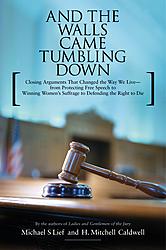
And the Walls Came Tumbling Down

[BOOK]

And the Walls Came Tumbling Down tells the stories -- with extensive quotations from the trial transcripts -- of a selection of famous cases (the subtitle promises "closing arguments that changed the way we live, from protecting free speech to winning women's suffrage to defending the right to die").

Did the Schiavo controversy get you interested in right-to-die issues? See the account of Karen Ann Quinlan's case. There's much more -- from the Amistad to Flynt v. Falwell. The catalog record and the publisher's description list the contents. Posted by Hello

Categories: , ,

Monday, April 18, 2005

ABA Law Student Division launches arbitration competition

Opening statements, witness examinations, exhibit introductions, evidentiary presentations, summations -- hey, they aren't just for jury trials! Show off your skills in the new Arbitration Competition, sponsored by the ABA Law Student Division and the National Arbitration Forum. This year, there will be no regional competitions -- instead, the first twenty teams to register will go to the national finals (Nov. 18-20, 2005, William Mitchell College of Law).

Filed in: , , ,

ABA Journal article on database discovery

The April issue of the ABA Journal has an article about the challenges of e-discovery: Jason Krause,The Paperless Chase: Litigators and Courts Wrestle with Database Discovery.

Filed in: ,

Using credit reports in litigation

The April ABA Journalreports on the use of credit reports in litigation -- and potential pitfalls. Steve Seidenberg, Reporting Errors: Lawyers Need to Consult Federal Law Before Ordering Credit Reports for Litigation.

Filed in:

Section of Litigation Annual Conference 2005

The ABA Section of Litigation Annual Conference 2005 is in New York this week (April 20-23). If you're in school in Seattle, you're not likely to drop by the meetings, but you might be curious about what the hot topics are. Take a look at the registration brochure.

Filed in: ,

ABA Presidential Task Force on the Attorney Client Privilege

In October, the ABA created a Presidential Task Force on the Attorney-Client Privilege. The Task Foce will

examine the purposes behind the privilege and its exceptions, the circumstances in which competing objectives are currently being asserted by governmental agencies and others to override the privilege, and the extent to which the correct balance is being struck between these competing objectives and the important policies underlying the privilege.
Why now? The Task Force's mission statement notes:
Among recent actions of the federal government affecting the privilege . . . are the U.S. Sentencing Commission's proposed amendments to the federal sentencing guidelines for corporations and other entities. These amendments include as a new factor in determining whether the entity has fully cooperated, and hence is entitled to leniency, whether the entity and its employees waive attorney–client privilege and work product protections. In addition, the U.S. Justice Department and the Securities and Exchange Commission, as well as other federal agencies, have also recently adopted policies requiring waiver of the privilege as a condition for cooperation. Moreover, while some federal agencies have entered into confidentiality agreements with the parties providing the agencies with privileged information, their effectiveness in protecting that information from further disclosure is in doubt.
The Task Force held a public hearing in Salt Lake City in February. A second hearing will be held in New York City this week (April 21).

Filed in: , , ,

Friday, April 15, 2005

KCBA Drug Policy Report

The Report of the Treatment Policy and Funding Task Force to the King County Bar Association Board of Trustees, released last week, recommends reforms to increase effective substance abuse treatment, reducing the detention, prosecution, and incarceration of people with substance abuse problems.

Filed in: ,

Bills before the Governor

Several Washington bills that are of interest to trial lawyers have passed both the House and the Senate. If the Governor signs them, they will become law. They include:

criminal trials, dependent adult witnesses

  • HB 2126, providing accommodations to dependent persons who are victims and witnesses.

legal services, court system
  • HB 1542, providing indigent defense services.

  • HB 1747, administering state-funded civil representation of indigent persons.

  • SB 5454, revising trial court funding provisions.

arbitration and mediation
  • HB 1054, enacting the revised Uniform Arbitration Act.

  • SB 5173, enacting the Uniform Mediation Act.

  • SB 5733, concerning mandatory arbitration (two more counties will be required to have it; in counties that have it, it will apply at a lower dollar threshold).

health care
  • HB 1291, "improving health care professional and health care facility patient safety practices."

  • SB 5065, requiring notice of potential injuries resulting from health care.
Filed in: , , , , ,

Congress passes bankruptcy reform legislation

The House of Representatives yesterday passed S.256, the Bankrupcy Abuse Prevention and Consumer Protection Act of 2005 (which had passed the Senate last month). It is now before the President for his signature. Judiciary Committee press release.

Filed in: ,

Tort Reform: An Overview of State Legislative Efforts to Improve the Legal System

Here's an overview of tort reform issues from the insurance industry perspective: Tort Reform: An Overview of State Legislative Efforts to Improve the Legal System (July 2004), a report by the National Association of Mutual Insurance Companies.

Filed in: , ,

Thursday, April 14, 2005

Access to Justice Conference

The 2005 Access to Justice Conference will be at the Bellevue DoubleTree Hotel June 3-5. Regular registration is $130; law student registration is $85.

Filed in: ,

Eliot Spitzer coming to Seattle

New York Attorney General Eliot Spitzer will be the keynote speaker at WSTLA's Law Day Dinner on May 2. (Sorry, students -- I don't see any discounted rate for you.)

Filed in: , ,

Division One visits UW -- three cases on trial practice issues

Division One of the Washington Court of Appeals will hold a session at the UW School of Law on Thursday, April 21 -- William H. Gates Hall, Room 133, about 9:30-11:30. The oral arguments will obviously interest students of appellate advocacy, but note that three of the cases are about trial practice issues.

Here are case summaries from Career Services, which is hosting the visit (I've highlighted the trial practice issues):

Olea v. Swedish Medical Center 528459: Raises issues developed during a trial on a personal injury matter, including: the correct number of peremptory challenges; the failure to provide curative instructions; discovery/production issues and prejudice; jury instructions; and the showing of an allegedly graphic video to the jury.

Washington v. Johnson 510053: Raises issues challenging a criminal defendant's decision to represent himself despite evidence before the trial court that the defendant may have been incompetent.

Washington v. Leonard 536699: Challenges jury instructions on elements required for second degree assault conviction. Contends the evidence was insufficient to convict defendant of "assault with intent to commit burglary." Argues that convictions for second degree assault and first degree burglary violate double jeopardy principles.

Kleiner v. Sears Roebuck & Co. 541391: Raises issue whether the store is liable for acts of security personnel who are chasing a suspect accused of stealing from the store. (Security guards got into appellant's vehicle in the parking lot while chasing a suspect and asked him to follow the suspect's car. During the chase, the suspect hit appellant's car and injured him.)

Larkin v. City of Medina 547640: A challenge to the city's decision to grant a property owner a "historical use permit" to tear down an allegedly historical building in order to build a coffee shop and laundry.

Full briefing is available to UW students in .pdf (electronic) form from the Career Services Center. Please email pservice@u.washington.edu if you want a copies of a certain case's briefs emailed to you. Please use the docket # to request.

Categories: , , ,

Wednesday, April 13, 2005

The Verdict on Juries (ABA Journal article)

What should be changed about the jury system? How should juror pools be created? What sort of pay should jurors receive? Should jurors be able to ask questions? Terry Carter, The Verdict on Juries, ABA J., April 2005, highlights some of the innovations being considered, including principles adopted by the ABA in February. (See earlier post.)

April 2006: The link to the article no longer works. The ABA Journal is available on LexisNexis, on Westlaw, and in print.

Categories: ,

South Carolina Trial Law Blog: Great Motion in Limine and a New Blog from Mark Zamora

David Swanner (South Carolina Trial Law Blog) recommends another blogging lawyer's advice on motions in limine (sample motion included).South Carolina Trial Law Blog: Great Motion in Limine and a New Blog from Mark Zamora.

Categories: , , , ,

How to Be a Better Trial Attorney

Here are 8 tips for younger lawyers on How to Be a Better Trial Attorney from the South Carolina Trial Law Blog.

Law Dawg Blawg offers a 9th tip (in the post that led me to the original list).

Categories: , , ,

Monday, April 11, 2005

Uniform Mediation Act

SB 5173, enacting the Uniform Mediation Act, has passed the legislature, with broad support (the votes were 47-1 in the Senate and 95-0 in the House).

Categories: ,

Proposal to exclude all apologies as evidence

Several states have laws allowing a doctor to apologize without having the apology become evidence in a med mal case. Now a blogger (who is an executive of a medical device company) proposes that the rule be broader -- excluding any apology, not just those from doctors. TigerHawk -- "Tort reform and civility; toward a national 'apology privilege.'"

Meanwhile, Washington's bill to establish an apology privilege for health care providers is still alive in the legislature. HB 1291 has passed the House and gone through committee in the Senate.

Categories: , , ,

A Suit That Makes More Cents for the Lawyers

An L.A. Times reporter noticed a dogeared check in his son's car trunk. Why did he have a check for 49 cents? He was a member of a class in case against Bank of America concerning certain credit card fees and billing practices. In "A Suit That Makes More Cents for the Lawyers" the reporter tries to track down more information about the case.

Categories: ,

Sunday, April 10, 2005

Cross-examination: Science and Techniques

The library recently acquired Cross-examination: Science and Techniques (2d ed. 2004). It's in the Reference Area, at KF8920 .P68 2004. Click here to see the publisher's description.

Categories: ,

New edition of Modern Trial Advocacy

The library has recently received the third edition (2004) of Steven Lubet's Modern Trial Advocacy: Analysis and Practice, published by NITA. NITA's description of the book includes links to the preface and table of contents. This edition includes a new chapter, "Electronic Visuals," by Edward R. Stein. The call number is KF8915 .L82 2004 at Classified Stacks.

Categories: , ,

Thursday, April 7, 2005

An A-List Turnout Does Cochran Justice

Johnnie Cochran's funeral provided an occasion for tributes and reflections on his career. The L.A. Times website includes video clips of eulogies. An A-List Turnout Does Cochran Justice.

Categories: ,

Brame suit drops county as defendant but keeps city - News Tribune

In a settlement with the family of Crystal Brame (the woman who was killed by her husband, the Tacoma Police Chief), Pierce County will add domestic violence investigators to the Family Justice Center and offer training to law enforcement personnel around the county. The family's lawsuit against the City of Tacoma did not settle. Brame suit drops county as defendant but keeps city TheNewsTribune.com.

Categories: , , ,

Candy magnate championed civil rights - News Tribune

A brief salute to a leader who was not a trial lawyer: Fred Haley, the former president and CEO of Brown & Haley, died this week. In addition to bringing Almond Roca to the world, he was an outspoken advocate of civil rights. As a school board member he fought for desegregation and stood up for a counselor who was accused of being a communist. The ACLU of Washington gave him its William O. Douglas Award in 1985. Candy magnate championed civil rights TheNewsTribune.com Tacoma, WA.

Categories: , , ,

The Seattle Times: Man representing himself in court admits he's guilty of poor judgment

The Seattle Times: Man representing himself in court admits he's guilty of poor judgment. A Massachusetts man is appealing his conviction, arguing that the trial court should not have allowed him to appear pro se. On appeal, his new, court-appointed counsel, argues that the judge should have questioned his competence to waive counsel.

Categories: , , ,

Revised Uniform Arbitration Act passed by legislature

S 1054, the Revised Uniform Arbitration Act, passed the House unanimously on Feb. 28 and passed the Senate unanimously on Tuesday. On to the Governor's desk!

Categories: ,

Tuesday, April 5, 2005

President's Proposed Remedy to Curb Medical Malpractice Lawsuits Stalls (washingtonpost.com)

The Washington Post reports on President Bush's efforts to reduce "junk lawsuits": President's Proposed Remedy to Curb Medical Malpractice Lawsuits Stalls (washingtonpost.com).

Categories: , , , ,

Law Students Prevail Again in High Court

In a small departure from coverage of trial advocacy, I'm highlighting a story about appellate advocacy -- specifically students in Stanford's Supreme Court Litigation Clinic, who won TWO Supreme Court cases this week: Law Students Prevail Again in High Court. Heck of a record!

Categories: , ,

SecurityFocus -- Web Browser Forensics, Part 1

SecurityFocus, a site about computer security issues, has an article describing how a security specialist can investigate how a web browser was used. The article outlines a hypothetical investigation -- a law firm's system administrator, Joe Schmoe, was found to have huge files of pirated software and movies loaded on the firm's documents management system. Did he do it? How can it be traced?

SecurityFocus HOME Infocus: Web Browser Forensics, Part 1

Categories: , ,

Bill re trial court funding

SB 5454 would revise the funding system for trial courts in the state, increasing the portion that is paid by the state. (I read in the Senate bill report that Washington ranks 50th in state funding for trial courts. Because of local funding, our trial courts are not the worst funded in the country altogether, but still the statistic is startling.) The bill passed the Senate on March 14 (45-3) and is now in the House, where two committees (Judiciary and Appropriations) have recommended passage. Bill Information for SB 5454.

Categories: ,

Monday, April 4, 2005

Electronic Discovery Resources | DiscoveryResources.org

Billing itself as "Your E-Discovery Destination Site," Discovery Resources.org offers some original content and some content from other sources about e-discovery.

Original content includes:


Articles from other sources include:

From my look at the site I couldn't tell the "organization" behind the ".org." The primary sponsor of the site is "Fios, a tier-one electronic discovery services provider for corporations and their law firms."

Categories: ,

Email subscriptions

The email subscriptions sent by Bloglet stopped working for a time. I'm not quite sure why they did, but I went through Bloglet's troubleshooting steps and I think they should work again. If you're an email subscriber, you might want to take a look at the blog to see if you've missed a week or two. Sorry about that. Technical difficulties and all.

Categories:

Saturday, April 2, 2005

Taking the Stand: Role Reversal: One Attorney's Tempestuous Voyage as a Client

Michael A. Caglioti was a partner at a large DC law firm. He also had a neuromuscular condition that required him to use a wheelchair. One day his motorized wheelchair malfunctioned and dumped him into a busy street. He had two broken legs and many serious complications from his treatment in the hospital.

Thus, a lawyer became a client. In an essay about his experience, he describes the disappointing performance of the first two personal injury lawyers he hired. A third was successful in a lawsuit against the wheelchair manufacturer. Taking the Stand: Role Reversal: One Attorney's Tempestuous Voyage as a Client, Washington Lawyer, Jan. 2005.

Categories: , ,

Friday, April 1, 2005

Trial practice lessons from poker


Trial practice lessons from poker Posted by Hello

An article in the March ABA Journal discusses lessons that lawyers can learn from poker, including how to read people's reactions (at the card table or in the jury box) and how to negotiate without showing your cards (literally, in the case of poker, or figuratively, in most other cases). Pete Hume, Courtroom Card Sharks, ABA J., March 2005. [April 2006: the link to the article on the ABA's website no longer works. Remember that the ABA Journal is available in print, on Westlaw, and on LexisNexis.]

Photo is of Ben Newmark, of the state's attorney's office, from the Chicago Daily News, 1921, available from the Library of Congress's American Memory project.

Categories: , ,

E-discovery (ABA Journal article)

Perhaps nothing of recent vintage has changed pretrial procedures more than the process of requesting, producing and sorting electronic records for litigation. Whole new types of data--from e-mail to database records to PalmPilot contact information--are now discoverable.
Jason Krause, Don't Try This at Home: Doing E-Discovery Is Best Left to Outside Experts, ABA J., March 2005. [April 2006: The article is no longer available free at this link. Remember that the ABA Journal is available on LexisNexis and Westlaw and in print.]

Categories: ,

Lawyers serving on juries (ABA Journal article)

In the April ABA Journal, Margaret Graham Tebo reports on lawyers (and law professors) serving on juries. Duty Calls: More Lawyers Are Taking Their Seats on Juries, Living the Trial Experience, Learning From It -- and Loving It. [April 2006: When an ABA Journal article is no longer available free on the ABA's website, remember that it's available in print and on LexisNexis and Westlaw.]

At least 40 states allow lawyers to serve on juries -- and now many do. Experiences vary, but many of the lawyers interviewed were impressed by the jurors they served with, who took their job seriously and carefully considered the evidence. (One, however, had fellow jurors who didn't pay much attention to the evidence and thought all they had to do was vote their gut feeling.)

Anyone who plans to present a case to a jury would do well to see things from the jurors' perspective. This article gives you a glimpse.

Categories: , ,

Change in focus of trial coverage

Today a coalition of major news organizations announced an initiative to abandon coverage of celebrity trials in order to offer more in-depth reporting of legal issues that affect ordinary Americans.

A spokesperson for CourtTV said, "One day we looked around and realized we had devoted precious resources to coverage of the Michael Jackson trial that we could have used to cover more important issues, such as the risks to victims of domestic violence who are unrepresented in their divorces." CourtTV's web page on the Michael Jackson case may not be developed further.

Larry King stated that he tired of the Scott Peterson trial shortly after it began but felt he had to keep interviewing participants to satisfy his producers. Now that Martha Stewart is out of prison, he welcomes the opportunity to interview consumer rights advocates about abuses by payday lenders, used car dealers, and debt collection agencies.

K. Rupert Murdoch, CEO of the News Corporation, assured investors that the change in emphasis was good business as well as responsible journalism. "We have conducted focus groups and learned that viewers will stay tuned much longer for serious analysis of important issues than for glimpses of celebrities and rehashing of scandals. We expect viewership to increase dramatically."