I visited the Washington State Legislature's page to scan for bills related to trial practice. There are some I'll be checking out, but first I thought I'd let you know about Senate Concurrent Resolution 8401, which would establish a state poet laureate, in recognition of "the value of poetry and the contribution Washington poets make to the culture of our state." The poet laureate will receive a salary of "one firkin of Washington beer per year donated by representatives of the Washington Brewers Guild." (A firkin is a small barrel.)
It's generally illegal to give away alcoholic beverages, but there's an exception for the Liquor Control Board (for purpose of negotiating the sale of liquor to the board), RCW 66.28.040, and the resolution says that the poet laureate would be a representative of the board for the purpose of receiving the firkin. I'm not quite sure it fits, but what the heck.
The proposed salary is in keeping with a part of our state's poetic tradition, as when "poets Theodore Roethke (1901-1963), Richard Hugo (1924-1982), Carolyn Kizer (b. 1925), Stanley Kunitz (1905-2006), and David Wagoner could often be found at the bar [of the Blue Moon Tavern], along with famous visitors such as Dylan Thomas (1914-1953) and Allen Ginsberg (1926-1997)." Walt Crowley, Blue Moon Tavern, An Unofficial Cultural Landmark, HistoryLink.org (1999). But I wonder if some potential poets laureate might prefer Washington wine or even something non-alcoholic, like a bushel of Washington apples, locally roasted coffee, or hand-crafted chocolates.
Sunday, January 14, 2007
Wash. to Have Poet Laureate?


Saturday, January 13, 2007
Unpatriotic to Represent Accused Terrorists?
Charles D. Stimson, the deputy assistant secretary of state for detainee affairs, riled lawyers and ethics experts by suggesting in an interview on Thursday that law firms shouldn't represent Guantanamo detainees -- and that clients should drop firms that do. Official Attacks Top Law Firms Over Detainees, New York Times, Jan. 13, 2007.
Monica Crowley, a syndicated talk show host, used a FOIA request to get a 14-page list of lawyers representing detainees. Mr. Stimson said it was "shocking" that the list included the country's "major law firms."
He said, "I think, quite honestly, when corporate C.E.O.'s see that those firms are representing the very terrorists who hit their bottom line back in 2001, those C.E.O.'s are going to make those law firms choose between representing terrorists or representing reputable firms, and I think that is going to have major play in the next few weeks. And we want to watch that play out."Others in the administration have distanced themselves from Mr. Stimson's comments.
Karen J. Mathis, a Denver lawyer who is president of the American Bar Association, said: "Lawyers represent people in criminal cases to fulfill a core American value: the treatment of all people equally before the law. To impugn those who are doing this critical work — and doing it on a volunteer basis — is deeply offensive to members of the legal profession, and we hope to all Americans."
In an interview on Friday, Attorney General Alberto R. Gonzales said he had no problem with the current system of representation. “Good lawyers representing the detainees is the best way to ensure that justice is done in these cases,” he said.The article said that Mr. Stimson was a lawyer (so you'd think he'd have picked up a little about the importance of representation in our adversary system). I was curious, so I looked up his background. He was appointed to his post a year ago, when he was 42. He went to law school at George Mason, and worked as a homicide prosecutor in Frederick County, MD, before becoming an assistant U.S. Attorney in DC. He was a Lieutenant Commander in the Navy JAG Corps. National Briefing Washington: Adviser On Detainees Is Named, N.Y. Times, Jan. 24, 2006, at A16.
With his background as a prosecutor, he really should have known that people accused of crimes, even horrible crimes, deserve to have good lawyers and that the lawyers who represent even guilty people are doing a good thing, not something treasonous.
Update (Jan. 14): See Carolyn Elefant's post and readers' comments at Legal Blog Watch: Should Law Firm Clients Control Law Firms' Pro Bono Work?, Jan. 12, 2007. And for much more -- news sources and over 100 comments, go to the Volokh Conspiracy.

NC AG Takes Case
Michael Nifong, the DA in Durham, NC, who has been charged with ethics violations because of his handling of the sexual assault case against three former lacrosse players from Duke, stepped down from the case yesterday. The state's attorney general, Roy Cooper, today announced that his office would take it over, giving it "careful review." Attorney General in N.C. Agrees to Take Duke Case - New York Times, N.Y. Times, Jan. 13, 2008.
Thursday, January 11, 2007
3 Strikes Book
New in the library: Unjust Sentencing and the California Three Strikes Law, by Douglas W. Kieso (KFC1172 .K54 2005 at Classified Stacks). The publisher's page about the book is here.
Wednesday, January 10, 2007
Public Citizen Med Mal Study
Public Citizen today released a study showing that medical malpractice litigation is not the cause of the health care "crisis."
Despite claims by business and medical lobbying interests and the Bush administration, there is no medical malpractice lawsuit crisis in America, according to analysis released today by Public Citizen. The new report, “The Great Medical Malpractice Hoax,” dispels oft-repeated myths of dwindling doctors and spiraling insurance premiums used to support limits on the ability of injured patients to seek redress in the courts.Press release, Jan. 10, 2007. The study was based on an analysis of medical malpractice awards from the federal National Practitioner Data Bank (NPDB), 1990-2005.
The real problems are a lack of attention to patient safety, the high incidence of preventable medical error and the lack of accountability for a small set of doctors who account for a majority of medical malpractice payments, the report reveals. The report also presents several recommendations for Congress, state governments and hospitals to reduce health care costs and save lives.
The Great Medical Malpractice Hoax: NPDB Data Continue to Show Medical Liability System Produces Rational Outcomes (Jan. 2007) (25 pp.) is here.
Drum Major Institute and Its Blogs
I just came across the Drum Major Institute, which has some policy papers on legal issues (immigration, tort system, etc.).
The Drum Major Institute for Public Policy is a non-partisan, non-profit organization dedicated to challenging the tired orthodoxies of both the right and the left. The goal: progressive public policy for social and economic fairness. DMI's approach is unwavering: We do not issue reports to see our name in print or hold forums for the sake of mere talk. We seek to change policy by conducting research into overlooked, but important social and economic issues, by leveraging our strategic relationships to engage policymakers and opinion leaders in our work, and by offering platforms to amplify the ideas of those who are working for social and economic fairness.The DMI Blog , subtitled "Politics, Policy, and the American Dream," is about politics and policy broadly.
Tort Deform: The Civil Justice Defense Blog "confronts and transcends the arguments put forth by the tort 'reform' movement, working to ensure that all Americans can access the courts." It includes commentary from many authors. (Several whose biographies I clicked on are connected with Public Citizen.)
Tuesday, January 9, 2007
Tons of Tips for New Lawyers!
Los Angeles Lawyer and the Los Angeles County Bar Association Barristers put out a special issue of Los Angeles Lawyer in the fall to welcome new bar members. Called "Survival Guide for New Attorneys in California," it is full of great, practical information and advice. Here's the Fall 2006 table of contents:
- Practice Basics
- Be a Dog, Patric M. Verrone
- Building a Good Mentoring Relationship, Michael A. Geibelson
- Seven Myths of California Legal Ethics, John W. Amberg
- Sharpening Your Legal Writing Skills, Scott Wood Getting the Most out of Support Staff, David A. Schnider
- Building a Profitable Practice with an LRIS, Sheldon J. Warren
- Establishing Your Own Practice, Laine T. Wagenseller
- The Importance of Professional Liability Insurance, Thomas L. Browne and Thomas P. Sukowicz
- The Benefits of a Tax Controversy Practice, Jennifer Kowal
- Yes, You Can Take a Vacation...and Should, R. J. Comer
- Case Strategies
- Demystifying Filing, Debora Sanfelippo
- Answers about Answering a Complaint, Lauren Sudar
- Practice That Takes You out of State, Hassan A. Allen
- Discovery Sanctions in Federal and State Court, Casey L. Morris and Kevin A. Shaw
- Corporate Depositions in State and Federal Court, Jerry Abeles
- Preparing a Witness for a Deposition, Robert C. O'Brien
- Defending Depositions, Valerie D. Rojas
- How to Succeed with Expert Witnesses, David Nolte
- The Dangers of the "Usual Stipulation" in Deposition Practice, Steven D. Archer
- Consolidation, Coordination, and MDL, Malini Nangia
- Preparing for Contractual Arbitration, Judge Lawrence C. Waddington (Ret.)
- Fact and Fiction of Structured Settlements, James J. Brady
- At Trial
- Choosing Venue in California Courts, Mark E. Millard
- Understanding Federal Civil Tax Controversies, Sharyn M. Fisk
- What to Expect When You Go to Court, Nancy A. Kaiser
- Practicing in Federal Court, Judge Margaret M. Morrow
- Pet Peeves from the Bench and Your Peers, Judge Anthony J. Mohr
- The Art of Direct Examination, Michael D. Schwartz and Phillip R. Maltin
- Preserving Issues for Appeal, Benjamin G. Shatz
- Preparing a Case
- Assuming Ownership of Your Cases, David A. Schnider
- Choosing Venue in California Courts, Mark E. Millard
- Consolidation, Coordination, and MDL, Malini Nangia
- How to Succeed with Expert Witnesses, David Nolte
- Avoiding the Worst Mistakes of Deponents, Carole Lieberman
- The Dangers of the "Usual Stipulation" in Deposition Practice, Steven D. Archer
- The Latest in Discovery Technology, Marsha J. Naegeli and Troy S. Moody
- Court-Ordered Arbitration, Karen Smith
- Appeals and Writs, Wendy Marantz Levine
- At the Courthouse
- Walking through the Los Angeles Superior Court, Judge Aurelio Muñoz
- Pet Peeves from the Bench, Judge Victoria Gerrard Chaney
- What to Expect When You Go to Court, Nancy A. Kaiser
- Practicing in Federal Court, Judge Margaret M. Morrow
- Developing Court Calendaring Skills, Joseph C. Scott
- Maintaining Successful Relationships with Courtroom Staff, Maria Perez
- Preserving Issues for Appeal, Benjamin G. Shatz
KCBA Trial Practice CLE
The King County Bar Association has an interesting CLE coming up: 7 Keys to Winning Performance in the Courtroom.
Friday, February 2, 2007Lish Whitson is a Trial Ad instructor.
Rainier Square Conference Center, 1301 Fifth Avenue, 3rd Floor Atrium, Seattle, Washington
Registration 8:30am - 9:00am
Seminar 9:00am - 4:30pm
Keynote Presenters:
Nathan Goldberg, Allred Maroko & Goldberg
Lish Whitson, Lish Whitson Law Offices
In an age of “New Media,” where everything is highly visual and fast paced – where our eyes, more that our ears govern our decisions, where attention spans are short, where many external pressures and influences create distraction – this program addresses the changing nature of today’s juries and the jury process.
This fresh, new seminar will offer incredibly useful insights into achieving more consistent and reliable results through the use of new presentation strategies and methodologies. You will enjoy a better understanding of information architecture in the litigation process. And you will leave with tools and techniques proven to engage the jury and keep them engaged throughout trial.
Program Chair: R. Craig Smith, Lead Trial Consultant, Trial Design Group, Seattle
UW Law Students NOTE: There are two free registrations for you - first come, first served. Email Denise Medlock, CLE Manager, KCBA, DeniseM @kcba.org. Thanks to KCBA for this contribution to law students' education!
Monday, January 8, 2007
Japan Trying Juries
An op ed piece -- Robert Precht, Japan, the Jury, N.Y. Times, Dec. 1, 2006 -- discusses Japan's reintroduction of the jury system. (It had American-style juries for 15 years, up to 1943.) Here's the article in the International Herald Tribune, which doesn't require you to log in.
Mr. Precht is the codirector of the Japanese Juries and Democracy Program of the Maureen & Mike Mansfield Center at the University of Montana.
Thanks: Ethan Leib at PrawfsBlawg. Prof. Leib says that he is looking at world jury systems to explore different decision systems (majority vs. supermajority, for instance).
Sunday, January 7, 2007
Winter Fun Is Going Downhill
If the lawyers had their way, Charles Foster Kane might never have uttered the word "Rosebud." That is the implication of news from Nebraska, reported by Walter Olson at PointofLaw.com. In the wake of a Nebraska Supreme Court decision that municipalities can be held liable for users' injuries in public recreation areas, towns in the state are closing or restricting skate parks and sledding areas.Robert J. Ambrogi, Sledding's Slippery Slope, Law.com Inside Opinions, Dec. 22, 2006.
This would mess up not just the plot of "Citizen Kane," but also that of "It's a Wonderful Life." On the other hand, there must be more to the story. Some sledding areas might indeed be horribly dangerous. (If George Bailey hadn't been there, his younger brother would have died, after all, and then wouldn't have been able to be a war hero!)
Coast to Coast
Coast to Coast is a regular podcast, hosted by J. Craig Williams and Robert Ambrogi, interviewing lawyers on a variety of topics. This morning while I was watching our dog cavort at the off-leash park, I listened to their program from Jan. 4 in which they and two guests (Carolyn Elefant and Stephen L. Kaplan) reviewed predictions they'd made for 2006 and looked ahead for 2007.
Much of their discussion was about the economy and politics -- oil prices, the war in Iraq, the new Congress, presidential candidates. In technology, will Microsoft bring out a new operating system and Office suite for small and medium customers (in addition to Vista for the big outfits)? Will Apple bring out an iPhone? And, speaking of Apple, will Steve Jobs be indicted for Apple's backdating stock options?
I was interested in Carolyn Elefant's prediction that the recent spate of big firm mergers might lead to more work for small and medium firms, as the big firms are conflicted out of representing some clients.
What do you think the new year will bring?
Seattle Profiles Innocence Project, Names Top Lawyers
This month's issue of Seattle Magazine has a long profile of the UW's Innocence Project Northwest. Todd Matthews, Finding Innocence, Seattle, Jan. 2007, at 90-95. (Sorry, the article isn't online, so you'll have to watch for a copy in print.) The article features the case of Ted Bradford, who was exonerated of rape by DNA technology that was not available at the time of his original trial. (See post.) Mr. Bradford was represented by project director Jackie McMurtrie and attorney (and Trial Ad instructor) Felix Luna who was working pro bono, as well as by Matt Ficcaglia and Theresa Connor (both UW '06). The article is about more than that one case. It tells how Prof. McMurtrie came to found the project -- something I hadn't known, even though I was working here at the time. And it describes how the issue of wrongful convictions inspired Kelly Canary, now a 3L, to finish college and apply to law school.
In Seattle's list of 155 top lawyers in town, I spotted several Trial Ad instructors and other UW faculty:
- Lourdes Fuentes (Immigration Law), who recently left private practice and is the new director of the UW's Immigration Law Clinic.
- Tom Hillier (Public Defender), Trial Ad Instructor. (He gets a full-page picture and a profile, pp. 82-83.)
- Todd Maybrown(Criminal Defense), Trial Ad Instructor.
- Jeffery Robinson (Criminal Defense), Trial Ad Instructor.
- Hugh D. Spitzer (Constitutional Law), who teaches Washington Constitutional Law, Local Government Law, and Roman Law.
Friday, January 5, 2007
Animators at Law Study of Communication Style
Animators at Law, a company that creates animations and graphics for trials, has released the results of a study of communication styles. Press release: Animators at Law Releases 3-Year Study Revealing That Attorneys and the General Public (e.g., Juries) Learn and Communicate Very Differently, Jan. 2, 2007.
Animators at Law, a consulting firm that helps litigators maximize the effectiveness of their communications with judges and juries, releases a first-of-its-kind study today. The study has wide-ranging implications for the legal profession and for those who interact with it. Using a survey designed by communication and learning experts, 387 attorneys and 1657 non-attorneys were surveyed over a three year period to determine how they fit into one of three learning/ communication styles: visual (seeing/showing), auditory (hearing/ speaking) or kinesthetic (feeling).I wrote to Kenneth Lopez, the CEO of Animators at Law and the person who sent me the press release, and I asked him more about the study. They are still working on the narrative that will give greater detail about methodology. So far, the study strikes me as suggestive, but not rigorous: the survey instrument was a quiz they offer on their website, and the sample of lawyers and nonlawyers studied was drawn from visitors to the website. Still, it's interesting to think about the general theme. And this suggests more research to undertake.
Results of the study show a marked difference between how attorneys and non-attorneys prefer to communicate. For example, only 18% of the non-attorney population learns best by hearing information, as compared to nearly 29% of attorneys. Further, 61% of the general population prefers to learn from visual information, while fewer than half of attorneys prefer to communicate with visual information. Since people tend to communicate the same way they learn, the everyday implications for the courtroom are especially significant.
It makes perfect sense that attorneys would have different communication styles and preferences from others. A professional ice skater should be very good at kinesthetic learning and probably doesn't need to be able to absorb, say, an appellate brief. Someone who is very good at spatial reasoning might choose to become an architect or a dentist and not a lawyer. And so on.
I suspect that the fuller report will give more information about overlapping preferences. Any one person can use any or all communication styles. For instance, if I want to learn a new dance step, I'll prefer kinesthetic learning, supported by the visual learning of watching the instructor (but don't bother showing me dance step diagrams!) If I want to learn the locations of a few landmarks in Manhattan, I'd like a map (supported by the kinesthetic learning of walking from, say, Penn Station to the New York Public Library, so I have a "foot" sense of how far it is). If I want to learn about today's news, I like to listen to NPR or skim headlines in a newspaper. So my preferences vary depending on task and context.
(I'm never sure where reading falls. Does it count as visual, because I'm using my eyes? Or is it auditory, because I sometimes have a voice in my head? It certainly doesn't have a lot of pictures and graphics -- at least, not most of my reading.)(Another question: if so many people are visual communicators, why won't anyone play Pictionary with me?)
I suspect a lot of jurors have a range of preferences as well. When they want to find out the latest about the bum that cousin Eileen is dating, maybe they'd prefer a nice hour of gossip (auditory learning). If they want to put together a bookcase from Ikea, good diagrams are great (visual learning). And if they want to learn how to knit, they'll do best if they try it themselves and feel the yarn and the needles in their hands (kinesthetic learning).
A lot of ordinary people spend a lot of time engaged in auditory communication. Just look at them! They're talking on the bus, they're talking on cell phones when they're walking their dogs (even when they're driving), they're talking at bars, they're talking during movies, they're talking, talking, talking. Of course, a lot of this talking is not about learning. Instead it's about establishing and renegotiating relationships, connecting emotionally, transacting business, flirting, making jokes, and more.
So when we think about communicating in trials, it probably pays to think about what we're doing. If you want the jurors to learn something (e.g., to learn that it's very, very likely that this DNA from the crime scene was the defendant's), then you might use one approach (animation, perhaps). But if you want the jurors to feel something (e.g., to feel that you are a trustworthy advocate, that your client is a likable, honest guy, that your client's doctor is an arrogant jerk), then you might use another approach (auditory, perhaps, because people connect emotionally via language).
Within any one style, there are undoubtedly substyles. One visual learner might do well with graphs and charts, while another, non-quantitative, visual learner prefers something else. Within auditory communication, there are important differences between lawyers and many other people. Lawyers cut their teeth on 1600-page casebooks. They are much more comfortable with polysyllabic latinate words and complex sentence and paragraph structures. But all that is often not easy to understand (even for those of us who can handle it if we concentrate). So not only do lawyers need to learn not to communicate only by speaking, but some of them also may need to learn to speak more directly and clearly.
Animators at Law is an interesting company. Ken Lopez founded it in 1995 when he was fresh out of law school. Now its customer list includes many of the largest, most successful law firms in America. A selling point is that the owners and many of the employees are lawyers, so they understand evidence, trial strategy, and so on, as well as making the pictures look good. There are interesting profiles of Lopez and the company linked from the Press page.
Prosecutor and School Board Recall
Yesterday the King County Prosecutor's Office rejected a petition by the Committee to Stop All School Closures to have a recall vote for five members of the Seattle School Board. The person who filed has now refiled, fixing the procedural technicalities Maleng's letter outlined. Parent fixes, resubmits School Board recall papers, Seattle P-I, Jan. 5, 2007.
Now what's the prosecutor's role in a school board recall? Prosecutors prosecute, right? What's that got to do with the school board dispute?
The King County Prosecutor is also the county's lawyer, and handles a lot more than criminal prosecutions. The Criminal Division of the office is the largest; the other divisions are Fraud (a special class of crimes), Family Support, and Civil.
So, what's the recall procedure? Step 1:
Whenever any legal voter of [in this case, Seattle] * * * desires to demand the recall and discharge of any elective public officer of [Seattle], under the provisions of sections 33 and 34 of Article 1 of the Constitution, the voter shall prepare a typewritten charge, reciting that such officer, naming him or her and giving the title of the office, has committed an act or acts of malfeasance, or an act or acts of misfeasance while in office, or has violated the oath of office, or has been guilty of any two or more of the acts specified in the Constitution as grounds for recall. The charge shall state the act or acts complained of in concise language, give a detailed description including the approximate date, location, and nature of each act complained of, be signed by the person or persons making the charge, give their respective post office addresses, and be verified under oath that the person or persons believe the charge or charges to be true and have knowledge of the alleged facts upon which the stated grounds for recall are based.RCW 29A.56.110 (emphasis added). Step 2. The petition is filed with "the elections officer whose duty it is to receive and file a declaration of candidacy for the office" (RCW 29A.56.120) -- in this case, the King County REALS Division. Step 3. If the political jurisdiction is all within one county (the Seattle School District is), the the county prosecutor has 15 days to prepare a ballot synopsis of the charge and (a) send it to the person who filed the charge and (b) send it to the superior court and ask the court to approve it and determine the sufficience of the charges. RCW 29A.56.130. Step 4. The court gets 15 days to have a hearing and rule on whether the acts are sufficient for a recall and whether the ballot synopsis is OK. RCW 29A.56.140. Step 5 (optional). The decision about the sufficiency of the charges can be appealed to the Supreme Court. Id. Step 6. The court transmits the ballot synopsis to the person asking for the recall, the officer in the hotseat, and the county auditor. Id. Step 7. The recall sponsors go out and try to get signatures in the next 180 days. RCW 29A.56.150. If they get at least 35% of the total number of votes cast for all candidates for the office (school board), then they file the petitions with REALS. RCW 29A.56.180. More Steps. It goes on. The signatures have to be verified (by statistical sampling) and then there can be a special election. And so on.
In this case, the prosecutor rejected the petition at Step 1 because there was one petition for five school board members, it wasn't notarized, and the petitioner didn't give his address. See letter from Janine Joly, Senior Deputy Prosecuting Attorney. (Why didn't the prosecutor give the guy a break? A Supreme Court case says that the statutory requirements for recall petitions have to be interpreted strictly. In re Recall of Wasson, 149 Wn.2d 787, 792-93 (2003).) The petitioner went back to the drawing board and resubmitted.
Thursday, January 4, 2007
Spokane Diocese Close to Settlement
The Spokane Roman Catholic Diocese has agreed to pay $48 million to settle claims of sexual abuse by clergy, according to a press release from the Nevada bankruptcy judge who is serving as a mediator. The settlement still needs to be approved by the bankruptcy judge who is presiding over the case and then voted on by the creditors. Spokane Diocese agrees to pay at least $48 million to settle clergy abuse, Seattle Times, Jan. 4, 2007.
The press release is here (on the Spokesman Review's website). And the Spokesman Review's ongoing coverage is here.
Ressam's Letter to Judge Coughenour
In November, Ahmed Ressam (who was convicted of involvement in a plan to bomb LAX) sent a letter to district judge John Coughenour. Now the letter (in Arabic) and a translation have been made public. Millennium bomber changes story about friend. Mr. Ressam's attorney is Tom Hillier, of the Federal Public Defender's office (and the Trial Ad faculty). (Judge Coughenour is teaching Advanced Trial Advocacy this quarter too.)
Renewed call for tougher gun laws
Seattle Mayor Greg Nickels -- joined at a news conference by police chief Gil Kerlikowske and Special Agent Kelvin Crenshaw (the head of the local ATF office) -- is urging the legislature to enact tougher gun control laws this session. Renewed call for tougher gun laws, Seattle PI, Jan. 4, 2007.
Protesting Soldier's Pretrial Hearing
1st Lt. Ehren Watada refused to deploy to Iraq with his Stryker brigade from Fort Lewis. Now he faces a court-martial. Today his lawyer argued in a pretrial hearing that the Army should not be allowed to prosecute him for conduct unbecoming an officer because of remarks he made explaining his decision to journalists and a group at a veterans convention; the prosecution for "missing movement" should be enough. Even though he's in the Army, the lawyer argued, he still has a constitutional right to speak out. Lt. Watada is also requesting an evidentiary hearing on the legality of the war itself. Judge hears motions during officer's pretrial hearing, Seattle P-I, Jan. 4, 2007.
See also Anti-war camp gears up for Watada's trial, Seattle P-I, Jan. 4, 2007.
Plea in Tacoma School Shooting
Today in Pierce County Superior Court Douglas Chanthabouly, 18, was charged with shooting fellow student Samnang Kok at in a hallway of Foss High School (Tacoma) Wednesday morning. Teen charged in Tacoma, Wash., school shooting pleads not guilty, Seattle PI (AP), Jan. 4, 2007.
“I can’t tell you why,” he told investigators, according to court documents. “I don’t want it in the news.”Court documents give details of Foss High shooting, News Tribune, Jan. 4, 2007.
For full coverage, see the New Tribune, which has a special page about the incident.
The Seattle Times has the Information and the Affidavit of Probable Cause online.
Wednesday, January 3, 2007
Putting the Cat Back in the Bag

During discovery, when parties might hand over the equivalent of millions of pages, it's quite possible for a privileged document to be included unintentionally. If they send -- or receive privileged documents -- what should counsel do? Law Practice Today has an article -- Carl G. Roberts, The Attorney-Client Privilege and the Amended Federal Discovery Rules, Dec. 2006 -- that discusses the issue.
Fed. R. Civ. P. 26(b)(5)(B) provides:
If information is produced in discovery that is subject to a claim of privilege or of protection as trial-preparation material, the party making the claim may notify any party that received the information of the claim and the basis for it. After being notified, a party must promptly return, sequester, or destroy the specified information and any copies it has and may not use or disclose the information until the claim is resolved. A receiving party may promptly present the information to the court under seal for a determination of the claim. If the receiving party disclosed the information before being notified, it must take reasonable steps to retrieve it. The producing party must preserve the information until the claim is resolved.That is, if you mistakenly turn over privileged material, notify the other party. (Oops!) And if you're on the team that got it, you have to do your best to get it back, destroy it, or whatever. If you aren't sure of the disclosing side's claim, you can ask the court to look it over.
The article discusses different types of privilege (attorney-client privilege is distinct from attorney work-product privilege, for instance).
The article discusses proposed Rule 502 of the Federal Rules of Evidence, which was published for comment in August 2006. Materials are linked from here. Comments are due Feb. 15, 2007. The text of the proposed rule (in case you're dying to read it):
Rule 502. Attorney-Client Privilege and Work Product; Limitations on Waiver(c) is in brackets because the committee is seeking comments but hasn't taken a position yet.
(a) Scope of waiver. — In federal proceedings, the waiver by disclosure of an attorney-client privilege or work product protection extends to an undisclosed communication or information concerning the same subject matter only if that undisclosed communication or information ought in fairness to be considered with the disclosed communication or information.
(b) Inadvertent disclosure. — A disclosure of a communication or information covered by the attorney-client privilege or work product protection does not operate as a waiver in a state or federal proceeding if the disclosure is inadvertent and is made in connection with federal litigation or federal administrative proceedings — and if the holder of the privilege or work product protection took reasonable precautions to prevent disclosure and took reasonably prompt measures, once the holder knew or should have known of the disclosure, to rectify the error, including (if applicable) following the procedures in Fed. R. Civ. P. 26(b)(5)(B).
[( c ) Selective waiver. — In a federal or state proceeding, a disclosure of a communication or information covered by the attorney-client privilege or work product 22 protection — when made to a federal public office or agency in the exercise of its regulatory, investigative, or enforcement authority — does not operate as a waiver of the privilege or protection in favor of non-governmental persons or entities. The effect of disclosure to a state or local government agency, with respect to non-governmental persons or entities, is governed by applicable state law. Nothing in this rule limits or expands the authority of a government agency to disclose communications 30 or information to other government agencies or as otherwise authorized or required by law.]
(d) Controlling effect of court orders. — A federal court order that the attorney-client privilege or work product protection is not waived as a result of disclosure in connection with the litigation pending before the court governs all persons or entities in all state or federal proceedings, whether or not they were parties to the matter before the court, if the order incorporates the agreement of the parties before the court.
(e) Controlling effect of party agreements. — An agreement on the effect of disclosure of a communication or information covered by the attorney-client privilege or work product protection is binding on the parties to the agreement, but not on other parties unless the agreement is incorporated into a court order.
(f) Included privilege and protection. — As used in this rule:
(1) “attorney-client privilege” means the protection provided for confidential attorney-client communications, under applicable law; and
(2) “work product protection” means the protection for materials prepared in anticipation of litigation or for trial, under applicable law.
Kids are Different
A public defender in Washington writes about a very human interaction with a 14-year-old client that reminded her of why she loves working with juveniles. Check it out: Kids are Different, Injustice Anywhere . . ., Dec. 29, 2006.
Witness Interview is Picture of the Year
One of the Seattle Times's Pictures of the Year for 2006 is a photo of a witness being interviewed by a detective and a King County deputy prosecutor (and Trial Ad instructor) Scott O'Toole at the scene of a murder/arson. (Conner Schierman has been charged and has pleaded not guilty to the crimes.)
Tuesday, January 2, 2007
Other Washington Trial Practice Blogs
Evan Schaeffer at the Illinois Trial Practice Weblog listed Other Trial-Practice Weblogs for You to Consider, Jan. 2, 2007. One I hadn't come across before is just over the mountains: Washington Trial Law, by Robert Boggs, of Lyon, Weigand, & Gustafson, P.S., in Yakima.
Another blog I've mentioned here before is Electronic Discovery Law by K & L Gates (until last week the firm was Preston Gates & Ellis).
Other Washington State blogs on topics even tangentially related to trial practice:
- Arbitrary and Capricious (an interesting source of commentary about the legal system, criminal law, and public defense).
- Employment Advisory, by Rod Stephens.
- Environmental Law in Washington State, by Paul Hirsch.
- Maritime Injury Law Blog, by Beard Stacey Trueb & Jacobsen, LLP.
- Marler Clark's blogs related to food safety litigation.
- Privacy and Security Law Blog, by Davis, Wright, Tremaine LLP.
- Real Estate - Construction - Lien Law Blog, by Levy, Von Beck & Associates, P.S.
- Seattle Landlord-Tenant Attorney, by Scott Eller.
- WA State DUI Blog, by Cowan Smith Kirk Gaston Law Firm
- Washington State DUI Blog, by StOrmshadow and Logan Wayne.
- Washington Construction Law, by Davis Wright Tremaine LLP.
- Washington Personal Injury News (part of InjuryBoard.com, sponsored by a number of personal injury lawyers and firms).
- Office of the Attorney General News Releases (it's not really a blog, but you can get an RSS feed).
These blogs vary a lot in how much content they offer, how often they are updated, and the extent to which they appear to be online extensions of billboards or late-night TV ads.
Let me know if you know of other blogs covering trial-related topics in Washington State. And stick with Trial Ad Notes for a hearty and stimulating mix of state and national news and legal developments about trial practice and the legal system.
Monday, January 1, 2007
Roberts Wants Raises for Federal Judges
Chief Justice Roberts's year-end report on the federal courts to the issue of judicial salaries, which he says has "reached the level of a constitutional crisis." Chief justice calls for higher pay for judges, Seattle Times (reprinting Wash. Post story), Jan. 1, 2007.
Federal judges make from $165,200 (district court) to $212,100 (Chief Justice). That's a lot compared to any number of workers, but federal judges have slipped compared with, say law school deans -- and even first year associates at big firms. (Supreme Court clerks often get signing bonuses as big as their justices' salaries.)
The Chief Justice's report is here.
See SCOTUSBlog's post about the report -- and a comment from someone who says that terming the pay issue a "consitutional crisis" only demeans the problem and takes issues with many of Chief Justice Roberts's contentions. (The commenter is Dennis Bedard, whom Findlaw identifies as a Miami lawyer.)
Sealed Group Health Settlements
A couple of weeks ago, the Seattle Times ran a story about two medical malpractice cases against Group Health Cooperative and one OB/GYN there. The cases were settled and sealed with confidentiality agreements. What the state didn't know about doctor, malpractice suit, Seattle Times, Dec. 13, 2006. The Times emphasized the public interest in knowing about negligent health care providers. Even regulators -- the Department of Health -- didn't know about one multi-million dollar settlement when it disciplined the OB/GYN.
I missed this story (I happened to be out of town that week) until today when I went to Group Health's website (it's my own HMO) and saw Group Health's Response to the Seattle Times Article, Dec. 13, 2006. Group Health says that it did not request to have the cases sealed. In the Times story, the plaintiffs' attorney said she did wanted to share her files. Who does that leave? The doctor?
Sunday, December 31, 2006
Harder to Seal Records
Continuing its Your Courts, Their Secrets series, the Seattle Times reports that the series has made a difference. No cases have been sealed in King County Superior Court since the series began in March; hundreds of cases formerly sealed have been opened up. "It's a new day" as secrecy fades, Seattle Times, Dec. 31, 2006.
Although the Times was investigating state cases, the local federal court (W.D. Wash.) also tightened its rules, saying lawyers can no longer file pleadings under seal without the permission of a judge.
The article recounts the legal efforts to get cases unsealed, from trying to serve parties who are only vaguely identified to countering motions from those who wanted to keep cases under wraps. Three Davis Wright Tremaine lawyers (Marshall Nelson, Eric Stahl, and Lissa Shook) represented the Times in most of the cases.
An accompanying story discusses the UW's $3.2 million settlement of a medical-malpractice case brought against the UW Medical Center and the manufacturer of an insulin pump. UW finally tells what it paid to settle suit, Seattle Times, Dec. 31, 2006.
Hats off to the reporters who have done such impressive work on this series: Ken Armstrong, Justin Mayo and Steve Miletich.
Friday, December 29, 2006
Juror Locked in Bathroom: Tainted Verdict?
The New York Appellate Division upheld a conviction over a claim that the trial judge should have investigated whether a juror who locked herself in the bathroom for 75 minutes was emotionally fit to serve on the jury. Conviction Upheld Despite 'Emotionally Upset' Juror, N.Y.L.J. (law.com), Dec. 8, 2006.
NY Judge Says Drowsy Lawyer Provided Good Assistance
Lawyer Provided Excellent Defense Despite Sleeping During Trial, ays Federal Judge, N.Y.L.J. (law.com), Dec. 15, 2006.
Denying a new trial, the judge noted that the lawyers didn't doze much -- and it was mostly during some tedious, routine testimony about gambling machines and agent surveillance of an organization. The judge kept the courtroom cold (telling the jurors to bring sweaters) and made sure the lawyer was supplied with ice water. In the end, his client was found not guilty on more counts than any of his codefendants.
"Civil Justice Attorneys"
The Fulton County (Ga.) Daily Report has a small piece about a lawyer changing firms in Atlanta. What's out of the ordinary is that the firm's new business cards will identify the lawyers as "civil justice attorneys" instead of "trial lawyers," following ATLA's name change to the American Association for Justice. "Civil justice attorney better defines what we dol. Our goal is not to get to trial. It is to obtain full, fair and just compensation for injured people and their families." A Trial Lawyer by Any Other Name ..., Fulton County Daily Report (law.com), Dec. 29, 2006.
Although the American Trial Lawyers Association voted on the name change last summer (see earlier posts here, here, and here, it only made the change official this month (letter, Dec. 5).
N.J. Judge OKs $14.5M Settlement in Class Action Over Bad Jeep Brakes
N.J. Judge OKs $14.5M Settlement in Class Action Over Bad Jeep rakes, N.J.L.J. (law.com), Dec. 29, 2006.
A New Jersey judge has approved a $14.5 million settlement in a national class action alleging defective brakes on Jeep Grand Cherokees.
Superior Court Judge Jonathan Harris, in a ruling released on Tuesday, certified, for settlement purposes, a class consisting of those who bought or leased 1.2 million 1999 to 2004 Jeep Grand Cherokees.
Locked Up for Christmas
New York attorney Anthony Colleluori vents about the NYS Dept of Criminal Justice Services. His client was arrested on Dec. 23 for assault in the second degree. The case is weak and the client has a job and family -- but the judge COULD NOT set bail because there wasn't a rap sheet yet because the Dept of Criminal Justice Services had not processed the client's fingerprints. That Lawyer Dude: NYS Department of Criminal Justice Services Christmas Message To The Families Of Accused Felons: BAH HUMBUG, Dec. 24, 2006.
Gee, when I watch "Law and Order," it seems they "pull the sheet" almost immediately. Who knew that TV wasn't the same as real life?
Intimate partner violence declining in US: DOJ report
Intimate partner violence declining in US: DOJ report, Jurist - Paper Chase, Dec. 29, 2006.
Nonfatal domestic violence is down. And homicide by intimate partners is down -- especially for male victims. The Bureau of Justice Statistics publication is here. A press release (Dec. 28) summarizes the findings.
8th Cir. Rejects Sentence for Mom Who Aided Pedophile
The 8th Circuit rejects of district court's downward variance from the sentencing guidelines in a case with disturbing facts. Court Throws Out Light Sentence for Mom, Washington Post, Dec. 19, 2006.
A woman pleaded guilty to aggravated sexual abuse and conspiracy to commit sexual abuse: she had "rented" her 9-year-old daughter to a pedophile, for $20 a session, often holding the girl down while the man molested her. The district court sentenced her to 17 1/2 years in prison, the minimum under the federal sentencing guidelines. The 8th Circuit remanded for reconsideration in light of United States v. Booker, 543 U.S. 220 (2005). The district judge then sentenced her to 10 years, giving her leniency because of her history of mental health problems and substance abuse. The 8th Circuit found that the sentence was unreasonable because it did not properly take into account the seriousness of the offense. the "sentence quite simply is not proportional to the circumstances of the crimes and the persons involved." United States v. Kane, 06-1103 (8th Cir. Dec. 18, 2006).
See comments at Sentencing Law and Policy.
Cohen Reviews the Year
Washington Post columnist Andrew Cohen reviews the year's legal news, decrying abuses of civil liberties -- and widespread indifference to the abuses. The Legal Year in Review, Washington Post, Dec. 29, 2006.
Supreme Court Reverses 9th Cir. Button Case
The Supreme Court reversed a 9th Circuit case granting habeas relief to a defendant during whose trial spectators wore buttons with pictures of the victim. Carey v. Musladin, 05-785 (Dec. 11, 2006).
The Court found that it was error to grant habeas because the California court's decision was "contrary to" or "an unreasonable application of" "clearly established Federal law." 28 U.S.C. 2254(d)(1).
Jurist's summary is here.
Bush Issues Pardons, but to a Relative Few - New York Times
Bush Issues Pardons, but to a Relative Few, New York Times, Dec. 22, 2006.
For lots of information about presidential pardons -- law, procedure, scholarship, cases, etc. -- see Jurist's Presidental Pardons page.
Did Lacrosse DA Break Ethics Rules?
After months of investigation, the North Carolina State Bar yesterday brought ethics charges against Durham District Attorney Mike Nifong for his conduct in prosecuting members of the Duke lacrosse team for sexual assault in the case that made national headlines last March. Nifong broke rules, Bar alleges, News & Observer, Dec. 28, 2006. At this point, three men from the team are charged with first-degree kidnapping and first-degree sexual assault; rape charges have been dropped.
If the News & Observer site makes you register (and you don't want to bother), see Charge could kick Duke prosecutor off case, CNN, Dec. 29, 2006.
The Bar's complaint alleges that Nifong knew or should have known that his statements to the media "would have a substantial likelihood of materially prejudicing" a trial of the matter, in violation of Rule 3.6(a); that his statements had "a substantial likelihood of heightening public condemnation of the accused in violation of Rule 3.8(f)"; and that his conduct was "prejudicial to the administration of justice in violation of Rule 8.4(d)." pp. 15-16.
(North Carolina's Revised Rules of Professional Conduct are here and here. Like Washington's Rules of Professional Conduct, they're based on the ABA's Model Rules, so they're very similar.)
Thanks for the lead: Mary Hotchkiss.
Thursday, December 28, 2006
What Do YOU Think About Trial Ad Notes?????
Readers --
As always, I'd love to hear if you find this blog useful or interesting. If you have ideas for posts -- or would like to write a little something yourself -- please let me know (whisner @ u.washington.edu).
I'm going to need to switch over to a new version of Blogger pretty soon. An advantage: I should be able to label posts more easily. A disadvantage: I might not be able to carry over the tagging system I've had (with the pull-down menu where you can find posts on particular topics).
(1) Would it be better to have dozens of detailed labels or just a handful of broad categories?
Having broad categories would make for a cleaner, simpler layout.
Having many labels would let me continue to tag areas of law (criminal law, health care, bankruptcy, immigration, ethics) and individual names (Coughenour, McMurtrie, Robinson).
If broad, what broad categories would be helpful? I'm thinking of:
- Studies & Scholarship (would include empirical studies, government reports, statistics, law review articles)
- Tips
- News
- Legislation & Rules (would include federal and state statutes and court rules)
- Cases (would include appellate opinions) (should it also include news stories about trial-level cases?)
- UW (would include comments about events at the UW, Trial Ad faculty in the news, etc.)
- Resources (would include books, cool websites, etc.)
Would you like to see any sorting by jurisdiction (Washington State, Other States, Federal)?
(2) Would anyone miss the detailed tags I've had? (I haven't inserted any since Nov. 2. Not enough time.) Have you ever used them?
(3) Does anyone use the little search box in the upper left corner?
You can comment by clicking on "COMMENTS" at the end of this post. Or send me an email message (whisner @ u.washington.edu).
THANKS!
Parenting Plan Forms en Espanol
The Northwest Justice Project has posted a new translation on Washingtonlawhelp.org: Parenting Plans and Child Support for Dissolution Cases and Modifications of Dissolutions Cases / Planes de Crianza y Manutención de Menores para casos de Disolución (Divorcio) y Modificaciones de casos de Disolución. This is a big packet of forms and instructions -- 110 pages in all -- translated by a court-certified interpreter/translator.
Instructions in the packet are all in Spanish, and then the official court domestic relations forms has the Spanish translations inserted, line by line. A caution on the front of the packet reminds users that all the forms have to be filled out in English -- but having the line-by-line translations should make it so much easier for those whose primary language is Spanish.
Surely there are plenty of Spanish speakers who can function in English day to day but would have trouble with lines like "Unless an emergency exists, the parents shall use the designated process to resolve disputes relating to implementation of the plan, except those related to financial support." The translations should help them past these hard parts. (Of course, some native speakers of English might lack the literacy skills to handle the forms smoothly, but that's another issue.)
Having accessible forms for domestic relations is critical. In several jurisdictions studied, at least one divorcing party has no lawyer in 70-80% cases. (See post at Shlep.)
In Washington State (according to the 2000 census), there are over 321,000 people over 5 who speak Spanish at home. Over 155,000 of them speak English "less than well." Table.
Thanks for the lead: Michele Storms.
Wednesday, December 27, 2006
Can You Continue to Handle Case You've Put on the Big Screen?
The California Supreme Court is considering whether a prosecutor can stay on a murder case after serving as an adviser to a film about it. The Court of Appeals said that the prosecutor must be recused but the DA's office could continue. Calif. High Court Takes Up Recusals Over Film, Book, The Recorder (Law.com), Dec. 22, 2006.
The case being reviewed is Hollywood v. Superior Court, Cal. App. (2d Dist. Oct. 5, 2006). (The defendant is actually named Jesse James Hollywood.)
The movie, Alpha Dog, is due to be released Jan. 12. No matter who the prosecutor is, won't it have some effect on the defendant's trial to have a big movie depicting what's supposed to be his life. (The parents in the movie are Bruce Willis and Sharon Stone -- that's some star power!) At least the main character in the movie is named Johnny Truelove, not Jesse Hollywood. But still, isn't there a risk of tainting the jury pool? IMDb's plot outline is "A drama based on the life of Jesse James Hollywood, a drug dealer who became one of the youngest men ever to be on the FBI's most wanted list."
On its own motion, the California Supreme Court is reviewing a similar case -- a challenge to a prosecutor who wrote a crime novel about a date rape similar to the one the defendant is accused of. Haraguchi v. Superior Court, Cal. App. (2d Dist. Oct. 5, 2006). (Earlier post is here.)
Blog Sex Trial
A Senate aide wrote in her blog about her sex life. Although she meant her blog to be read only by a few friends, another blogger linked to it and it became something of a hit. She was fired. Her boyfriend sued her. Blog sex scandal trial could spank protagonists, Seattle Times, Dec. 27, 2006.
the Washingtonienne lawsuit has become a study into when to make a federal case out of something and when to just let it go away. It's a question lawyers wrestle with all the time.
Lanny Davis, the former special counsel to President Clinton who now advises companies during times of crisis, tells clients to decide whether they want justice or simply to set the record straight and get a message across.
"If you're looking for justice, the court system is the only thing you have," Davis said. "If you're looking to get the full story, good and bad, into one coherent narrative, the court system is perhaps the worst possible forum."
Not So Many Interlock Devices
When they get their licenses back, people with DUI convictions are required to have ignition interlock devices that will prevent their cars from starting if they've been drinking. But it appears that a lot of people ignore the requirement. About 28,000 drivers are covered, but only 4,400 of the devices have been installed. (The disparity is much larger than the number of drivers who quit driving after their DUIs.) DUI offenders ignore orders to add breath tester to cars, Seattle Times, Dec. 26, 2006.
The article discusses the state's lack of an enforcement mechanism. New Mexico, by contrast, has special enforcement units -- as many as six officers in one county.
Amy Freedheim, the senior deputy prosecutor who heads the felony DUI unit for King County, says that interlock violations are generally caught only when the offender is pulled over for something else.
"Some people blatantly disregard the order; some people say they can't afford them," she said. "You don't know if they're on the car unless they get caught."To keep in mind the reason for her work, Friedlander displays photos of people whose lives were taken by drunk drivers.
The law requiring ignition interlock devices is the Mary Johnsen Act, Laws of 1998, ch. 210 (amending RCW 46.20.720 and 46.61.5055). See also RCW 46.20.391(b) (requirement that applicant prove to Dept of Licensing that he or she has the interlock device).
Tuesday, December 26, 2006
Looking for Good Law Blogs?
Looking for good law-related blogs? Check out Blawg Review, which has weekly installments describing law blogs (blawgs). This week's offering is Blawg Review Awards 2006.
Congratulations to Shlep: the Self-Help Law ExPress, which was named Best Law Blog in the Public Interest. Shlep is the brainchild of David Giacalone, who keeps the posts flowing. (I'm on the Shlep team and contribute from time to time, but David posts more than the other teammates and I put together.)
Congratulations also to Evan Schaeffer, whose posts from I often mention, for being recognized for "a lifetime of achievement in blog years" for Evan Schaeffer's Legal Underground and Illinois Trial Practice Weblog. Evan also made it onto Dennis Kennedy's Blawggies list, with Illinois Trial Practice Weblog being named the Best Practice-Specific Legal Blog. Kennedy says:
Evan's blog is exceedingly well-written and loaded with practical tips and insights. I also enjoy Evan's occasional impassioned efforts to defend trial lawyers from the constant stream of criticism they get. I don't think he's been able to change many opinions, but I admire the effort. Evan's now written a book on deposition techniques, in no small part because of his work on this blog. If you are a trial lawyer, this blog is a must-read. If you have to hire a trial lawyer, this blog is a valuable read to help you understand the process and to evaluate what your lawyer is doing.
Saturday, December 23, 2006
Court halves Exxon Valdez damage award
Court halves Exxon Valdez damage award, Seattle Times, Dec. 23, 2006.
The case is In re the Exxon Valdez (Baker v. Exxon Mobil Corp.), No. 04-35182 (9th Cir. Dec. 22, 2006).
Marijuana Is Big Cash Crop
It's not directly about trial practice, but fyi... Analyst finds that pot rivals rivals apples as state's biggest cash crop, Seattle Times, Dec. 23, 2006.
Youth Courts
This morning's Seattle Times has a front-page story about a youth court in Lynnwood, where teenage volunteers service as judge, prosecutors, defense attorneys, and jury in proceedings to determine the sentences of other teens who have pleaded guilty to misdemeanors and infractions. Teen courts put youngsters at the mercy of their peers, Seattle Times, Dec. 23, 2006. One benefit: teenagers who are "tried" in these courts have a much lower recidivism rate than others.
Washington's youth courts are set up under RCW 13.40.580 - .640. They are "diversion units," not true "courts." A list of youth courts in Washington is here.
For information about youth courts nationally, see the Federal Youth Court Program. The site includes a 2002 study: Jeffrey A. Butts et al., The Impact of Teen Court on Young Offenders. According to a fact sheet, there are now over 1100 youth court programs in 49 states and the District of Columbia.
Friday, December 22, 2006
Polls: What Do Americans Think of Their Courts?
Information from recent polls by CNN and by the Annenberg Public Policy Center is in Polls: What Do Americans Think of Their Courts?, The Third Branch, Nov. 2006. The article links to the surveys.
Are federal judges too liberal, too conservative, or about right? The most common answer (41%) was "about right," with 20% saying "too conservative" and 34% saying "too liberal."
Federal Courts on TV?
Several proposals in Congress could open up federal court proceedings to television cameras. A report from the Congressional Research Service reviews the history of the issue, summarizes the proposals, and lists arguments for and against. Televising Supreme Court and Other Federal Court Proceedings: Legislation and Issues, updated Nov. 8, 2006.
Thanks: beSpacific.
Spanish Language Style Guide & Glossaries- Webcontent.gov - Guide to Managing U.S. Government Websites
Spanish Language Style Guide & Glossaries- Webcontent.gov - Guide to Managing U.S. Government Websites: "This new Spanish Style Guide is a resource for government employees, translators, and communications professionals who work with the government to improve the way we communicate with the public in Spanish. The guide contains information on grammar and style issues as well as glossaries to standardize the use of Spanish across government."
This resource might seem very tangential to trial advocacy, but consider that in the federal courts alone, there were nearly 200,000 "language-interpreting events" in Spanish last year. U.S. Courts press release, Nov. 14, 2006.
How Do You Prosecute Shell Corporations?
The Senate Committee on Homeland Security and Governmental Affairs held a hearing in November entitled Failure to Identify Company Owners Impedes Law Enforcement:
The Permanent Subcommittee on Investigations’ hearing will examine the issue of states routinely incorporating hundreds of thousands of new, non-publicly traded companies in the United States each year without obtaining the identity of the corporate owners, thereby impeding law enforcement investigations into persons misusing U.S. shell corporations for money laundering, tax evasion, terrorist financing, or other crimes. The hearing will feature the April 2006 Government Accountability Office (GAO) report prepared at the Subcommittee’s request, "Company Formations: Minimal Ownership Information Is Collected and Available."The GAO report is here.
Sealed Settlements Study
At the request of the Civil Rules Advisory Committee, researchers at the Federal Judicial Center did an empirical study of settlements that were sealed. Now one of the researchers writes about the project: Robert Timothy Reagan, The Hunt for Sealed Settlement Agreements, 81 Chi.-Kent L. Rev. 439-62 (2006).
He reports that sealed settlements are fairly uncommon: less than 1/2% of the cases resolved in the two-year period they sampled. They are most common in patent cases and least common in property cases.
He notes that, even when the settlement is sealed, the public is not necessarily deprived of all information about the case. Often the complaint and docket sheet were not sealed -- so one could find out what the plaintiff's allegations were. Most often, the only information that was sealed was the amount of settlement.
The whole study is Robert Timothy Reagan et al., Sealed Settlement Agreements in Federal District Court (Federal Judicial Center 2004). It includes an appendix summarizing local district court rules on the topic. An earlier report summarizes federal and state rules, as of 2003: Robert Timothy Reagan et al., Sealed Settlement Agreements in Federal District Court -- May 2003 Progress Report.
Drug Use Among Prisoners
Drug Use and Dependence, State and Federal Prisoners, 2004 (Oct. 2006, revised Nov. 29, 2006) is a special report from the Bureau of Justice Statistics.
About a quarter of offenders reported using a drug at the time of their offense, and about half had used within a month of their offense. Perhaps it's not surprising that drug and property offenders were more likely to be drug users than violent offenders.
Drug dependent or abusing inmates were more likely than other inmates top. 8. More prisoners participated in drug abuse programs in prison in 2004 than in 1997. In state prisons, it's around 40% for prisoners who reported using within a month of the offense AND for the prisoners who met the criteria in the study for drug dependence. It's a little higher in the federal system.
report troubled personal backgrounds, including experiences of physical or
sexual abuse, homelessness, unemployment, parental substance abuse, and parental incarceration.
Thanks: beSpacific.
E-Discovery Guidelines for State Courts
Discovery of electronic documents presents -- both in quantity (there are a bazillion of them) and quality (metadeta, versions, media, software). In August the Conference of Chief Justices (affiliated with the National Center for State Courts) released Guidelines for State Trial Courts Regarding Discovery of Electronically-Stored Information (Richard Van Duizend, Reporter).
On the special challenges of e-discovery, consider this paragraph from the report's introduction:
One paper document originating from a corporate computer network and shared with other employees who commented on it may result in well over 1,000 copies or versions of that document in the system. A company with 100 employees sending or receiving the industry average 25 e-mail messages a day produces 625,000 e-mail messages a year, generally unorganized and full of potentially embarrassing or inappropriate comments. Document search locations not only include computer hard drives, but also network servers, backup tapes, e-mail servers; outside computers, servers, and back up tapes; laptop and home computers; and personal digital assistants or other portable devices. Electronic documents are easily damaged or altered – e.g., by simply opening the file. Computer systems automatically recycle and reuse memory space, overwrite backups, change file locations, and otherwise maintain themselves automatically—with the effect of altering or destroying computer data without any human intent, intervention, or even knowledge. And, every electronic document can look like an original.p. v. Zowie.
Among the recommendations: Judges should encourage attorneys to become familiar with how their clients store and manage documents so that they can make informed decisions about and responses to discovery requests. Attorneys should be prepared to work out an agreement with opposing counsel about what documents to exchange and in what format. They should consider agreements covering the inadvertent transmission of privileged material.
For more on e-discovery, state and federal, see the LLRX column, E-Discovery Update.
Thursday, December 21, 2006
Chihuly Settles Suit
Dale Chihuly has settled his lawsuit against a glass artist against whom he had filed a copyright infraction suit. Chihuly, rival glass artist settle dispute, Seattle Times, Dec. 19, 2006. The terms of the settlement are confidential.
See earlier post.
Prosecution for Firefighter Deaths

A criminal complaint was filed yesterday against Ellreese N. Daniels, the U.S. Forest Service crew boss who was supervising the four firefighters killed in the Thirtymile wildfire in 2001. The complaint charges him with four counts of manslaughter for gross negligence and 5 counts of giving misstatements to investigators. Thirty Mile crew boss charged in 4 fire deaths, Seattle Times, Dec. 21, 2006.
The Times includes the complaint on its website. Including a long affidavit from a special agent from the U.S. Department of Agriculture Office of the Inspector General, it is 70 pages.
(I'm not sure of the relationship between the Inspector General and the U.S. Attorney. Skimming the affidavit, I found that the agent investigated "in concert with the U.S. Attorney's Office in the Eastern District of Washington." p. 3 An assistant US attorney is quoted in the newspaper, but the agent is the who signed the complaint.)
Proseuting a Forest Service employee for deaths during a forest fire is very unusual:
Until two years ago, it had never happened before, said Dick Mangan, a retired 30-year Forest Service veteran who heads the International Association of Wildland Fire.The statutes cited in the complaint are 18 U.S.C. 1112 (manslaughter generally), 18 USC 1114 ("protection of officers and employees of the United States"). The law that increased investigations was Pub. L. 107-203 (codified at 7 USC 2270b-2270c), which requires USDA's Inpector General to investigate "each fatality of an officer or employee of the Forest Service that occurs due to wildfire entrapment or burnover" and report to Congress. These investigations are to be independent of Forest Service investigations.
But after the Thirty Mile Fire, a new federal law boosted investigations of forest-fire deaths. And in 2004, federal prosecutors considered criminal charges against a Forest Service supervisor after a fire in Idaho the previous year killed two firefighters. In the end, though, the supervisor struck a deal, agreeing to quit the Forest Service and serve 18 months of federal probation in return for no formal charges being filed, according to press accounts.
Update (Dec. 28):The International Association International Association of Wildland Fire and the Federal Wildland Fire Service Association just issued a joint news release today, saying that the prosecution of the crew leader does not serve the public's need for fire protection. They say that it will have a chilling effect; already firefighters are saying they will not be willing to make split-second decisions in their jobs if it means that they could be prosecuted years later when hindsight indicates that their decisions had bad results.
Photo of site where firefighters were trapped from Wildland Fire Leadership Development Program.
Maleng Makes Capital Decision
King County Prosecutor Norm Maleng announced yesterday that he has decided not to seek the death penalty in the case against Naveed Haq, the man accused of the shootings at the Jewish Federation offices this summer. Execution ruled out for alleged shooter, Seattle Times, Dec. 21, 2006.
Although he sees "this crime as one of the most serious crimes that has ever occurred in this city," Maleng found that Haq's long history of mental illness was a mitigating factor. RCW 10.95 covers aggravated murder. The factors to be considered for leniency are in 10.95.070.
See earlier post about Maleng's charging decisions.
Examining the Work of State Courts
In October the National Center for State Courts released Examining the Work of State Courts, 2005: A National Perspective from the Court Statistics Project.* If you're interested in the American legal system, this is a treasure trove.
The questions "How many?", "What proportion of the total?", and "How do states compare?" are answered for many, many categories: trials, settlements and other dispositions, jury trials, bench trials, civil cases, domestic relations cases, protection orders, probate cases, criminal cases, appeals, and more!
Examining the Work of State Courts has been a statistical staple for years. The online version now offers extra features -- for instance, you can click on a logo by a chart or table to get an Excel spreadsheet with all the data.
Here are samples of the sort of charts that are available. First, a comparison of the mix of civil cases -- contract, tort, property, and other. Isn't it surprising that the states vary so much? (I circled Washington in red.) Would the people who talk about how much tort litigation swamps our courts be surprised by the high proportion of contracts cases? p. 25.
Here's one comparing rates of clearing felonies: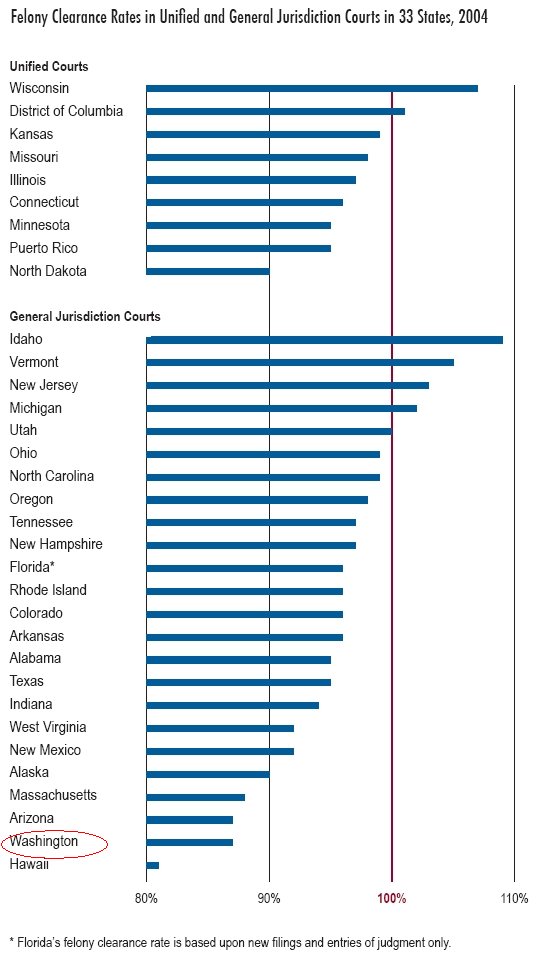 p. 48.
Graphics used with permission.
*Full citation is: R. Schauffler, R. LaFountain, S. Strickland & W. Raftery
Examining the Work of State Courts, 2005: A National Perspective from the Court Statistics Project (National Center for State Courts 2006)
Tuesday, December 19, 2006
5 Things About Me
Andrew Flusche (the Virginia law student who writes the very helpful blog, Legal Andrew) tagged me for the "5 Things You Didn't Know about Me Meme." Since I'm not firmly ensconced in blogger culture, I had to look up what it is.
Here's what I gleaned:
- "Meme" refers to socially transmitted information, beliefs, or behavior. Wikipedia has a long entry on the topic.
- Internet memes are the jokes and videos and other stuff that circulate and circulate. Bloggers sometimes intentionally get memes going by posting questions that they hope other bloggers will pick up and answer themselves. There's even someone who keeps track of them in the Daily Meme, and he tells you a lot more about memes here.
- This "5 Things" meme has been going around for over a year. The deal is you list 5 things about yourself that your blog's readers are unlikely to know, and then tag 5 other people to do the same.
- My partner and I just adopted a dog from Pointers from Oz.
- I play alto sax in the Ballard Sedentary Sousa Band. I wish I were a better musician -- but I don't wish it hard enough to make time to practice regularly, so I muddle through.
- I volunteer for the Youth Tutoring Program and love it.
- I enjoy rowing (Center for Wooden Boats) and kayaking (Moss Bay) on Lake Union.
- I read widely. I just finished Julie Powell, Julie and Julia: My Year of Cooking Dangerously (thanks, Jocelyn) and have bookmarks somewhere in Bill Bryson, Made in America: An Informal History of the English Language in the United States, Charles J. Ogletree, Jr., All Deliberate Speed: Reflections on the First Half-Century of Brown v. Board of Education, Louis Menard, The Metaphysical Club: A Story of Ideas in America (thanks, Kate -- I'll finish this and return it to you one day!), Elizabeth Marshall Thomas, The Tribe of the Tiger, Norman E. Rosenthal, The Winter Blues: Everything You Need to Know to Beat Seasonal Affective Disorder, Ross E. Davies, ed., The Green Bag Almanac & Reader 2006, and Jonathan Raban, Hunting Mister Heartbreak: A Discovery of America. I'm a couple of issues behind on The American Scholar, my favorite subscription.
Friday, December 15, 2006
Therapy Dogs for Prosector's Office
Prosecutor Ellen O'Neill-Stephens writes about the therapy dogs used by the King County Prosecutor's Office, who are especially helpful with child witnesses. Courthouse Canines Reach Out to Those in Need, Bar Bull., Nov. 2006.
The first story O'Neill-Stephens relates is of a 5-year-old boy who, along with his mother, was beaten and doused with gasoline by her boyfriend. He wasn't able to talk about it with therapists or his mother until Ellie the dog snuggled with him.
The program began with a dog named Jeeter, who usually works with O'Neill-Stephens's son but goes to work with her on some days. It turned out that Jeeter was great at helping traumatized children stay calm when being interviewed. Prosecutors saw how helpful the dog was and successfully applied to Canine Companions for Independence for another dog -- and that's Ellie, who works full-time for the office.
Dec. 22 update: A reader sent me Children's Victim Advocates Have Four Legs, Fur, Gainesville Sun, Aug. 26, 2006. Four Legged Advocates (Florida)(FLA FLA) was founded by a sexual assault counselor, recalling the support she had received from her own dog after she was assaulted herself. Volunteers with this nonprofit group work with victims in a variety of settings. It sounds like a great program. Thanks for the tip, reader!
By the way, the Seattle Times featured the King County dogs in a story last year: Dogs Lend Comfort to Kids in Court, Seattle Times, May 14, 2005.
Criminal Law in Song
In last month's Bar Bulletin, UW faculty member
Sarah Kaltsounis offered a light review of criminal law -- from possession of controlled substances to escaping from custody -- by quoting lyrics from popular music and relating them to Washington law. The School of Rock: Learn Criminal Law by Listening to the Radio.
Judicial Campaign Legislation
Many people raised concerns about campaign funding during the last elections of judges. Legislation may be introduced in the next legislative session (beginning in January). See a survey about the issues: KCBA Board Wants Your Views on Upcoming Judicial Campaign Reform Legislation,
Couple Charged with Stealing from Elderly Woman
Armed with power of attorney, a couple allegedly stole over $300,000 from an elderly woman who suffers from dementia. The King County Prosecutor's Office is bringing charges. Kent couple charged with theft from elderly woman, Seattle PI, Dec. 12, 2006.
Local U.S. Attorney Resigns
John McKay, the United States Attorney for the Western District of Washington, announced his resignation yesterday, effective Jan. 26. U.S. Attorney Who Led Fight Against Terrorism Steps Down, Seattle PI, Dec. 15, 2006. McKay was appointed to the post in September 2001, just after 9/11, and worked to improve cooperation among federal investigating agencies. One of his most prominent prosecutions was of Ahmed Ressam for charges in connection with a plot to bomb Los Angeles International Airport. McKay will return to private practice, but did not comment on specific plans for the short term -- other than skiing.
Preston Gates Merges
Prominent Seattle law firm Preston Gates & Ellis has decided to merge with an even larger firm, Kirkpatrick & Lockhart Nicholson Graham, effective Jan. 1, 2007. Preston Gates & Ellis OKs merger: New firm will be one of world's largest, Seattle PI, Dec. 15, 2006. The new firm's formal name will be Kirkpatrick & Lockhart Preston Gates Ellis LLP, but day to day it will go by K&L Gates. (Yes, the Gates is the William H. Gates our law school building is named for, as well as the Gates Public Service Scholarships.)
Friday, December 8, 2006
IM Codes for Law
Regular users of instant messaging, text messaging, and email often abbreviate phrases -- "CU" for "see you," "LOL" for "laughing out loud," and so on. Now an appellate lawyer proposes a series of similar abbreviations for briefs: e.g., "OFG" for "open the floodgates" and "AFB" for "at first blush." Instead of "oral argument requested," tomorrow's attorney might simply type "F2F" (wanting to see the judges face to face). Roger W. Hughes, Legalese in the Age of IM (Instant Messaging), Appellate Advocate (State Bar of Texas Appellate Section Report), Summer 2006, at 14.
Hughes goes on to suggest: "Possibly the IM brief will induce tech-savvy justices to issue the 'IM opinion,' one short enough to be sent direct to cell phones." How would you like an opinion reduced to "Aff'd NNuH" (affirmed, nothing new here)?
Maybe this is the wave of the future. But in the short term -- for instance, on your finals next week, UW students -- it might be wise to fill in your thoughts just a little more. (Good luck on those exams, by the way!)
Thanks: Law Dawg Blawg.
Thursday, December 7, 2006
NWIRP Leader Honored
Magdaleno Rose-Avila, the executive director of the Northwest Immigrant Rights Project, was given the City of Seattle's Distinguished Citizen Award for Human Rights today. See the profile in the Seattle Times: Advocate for immigrants will be honored with city award, Dec. 7, 2006. Congratulations, Leno!
The Human Rights Day celebration also honored the Seattle Trans Jail Policy Group, which worked with the Department of Adult and Juvenile Detention to develop a new policy for the King County Jail to use in dealing with incarcerated transgender, gender variant, and intersex inmates. The jail began phasing in the policy in August.
Monday, December 4, 2006
Slain Officer Was Former Prosecutor
A King County Sheriff's Deputy who was shot and killed on the job early Saturday morning began his career as a prosecutor. Slain deputy had become White Center's "Superman", Seattle Times, Dec. 3, 2006. A graduate of Willamette law school, Steve Cox prosecuted "high-profile murder and gang cases in Pasco" (Franklin County) in the 1990s. Franklin County Prosecutor Steve Lowe recalled that Cox talked with him about his misgivings about the legal system:
"It's not a perfect system, and sometimes we lose cases because of technicalities. That really, really bothered him," Lowe said. "He made it clear that his goal in life was to go back and be a patrol officer. He was frustrated with what is frankly an imperfect system, and he wanted to always help people and make the community safer. He felt he could do that better back in law enforcement."
He worked briefly for the King County Prosecutor's Office before joining the Sheriff's Office in 1997.
Times Probes Guardianship System
As part of its Your courts, their secrets series, the Seattle Times is now taking a hard look at our state's guardianship system. Yesterday the feature story was about the mismanagement of an elderly woman's affairs by a professional guardian in Spokane, and the frustrations her son had in trying to get access to her court file, which the guardian had had sealed. Maureen O'Hagan, Cheryl Phillips, and Justin Mayo, A son struggles to reveal how lawyer was treating his mother, Seattle Times, Dec. 3, 2006. The Times analyzed the orders sealing files and found that, contrary to the rules, 97% failed to cite compelling circumstances for sealing and 99% failed to weigh the public interest. Thirty-nine percent gave no explanation at all for sealing. Meanwhile, guardians sometimes overcharge and underperform.
A graphic presentation explains How guardianship works -- or doesn't -- and what to watch for.
Today's front-page story looks at the guardianship of a woman who suffered brain damage in a car accident. The lawyer advising the family (the woman's daughter) disclosed that he also represented the guardianship company. At first that seemed to the daughter like an endorsement, but later, when the family was challenging the guardianship company, it looked more like a conflict of interest. Meanwhile, the guardian ad litem who was appointed to review the guardianship had ALSO represented the guardianship company. Cheryl Phillips, Maureen O'Hagan and Justin Mayo, Secrecy hides cozy ties in guardianship cases, Seattle Times, Dec. 4, 2006. After a long struggle -- and over $100,000 in legal fees for the ward -- the ward's sister is now the guardian.
Judge Reprimanded for Telling Defendants of Rights Only in Writing
The Commission on Judicial Conduct has reprimanded municipal judge James Helbling for informing unrepresented criminal defendants of their rights in a written form rather than explaining the rights orally or confirming orally that the defendants understood the form. Bonney Lake judge rebuked, News Tribune, Dec. 4, 2006.
The Stipulation, Agreement and Order of Reprimand is here.
Thanks: Lisa Kremer.